Why is the sea water off Isle of Man orange and is it toxic?

 BBC
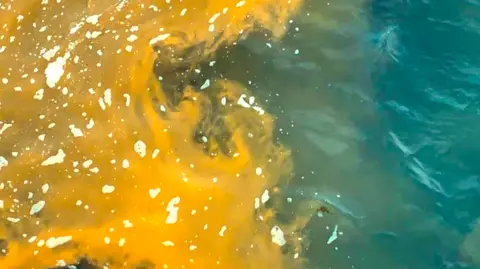
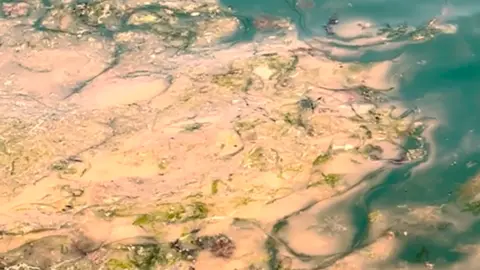
BBCResidents walking along Douglas Promenade may have noticed patches of orange-coloured water while walking along the sea wall.
The unusual sight was caused by an algae bloom of Noctiluca scintillans, a microscopic marine organism more commonly known as "sea sparkle" or the "fire of the sea".
The bloom was first reported in Douglas Bay earlier this month, and is expected to gradually fade over the coming days.
Although the bright orange colour can look alarming, the environmental department reassured the public that algae were considered non-toxic to humans, although it advised against swimming through it.
What is Noctiluca scintillans?
Explaining the phenomenon when it last appeared in 2024, Taylor Bridgens, Marine Monitoring Officer at the Department of Environment, Food and Agriculture (Defa), explained that Noctiluca scintillans was a single-celled marine organism known as a dinoflagellate.
Rather than producing its own food using sunlight, it feeds on other microscopic marine life.
It is best known for creating a blue-green glow when disturbed, earning it the nickname "sea sparkle".
After feeding on organisms rich in natural pigments, however, it can turn orange or red, causing the water to become discoloured instead.
Why do blooms happen?
Bridgens explained that blooms develop when environmental conditions favoured rapid growth.
Factors such as water temperature, sunlight and the availability of nutrients can combine to allow microscopic organisms to multiply quickly, particularly during the summer months, they said.
The Isle of Man has experienced similar blooms along its east coast in previous years, including in 2018, 2019 and 2021.
Can it be harmful?
While Noctiluca scintillans is not poisonous to people, Defa advises against swimming through areas of discoloured water.
Although uncommon, some people may experience skin irritation or respiratory discomfort.
Large blooms can also affect marine life. As the organisms die and decompose, bacteria use up oxygen in the water while breaking them down. In severe cases, oxygen levels can fall low enough to make it difficult for fish and other marine species to survive.
The blooms can also attract jellyfish, which feed on the algae.
Read more stories from the Isle of Man on the BBC, watch BBC North West Tonight on BBC iPlayer and follow BBC Isle of Man on Facebook and X.
