Is it the public's job to police Britain's roads?

 BBC / Harry Craig
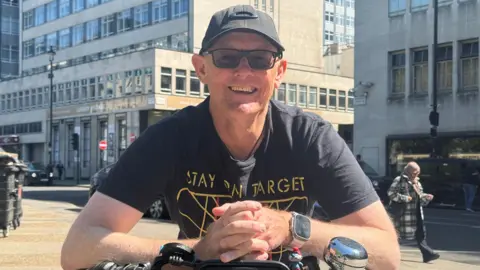
Mike van Erp, better known as Cycling Mikey, has become notorious online for his policing of London's roads.
Equipped with his helmet camera, he records motorists allegedly driving dangerously or carelessly.
He reports them to the police and then posts the clips on social media, where they frequently go viral.
Van Erp claims to have reported almost 2,500 drivers since 2019, with his bio on X boasting of nearly 3,000 penalty points and 36 drivers disqualified.
"I see what I'm doing as good civic duty," he says.
"I've become like this demon on the shoulders of drivers, [which means] everybody is much more worried about being on their phone."
Van Erp is among an increasing number of people using cameras to help police the roads.
 BBC / Harry Craig
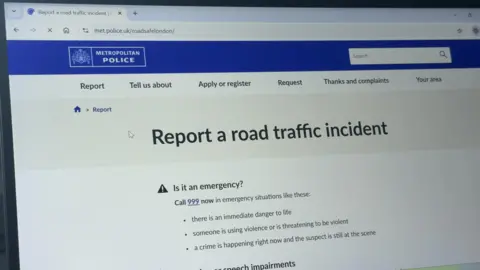
In 2016, North Wales Police launched Operation Snap, which has since been gradually rolled out by most police forces in England and Wales.
This provides an online portal for the public to upload footage of alleged driving offences.
In London, the Metropolitan Police received 22,971 submissions of road traffic incidents via the Single Online Home platform in 2025 — and 25,439 in 2024.
In 2025, the most commonly reported offence was for driving without due care and attention, which includes driving too close to another vehicle, turning into the path of another vehicle, or unnecessarily staying in the overtaking lane.
The second-most reported alleged offence was using a mobile phone while driving, with these two offences together accounting for a majority of all those reported in 2025.
Out of the submissions received in 2025 which have been resolved, 14.3% resulted in an advisory letter being sent, while 10.1% led to a fine being issued, and 8.9% to a training course.
Just under 12% of cases were sent for prosecution.
Det Ch Supt Andy Cox, from Northamptonshire Police and former lead for Vision Zero, a London-based road injury reduction project, believes public reporting has saved lives.
"More people die on our roads than through any other form of crime," he says.
"If you were to look at the mindset of the dangerous driver, they look for the speed camera, they look for the police officer, and if they see neither, they are minded to drive dangerously.
"If they know the average member of the public has a camera, they are more minded to drive safely."
'Against the law'
One driver caught and reported by Cycling Mikey for using their phone while in traffic said they received six points and a £200 fine as a result.
They wished to remain anonymous, but told the BBC: "In a way I'm grateful for the encounter as it definitely changed my relationship with my phone in my car.
"I have never touched it in the car since. It made me think more about the consequences.
"While the risk of harming someone while using a phone when stationary is low, it is against the law and I shouldn't have done it."
 BBC / Harry Craig
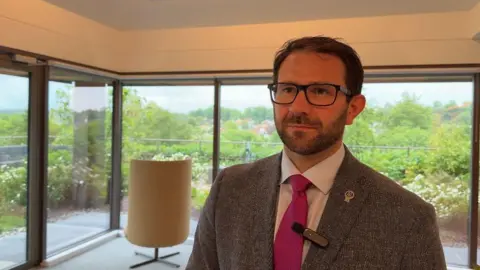
The AA's head of roads policy Jack Cousens believes more drivers are using dashcams due to a perceived lack of adequate and visible policing on the roads.
"Over a number of years, there has been a big loss in the number of road traffic officers out on the roads," he says.
"With the rise of dashcams, people are now being a bit more proactive that where they feel drivers are overstepping the mark, they've got footage to send on [to the police].
"What we need is a mix of both. It's absolutely fine for people to submit camera footage, but what we really want to see is more traffic officers out on the road."
The role of social media
However, this is not just a case of reporting to the police — road users have also turned to social media to post examples of bad and careless driving.
Van Erp believes posting online has a strong deterrent effect.
"Posting online has made what I'm doing 100 times more powerful," he says.
"It's a bit like Archimedes lever — give me a long enough lever and I'll move the world.
"I'm not trying to move anything quite that big, but it is hard to move people on road safety, and posting videos online does seem to achieve that."
Cox also believes footage posted on social media can deter poor driving.
"It is helpful to stimulate a debate and help people to recognise that they need to drive more safely," he says.
"By showcasing dangerous driving, it hopefully leads to an improved standard of driving through education and awareness."
 BBC / Harry Craig
Accounts that post footage of traffic incidents have attracted significant interaction on social media in recent years.
Exposed: UK Dash Cams has almost 350,000 followers and 12 million likes on TikTok.
Rich started the page in 2023, and says that although his main motivation was to make money, he also aims to combat a perceived decline in driving standards.
"I thought that sharing dashcam footage could help raise awareness, educate drivers, and potentially encourage better behaviour on the roads," he says.
However, some feel that clips shared online focus too much on drama and clickbait.
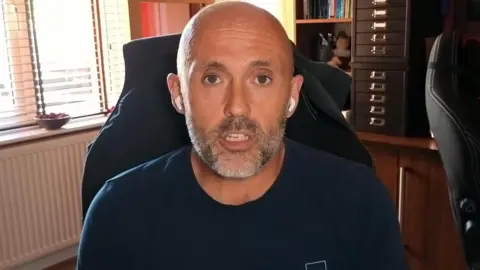
Driving instructor Ashley Neal, who runs a YouTube account giving driving advice, believes we should instead focus on educating road users.
"Anyone can buy a camera and create these [videos], and there's a pull for likes," he says.
"They are always going to go for the drama and road rage, and those are the clips that are going to be most viewed.
"It's always about pointing the finger; it's not about what could have been done better to stop that situation."
 BBC / Harry Craig
So, should it be up to the public to police our roads?
Legal academic Professor Sally Kyd says schemes such as Operation Snap act as a "Neighbourhood Watch of the roads".
"It shouldn't be seen as replacing the role of the police, but used to support the role of the police," she says.
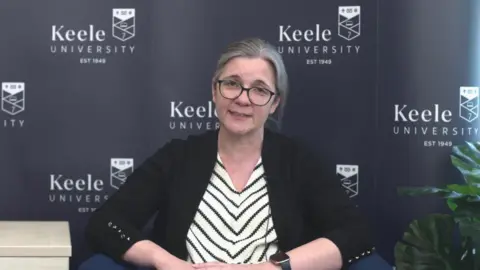
Dr Helen Wells, a criminologist at Keele University who specialises in road safety, worked on a research project in 2024 looking at the impact of public reporting of traffic incidents.
She said these schemes were a response to a public desire to report video evidence from the roads.
"This grew from the bottom up," says Wells.
"It was a publicly demanded approach... the public were saying enough is enough, the roads aren't safe, and we want something done about it."
She believes the public can help deter bad driving through journey cams.
"We want to see road users encouraged to submit more footage," she says.
"A lot of research shows that we would expect increasing amounts of surveillance on the roads to have a chilling effect on people's behaviour.
"If you think about the vehicle behind you, or the cyclist you're trying to pass, and imagine them as somebody who has the means to hold you accountable, maybe you won't do some of the things we see captured in footage every day."
Listen to the best of BBC Radio London on Sounds and follow BBC London on Facebook, X and Instagram. Send your story ideas to hello.bbclondon@bbc.co.uk
