Veteran, 101, helps mark Polish allies anniversary

 BBC
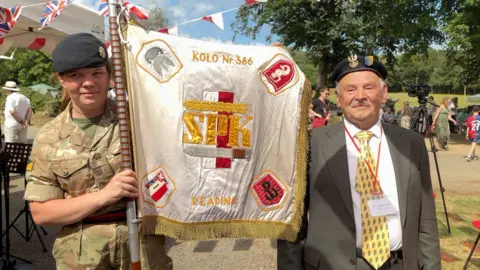
BBCA 101-year-old veteran has helped mark the 80th anniversary of allied Polish Troops arriving at a rural base.
Ches Black joined guests at the Black Horse pub at Checkendon Camp in Oxfordshire on Saturday, where he lived after escaping being forced to work for the Germans.
The abandoned Catholic chapel is one of the last visible reminders of a refugee camp that once housed thousands of people who fled Poland after World War Two.
Black, said "I didn't think I'd live that long" and seeing these "wonderful" people was "very strange", adding that he felt he had started "living again".
In commemoration of the veterans and their families who came to call Checkendon home in 1946, artists sung Polish and British wartime songs, military vehicles drove in convoys and units with ties to the Polish forces joined in proceedings.
Like most of the Polish soldiers who lived at the camp, Black fought at the Battle for Monte Cassino in Italy, where roughly 55,000 Allied troops lost their lives.
He said he thought he had helped build Hitler's bunker in Berlin.
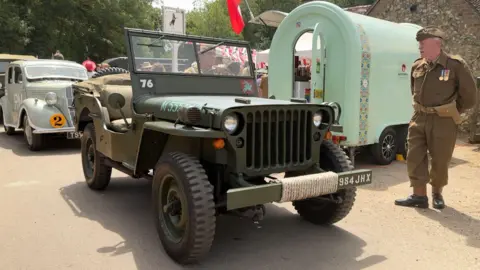
Eight decades after the camp became a home for the Polish Allied troops, the event celebrated their enduring legacy and the profound bonds formed between the Polish community and local villagers.
As with most camps, accommodation was basic but, with their homeland now occupied by the Soviets, it soon became a bustling enclave for the Poles.
The camp closed in the 60s but at the Black Horse down the road, which has been in the same family for more than a century and where Polish and British troops drank, former residents and their families returned to mark the anniversary.
Marian Greczyn, from Sandhurst in Berkshire, was raised at Checkendon Camp, where his father was a commanding officer.
He said it was "important" to celebrate the anniversary because it "defines our future".
"These people fought not only for their country but for all the countries to get their freedom."
He said he remembered growing up in the community where it was "very friendly".
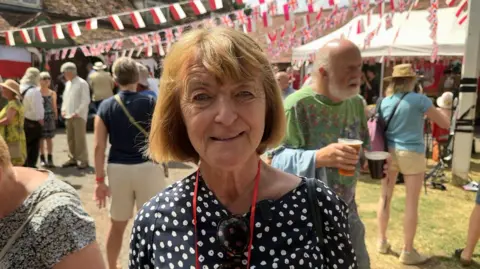
"I spent my first nine years of life in the camp," said Stanislawa Szpak, whose father was a soldier at Monte Casino.
"For children, it was idyllic. We had the freedom, we had the woods, we could just go anywhere we liked."
She recalled cycling to a sweet shop in the village, adding: "There were no cars in the roads. I don't remember potholes either. And you just never thought of not being safe."
Szpak said she spoke English with her friends and neighbours but behind closed doors she kept "her traditions" and spoke Polish.
She said her father did not talk much about the friends he had lost and the family were saving "whatever they could" to buy their first property, something that "this time, wasn't going to be taken away from them".
After her family, like many others, fled Poland she said they had "no home" left to return to.
The event was organised by Friends of Checkendon, Nettlebed and Kingwood Common camp.
