Farmers' warning as milk prices fall below cost

 BBC
BBCDairy farmers say they are being paid far below the cost of production, raising fears for the next generation who want to follow them into the industry.
Industry figures show farmers are paid 32-35p a litre, while production costs can reach nearly 42-49p.
"If we don't sort out the milk price pretty quickly, there'll be no industry left," says Ben Yates from Frome, Somerset.
Both his sons want to follow him into farming but unless the gap between what they are paid for the milk and what it costs to produce is reduced, Yates warns "there will be no future in this industry".
"It's terrifying," said Tom Kimber, a 10th generation dairy farmer. "It just cannot be done much longer like this."
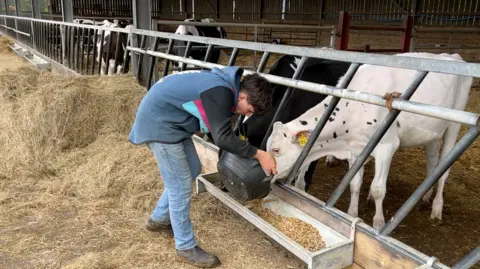
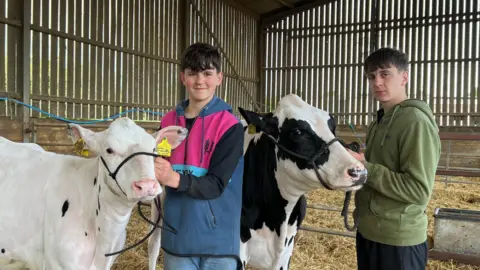
Straight after school, Seth and Oscar head to the young stock sheds on the farm south of Frome that their dad Ben Yates manages.
Oscar has spent the day remembering his Shakespeare, for an English Literature GCSE.
But while his mates relax, he and his brother muck out the prize calves they are preparing for the Royal Bath & West Show.
"This one's already a champion," smiles Seth, walking a young white Holstein calf on the halter.
Blaze won her class at the North Somerset show, so Seth has "high expectations" at the bigger regional competition.
Oscar was given his calf for his 16th birthday.
Farming, he says, is "part of who I am". Both want to follow their dad into a farming career.
They understand the challenges of a changing climate and how hard it is to make money, "but that doesn't take away from how nice it is to work with the animals round the farm", insists Seth.
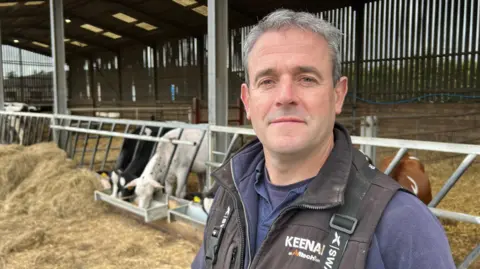
But their dad worries that it is becoming impossible to earn a living out of milk.
Simply put, the average UK dairy farm loses 10p on every litre of milk they sell at the moment meaning it costs significantly more to produce milk than supermarkets are paying.
Yates says: "If we don't sort out the milk price pretty quickly, there'll be no industry left.
"We've got to have the future. We've got to make farming and milk production attractive so that people want to come and be in it, build it."
Already, he says, farmers are selling up.
"You drive around the roads and you see empty dairy farms. And once you stop dairy farming, you don't get back into it," he added.
Industry figures bear out his observations. The latest dairy survey from the industry body Agriculture and Horticulture Development Board (AHDB) found the number of dairy farms had fallen to a record low, at 7,010 from 8,310 in 2020.
So if family dairy farms are closing, does that mean shops will run out of milk?
In fact, fewer, larger farms are now producing slightly more milk. The AHDB reports an increase of 4% in total milk production.
But farmers worry that for the small family farm, the economics are increasingly against them.
Big price jumps
The price of milk has gone up and down dramatically in the last few years, directly affected by global events.
When Russia invaded Ukraine in 2022, there was a sudden drop in global supply. British farmers found themselves paid up to 55p a litre, 10p more than it cost to produce it.
It did not last long. By 2023, global dairy production had risen and prices had fallen back to 45p a litre - the break-even point for most farmers.
But in late 2025, a worldwide glut of milk caused a big fall.
Since October, farmers have been getting 32-35p a litre, depending on their exact contract.
Meanwhile, their costs have risen steadily.
So-called red diesel, sold just to farmers, doubled in price after the US began bombing Iran. Other costs went up fast as well.
Yates explains: "We've had these big jumps. It was 50% increase in fertiliser on the Ukraine war, 50% again now, but the milk price isn't moving and it's got to."
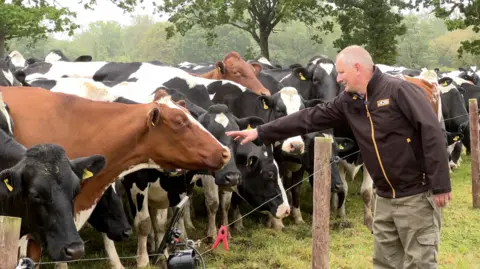
"It's terrifying," says Tom Kimber simply.
His family have been grazing cattle on the lush pastures of Charlton Musgrove, near Wincanton in Somerset, for 350 years.
They run about 200 cows on their farm, which is typical of British dairy farming. Tom has grown up with the industry, he knows how it works.
"We are price-takers not price-makers," he explains. "So we are told each month what we will be receiving."
Dairy farming is not like other businesses. Your prices are set for you, you have to milk the cows every day, whether it is profitable or not, and you cannot store it up until prices get better.
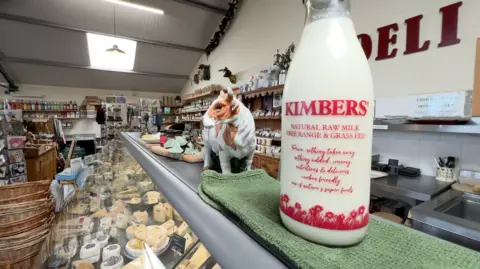
Tom and his family supplement the ups and downs of the milk market with a successful farm shop, selling their own beef and pork, plenty of famous Somerset cheddar and even their own raw milk.
In the summer, costs on the dairy farm are low as the cows graze the fields.
But when winter comes, he will have to buy feed in and hire extra help to manage the herd under cover.
"Doing another winter at these kind of price gaps is terrifying quite frankly," he says.
"It just can't be done, and there will be people looking at it and thinking 'I'm done. I'm not going to put myself and my family through that any longer'."
Follow BBC Somerset on Facebook and X. Send your story ideas to us on email or via WhatsApp on 0800 313 4630.
