China's Moonshot AI stole from Anthropic, Trump tech adviser says

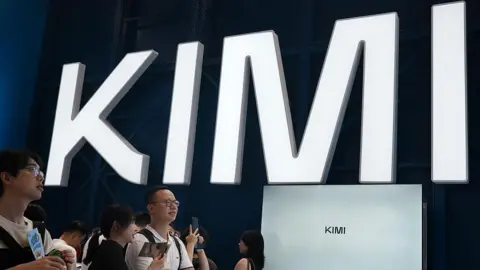 Future Publishing via Getty Images
A White House adviser has accused China's Moonshot AI of a "large scale" effort to steal the capabilities of top US artificial intelligence (AI) models.
US President Donald Trump's Science and Technology adviser Michael Kratsios said Moonshot AI carried out the campaign through what is known as distillation - when a weaker AI model extracts answers from a stronger one.
Moonshot also gained access to restricted cutting-edge Nvidia servers to train its models, Kratsios said in a social post on Wednesday.
The BBC has contacted Moonshot, Anthropic, the White House, and Nvidia for comment.
Kratsios said on X that the US government has information that Moonshot AI "distilled" capabilities from Anthropic's Fable AI for the development of its K3 model.
Kimi K3 gained attention around the world after it was unveiled last week, with many believing it to have narrowed the gap between Western and Chinese AI models. Moonshot said its K3 model is able to rival top US technology.
Moonshot is likely to have also used servers powered by Nvidia's GB300 Grace Blackwell computing platform, Kratsios said.
Washington restricted the export of Nvidia's most advanced chips in 2022 over concerns that they could be used by the Chinese military.
Since then, government's around the world have cracked down on the smuggling of the chips.
In response to queries from the BBC, the Chinese embassy in Washington referred to remarks made by foreign ministry spokesperson Lin Jian on Wednesday, saying China opposes the "politicising" of trade and tech issues.
Lin said China's AI development is centred on "joint contribution for shared benefit", urging all countries to take a "people-centred approach".
Kratsios' allegations come just a day after Treasury Secretary Scott Bessent said on Tuesday the US would examine whether Chinese AI models have stolen the capabilities from American rivals.
On Wednesday, Bessent also said that sanctions "will be on the table" when Chinese companies "cross the line" into intellectual property (IP) theft by conducting "industrial-scale distillation attacks".
"We support open-source AI and the innovation it unlocks. But open source is not open season on American IP," Bessent said on social media.
The Chinese government has not yet issued a public statement in response to the latest allegations but has previously said that its country's development of AI was "the result of its own dedication and effort as well as international cooperation".
The increased scrutiny by the US of Chinese AI companies also comes as Trump is expected to meet his Chinese counterpart Xi Jinping in September.
Moonshot AI will release Kimi K3 as an open-source model on 27 July, making it the first of its scale that can be freely downloaded and customised by developers and members of the public.
In June, Anthropic accused Chinese e-commerce and tech giant Alibaba of "illicitly" extracting the capabilities of its Claude AI models using distillation attacks.
Anthropic urged Congress to penalise the companies behind the alleged attacks and heighten measures to prevent US technology from being stolen.
The White House said in April that it would work more closely with US AI companies to combat "industrial-scale campaigns" by foreign rivals to steal technology.
Kratsios said in a memo at the time that the campaigns were aimed to "systematically undermine American research and development and access proprietary information".
