MP opposes wind farm plan over risk to peatland

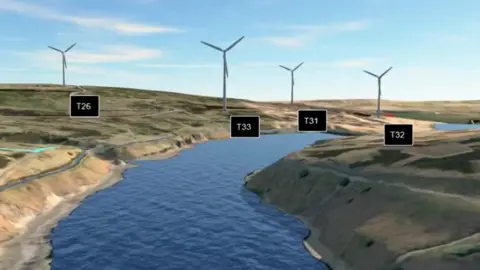 Calderdale Energy Park
Plans to build one of the country's largest wind farms on moors above Hebden Bridge are being opposed by the local MP because of fears about damage to peat.
Calderdale Energy Park wants to build 34 turbines on Walshaw Moor, with each about 656ft (200m) tall. A public consultation on the plan runs until 10 June.
Josh Fenton-Glynn, Labour MP for Calder Valley, said: "I do believe in net zero, but I don't think we're going to get there by digging up carbon-rich peat."
Christian Egal, project director for Calderdale Energy Park, said: "Each turbine is located where the peat is shallow and any peat that is removed will be reinstated locally so the net balance will be zero loss of peat."
Fenton-Glynn said: "I've been led by the science on this and it's clear to me building wind farms on peatland won't have the positive impact on climate change that we need to be having.
"The nature minister Mary Creagh referred to our peatland as our Amazon rainforest and she's absolutely right - except that peat absorbs 30 times more carbon per hectare than does the Amazon rainforest.
"So you can imagine the global reaction if they were to start felling trees in the Amazon to install solar panels, and actually we need to take it just as seriously if we're going to be digging up deep peat for wind turbines that will only last 25 years."
He said if peat was disrupted there was a "real risk of undermining" net zero targets.
He added: "I don't mind wind turbines, I think they look quite beautiful, but the point is you can't be building them on things that are going to have a negative impact on our climate goals."
A recent study by the University of Aberdeen found that one hectare of peatland can contain 5,000 tonnes of carbon that starts to be released into the atmosphere when wind turbines are installed.
Researchers said: "The deeper the soil, the more carbon will be emitted during construction, which also rapidly decomposes the peat and creates large holes in the land.
"As the surrounding peat drains into the holes, the peatland dries out, and huge quantities of carbon dioxide are released."
Egal said Walshaw Moor had been chosen after extensive investigations found that most areas with high wind levels were covered by peat.
"We need to assess how much carbon we can avoid throughout the asset life," he said.
"Obviously the carbon that we release during construction and operation is by far compensated by the carbon we save by using renewable energy based on wind compared to fossil fuels.
"Altogether, we avoid 3m tonnes of carbon on this site throughout the asset life."
If it gets the go-ahead the wind farm would generate enough electricity to power 198,000 homes and would operate for 25 years.
 House of Commons
The project is also opposed by Keighley and Ilkley Conservative MP Robbie Moore, whose constituency includes Haworth, from where the turbines would be visible.
He said: "What we are talking about here is building a huge infrastructure project with foundations, cabling and roads disturbing the peat and this goes against the idea of having a completely renewable project.
"People come to Haworth to see the landscape and it will have a hugely negative impact on that."
The application for the wind farm will be decided by Energy Secretary Ed Miliband, after the site was designated a Nationally Significant Infrastructure Project (NSIP), meaning it is too large in scale to be dealt with by Calderdale Council planning officers.
Calderdale Council said: We will be providing a detailed response to the Calderdale Energy Park consultation, ahead of the closing date of Wednesday 10 June 2026.
"This is being finalised and we are therefore unable to comment further at this time."
Bradford Council said: "Our response will only provide a list of technical risks, issues and benefits, rather than an official position on whether we support or oppose the proposals."
Plans for the wind farm have been scaled back twice from 61 turbines to 41 before being reduced to the current proposal for 34 turbines.
Listen to highlights from West Yorkshire on BBC Sounds, catch up with the latest episode of Look North.
