Award for late teacher's fight against Alzheimer's

 Family handout
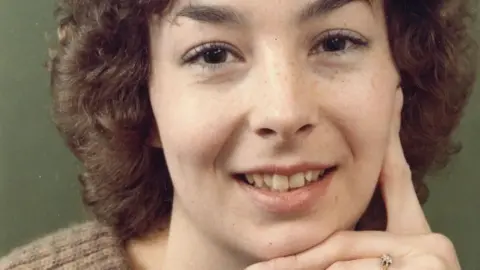
A teacher from Nottingham has been given a posthumous doctorate for her contribution to Alzheimer's research.
In 1983, Carol Jennings' father Walter Bexon was diagnosed with the disease, followed by four of his siblings.
She was convinced genetics played a role, and made contact with researchers through the Alzheimer's Society, with her family's contribution going on to be pivotal in proving it to be true.
Jennings, who died in March 2024 with Alzheimer's herself, has been handed a rare posthumous Honorary Doctorate, DSc (Med) from University College London (Queen Square Institute of Neurology) for her instrumental role which led to the first treatments to slow the progression of the disease.
'Immeasurable' impact
Determined to understand the underlying causes of the condition that was devastating her family, Jennings responded to an advertisement that was placed in an Alzheimer's Society newsletter by two researchers looking for families with multiple members affected by Alzheimer's.
Prof Sir John Hardy and Prof Martin Rossor, thanks to Carol's decision, went on to identify a mutation to the amyloid gene by studying the family - the first evidence that a protein contributed to the underlying causes of familial Alzheimer's disease.
Years later, this discovery led to the first treatments proven to slow the progression of Alzheimer's disease in people at the early stages of the condition.
Together with her husband Stuart Jennings, who collected the award on her behalf, she became an advocate for dementia research.
The Alzheimer's Society named them both Vice Presidents and established the Carol Jennings Fellowship, to recognise innovative dementia research and to continue her legacy.
Hardy, who nominated Carol for the award after her death, said: "Carol's impact on our research is immeasurable and will continue to resonate for decades to come.
"These findings have given hope to millions. That is possible thanks to Carol, and what became her life's work."
Listen to BBC Radio Nottingham on Sounds and follow BBC Nottingham on Facebook, on X, or on Instagram. Send your story ideas to eastmidsnews@bbc.co.uk or via WhatsApp on 0808 100 2210.
