Digital technology lessons proposed for school pupils

 Getty Images
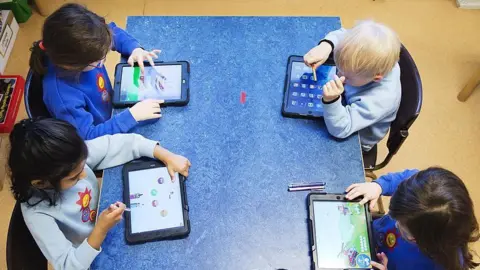
Learning about digital technology from an early age, and "awareness of different cultures" are part of planned changes to what is taught in schools.
For instance, children will learn about "identity, privacy and cybersecurity" online from the earliest years of primary school.
Education Minister Paul Givan has launched a proposed new curriculum for Northern Ireland.
A curriculum sets out what knowledge is taught to pupils in school, and how their learning progresses as they get older.
The new curriculum places emphasis on children learning through knowledge of subjects like science, maths and English rather than broad skills.
While teachers will still decide what to teach in class they will have less flexibility to decide how to interpret the curriculum.
The Department of Education (DE) has said the current approach is too vague but new curriculum is not "a prescriptive teaching script".
What are the main changes to what is taught in school?
The current Northern Ireland curriculum dates from 2007 and covers what is taught to children and young people from when they start school at age four until they are aged 16.
It sets out areas of learning like language and literacy, maths and numeracy, the arts and the world around us.
Teachers have "flexibility to select aspects from each area that are appropriate to their pupils' abilities and interests".
But the new curriculum is more subject-based and moves away from broad areas of learning.
The department said the current curriculum was "frequently ineffective", and that "teachers may struggle to ensure progression" for pupils.
The new curriculum is based around subjects including a new subject of digital technology which will be taught to children as soon as they start school.
Children in the later years of primary school can also be taught a second language and "cultural awareness" which aims to "broaden their awareness of different cultures".
But learning a second language will not be made compulsory for primary school children in Northern Ireland and will remain optional.
Does this mean that exams will change?
 Getty Images
The curriculum is distinct from qualifications but change is already underway when it comes to GCSE and A-levels.
AS-levels, for instance, are due to be scrapped and replaced with a new two-year modular A-level, with three separate topics or sets of exams.
The changes to qualifications are due to be fully introduced by September 2029.
Why is what children and young people are taught in schools changing?
In a foreword to the new curriculum, the education minister, Paul Givan, said the current one was over 20 years old and had "significant structural weaknesses".
He said it lacked clarity on what should be taught, when it should be taught and how learning should progress.
He said that the new school curriculum had been drawn up by experts and teachers and would provide "a well-sequenced and coherent curriculum," which would provide teachers with "clarity".
The expert who had reviewed what is taught in Northern Ireland's schools, Lucy Crehan, has previously denied that the reforms are "right-wing".
What about how religion is taught in schools? Is that changing?
Yes, but not yet.
In 2025, the UK Supreme Court ruled that the Christian religious education (RE) taught in schools in Northern Ireland was unlawful.
It ruled that RE was not taught in schools in "an objective, critical, and pluralistic manner".
Givan subsequently said the court's judgement could not be ignored but had not struck down existing law on RE.
He did, though, appoint a panel to reform what is taught in RE, which is expected to complete its work soon.
It will produce a new RE syllabus which is "critical, objective and pluralist, whilst retaining a central focus on Christianity", according to DE.
New curriculums for what is taught in Special Schools and Irish-medium schools are also due to be developed.
How long does the consultation on the new school curriculum run for?
The consultation period runs until 30 September 2026.
After it is completed, the department will introduce the new curriculum in law, but it will not start to be taught in schools until September 2028.
