Reading 'riskiest place to cycle' outside of London

 Getty Images
Reading is the most dangerous place for cyclists, outside of London, new analysis shows.
A study by process safety consultancy Sigma-HSE analysed the latest data from the Department for Transport (DfT). It revealed that Reading ranked 11th in the list of riskiest areas for cyclists in Great Britain.
In 2024, the town recorded 277 total road casualties, with 80 involving cyclists - representing 28.88% of the total.
Reading Borough Council said it "actively works" to reducing risk for vulnerable road users, including cyclists. The DfT said it was set to invest more than £4.5bn in active travel up to 2030.
The data, which showed reported road casualties by road user type and local authority in Great Britain, found that the City of London is the most dangerous place for cyclists.
In 2024, there were 184 total road casualties, of which 88 were cyclists - giving it the highest cyclist casualty rate at 47.83%.
Greg Woodford, who runs cycle training company Avanti Cycling, said: "We get a lot of people who are worried about cycling on the roads in Reading and around."
He said the Low Traffic Neighbourhoods concept, introduced in Oxford, "works well".
Tony Carr from Reading Cycling Campaign, highlighted the roundabout next to the Thames Quarter as "one of the worst sites in Reading" for cycle casualties.
He said that a lot of the cycle routes in the town are not continuous, adding: "The lack of joined up cycle routes is where the problems occur."
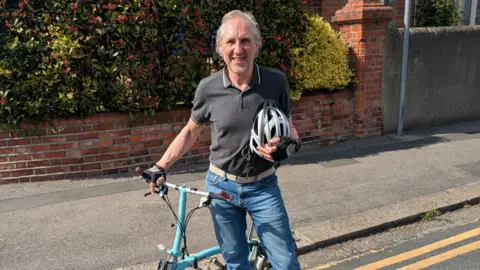 Tony Carr
The council said it "regularly carries out reviews of problem parking in risk areas such as junctions and bends, considers any opportunities to deliver improvements such as parallel crossings when funding is available and introduce speed reduction schemes".
It said larger-scale schemes, such as the South Reading Bus Rapid Transit scheme and bus lane installations, always incorporated facilities for cyclists, along with active travel schemes, such as the Shinfield Road cycle lane.
"We also regularly meet with cycling groups in Reading to understand any concerns they may have and to consult on any future transport projects," it added.
The DfT said: "We want walking and cycling to be easy, safe, and accessible for everyone, which is why we recently published our new Cycling and Walking Investment Strategy which is projected to invest over £4.5 billion into active travel up to 2030.
"We have guidance in place to help councils develop active travel schemes, and Active Travel England provides expert support to councils to support delivery."
