Tests for JCB vehicle before land speed record bid

 BBC
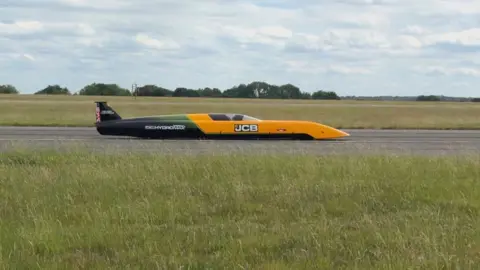
BBCA JCB vehicle has entered the next phase of testing as engineers prepare to attempt a new world land speed record with a car powered by hydrogen.
The Staffordshire manufacturer said its Hydromax car had completed its first test runs under hydrogen power at RAF Wittering, Cambridgeshire, ahead of a planned record attempt in the US in August.
The 32ft-long vehicle has been built to beat JCB's existing diesel land speed record of 350.092 mph, which was set in 2006 by the firm's Dieselmax car.
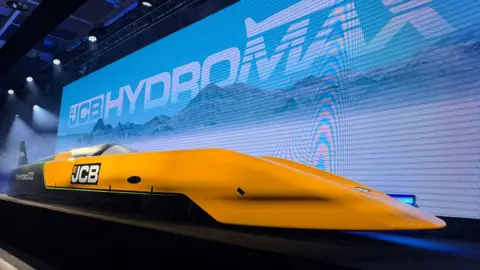
Powered by two hydrogen-fuelled internal combustion engines, producing a combined 1,600bhp, the Hydromax was unveiled at JCB's headquarters in Rocester in May.
JCB chairman Lord Bamford said on Tuesday that the project had made rapid progress.
"Twelve months ago this car was a set of drawings being discussed by a room full of engineers,"he said.
"Today it is a reality and on wheels, running, and being tested in the UK.
"The team has done a wonderful job to get us to this point. Our focus now turns to the real challenge - setting a world hydrogen land speed record in Bonneville."

This month's tests included shakedown runs, refuelling exercises and pit-stop rehearsals ahead of Bonneville Speed Week in Utah in August, where the record attempt is expected to take place.
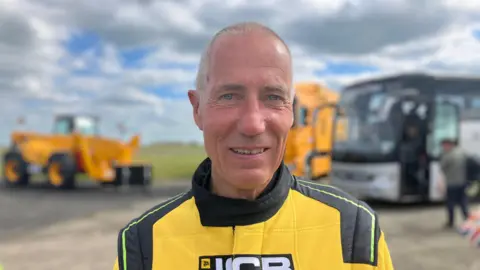
The Hydromax will be driven by former RAF wing commander Andy Green OBE, who also piloted Dieselmax, a diesel-powered vehicle, to a record-breaking run 20 years ago.
Green said the vehicle was beginning to "sound, feel and look like a race car".
"We've had an absolutely brilliant afternoon," he said.
"That was a really, really good run. Every single run we are turning the wick up a little bit on the engines, accelerating the car a little bit harder.
"It's now starting to sound, feel and look like a race car.
"It looks good on paper, but here's where we actually proved it. That's what happened again today with the highest power setting, so end to end, really, really successful day."
Green said the Hydromax had already reached almost 180mph (290km/h) during testing, while engineers were also carrying out braking, parachute deployment and hydrogen safety checks.
Comparing the vehicle with the record-breaking Dieselmax, he said the new car was benefiting from two decades of technological advances.
"Looking back at the JCB Dieselmax, which was an extraordinary achievement at the time, it is astonishing because we were so short of time and we had so many technical challenges in that project," he said.
"This car, by comparison, is already feeling faster, easier. The huge advantage of 20 years of technology, of course, is an awful lot more software.
"We are building what is arguably the best straight-line racing team in the world right now to take this hydrogen-powered car and do something no-one has ever done before out in Bonneville."
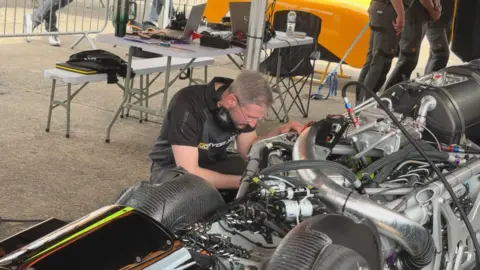
JCB said the vehicle would consume just over two kilograms of hydrogen during a full-speed run and produce 18 litres of water as its only by-product.
Chief engineer Ryan Ballard said tests on the car would continue at the RAF site for the rest of the week.
"It's been a long day building up to this point," he added.
"We've had a few hiccups which is the nature of this type of motor-sport - you end up finding a little problem, fixing it and so on.
"It's brilliant seeing the car travelling down the track and everything went to plan in the end."
Follow BBC Stoke & Staffordshire on BBC Sounds, Facebook, X and Instagram.
