Hospital staff didn't notice my vulnerable wife walk out with a tube still attached

 Alan Dutton
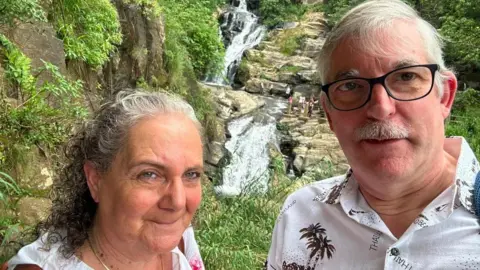
A vulnerable woman with a brain tumour and intravenous tube attached to her was allowed to leave hospital without staff noticing, her husband has said.
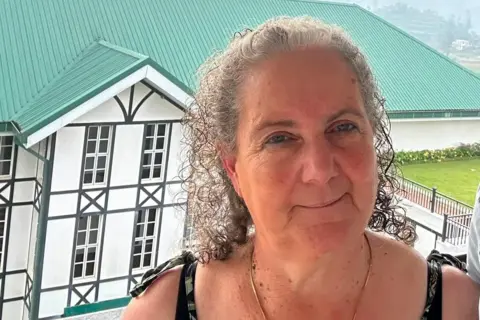
Julia Dutton, 63, who has a pituitary gland tumour, was being treated at Wrexham Maelor Hospital.
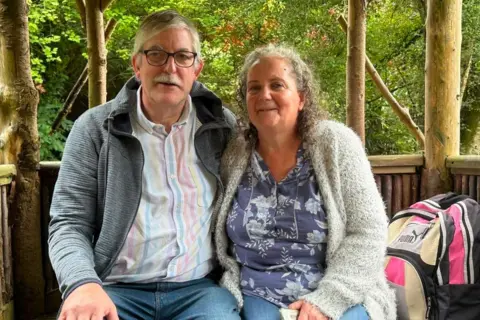
Husband Alan Dutton, 60, found her in the hospital car park with the cannula after she asked him to collect her.
"I spoke to the nurses and I said, 'you can't just let a vulnerable patient walk out, she's in your care. This is not good enough'," he said.
Alan Dutton later discharged his wife because he was "too fearful" to leave her there unattended.
Betsi Cadwaladr health board said ensuring patients felt "well cared for "was its "primary concern".
The failing health board, which covers all of north Wales, has been under special measures for the past nine years.
Julia Dutton, from Burton near Wrexham, was being treated for dehydration at the hospital.
The tumour, diagnosed last month, effects her ability to recognise when she needs to eat and drink, leading to several emergency admissions. She also suffers from anxiety.
Alan Dutton said: "She rang me to say, 'I've had the drip, I am coming home'.
"I literally jumped in the car, drove to the hospital and I found her standing outside A&E with her bag ready to come home," he said.
But then he saw the cannula and realised his wife had not been discharged.
She was returned to a treatment room and put back on fluids before being moved to an observation unit.
Alan Dutton stayed with his wife through the night and following day because he was concerned she was not being properly monitored.
He said there were long periods when staff did not check on her.
"There weren't enough nurses, there weren't enough healthcare assistants and there weren't enough beds," he said, adding management issues were to blame, saying they seemed to be in a "vicious circle".
Alan Dutton decided to "get her out" of hospital after his wife had eaten.
 Alan Dutton
He said it was a "24-hour challenge" to keep his wife fed and hydrated, and said it was "worrying" to think he may have to take her to the "maxed-out" A&E again.
But he said there was no alternative route for urgent specialist care, despite some clinicians agreeing with him it was not the most appropriate place for her.
He praised the endocrinology and mental health teams who were now trying to support his wife through outpatient care, but said they were largely constrained by the system.
 Alan Dutton
The health board has been given a "final chance" to improve by Health Minister Mabon ap Gwynfor.
The Welsh government will take on a more direct role if it does not improve, with an expert panel due to report back by the end of October.
Betsi's chief operating officer Tehmeena Ajmal said she was "very sorry" when a patient feels they have not been well looked after.
"We want patients to engage with us and tell us where they feel care could have been improved or where it has worked for them," she said.
"We take note of every interaction and they help us to understand where we can strengthen services, where necessary, and/or find resolutions."
Alan Dutton is considering making a formal complaint, but is "grateful" to staff who cared for his wife.
"[They] really are working under very difficult circumstances," he said.
"They're doing everything they can. The problem is the system they're working in."
