Planning laws 'undermine democracy' claim villagers

 BBC
BBCCommunities in Cornwall have bemoaned what they say is a lack of democracy around decisions over whether solar farms should be built in their area.
Plans for panels over 60 acres (24 hectares) of fields in St Hilary were recently approved by Cornwall Council - despite thousands of objections over its visual impact and the loss of agricultural land.
Residents and councillors have criticised national planning policies supporting renewable energy projects - which they said made it hard for them to be opposed.
Developers stressed they had worked to reduce the visibility of the panels, while the government insisted planning laws were fair and would boost clean energy while protecting farmland.
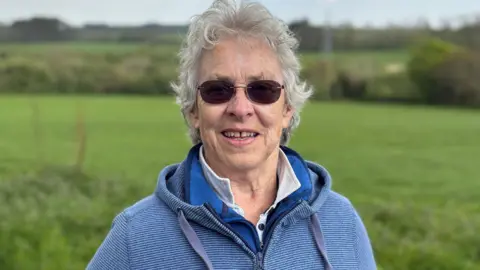
Resident Kate Finch said people in St Hilary were strongly opposed to the scheme as it was being built on agricultural land and close to the Cornish Mining World Heritage site.
She felt councillors seemed "defeated" and democracy was being "undermined."
"What is the point in having planning meetings, what is the point in asking people for their opinion, what is the point in going ahead with any of it if every decision that's made is then overruled by central government," she questioned.
Alison Badcock, who has lived in the area for decades, added: "None of us in the village are against solar panels.
"We just feel that the use of good agricultural land which is farmed quite intensely - to give that up and put solar panels on it is criminal.
"We do need food security here."

The government's updated National Planning Policy Framework included guidance for local authorities to be supportive of renewable energy schemes.
The Planning Inspectorate has also overturned on appeal the council's last six rejections of solar farms.
Independent Councillor Mike Thomas, who sat on the committee for the St Hilary solar farm, said: "I would have probably not supported it because of its effect on the landscape.
"However, because of the council policy and the likelihood of it going to appeal, we would lose and cost the council taxpayer a lot of money. That influenced my decision."
He warned their "hands were tied" and the system risked being viewed as "feudal".
He said: "The landowner makes that sort of application and, because they own the land, then they've got that right and power to push something through which the people around them don't want.
"The voice of the people may be heard, may be listened to, but is not taken notice of."
'Recognise the sensitivity'
Henry Mathews, head of land and property at St Aubyn Estates, said: "We recognise the sensitivity of this area, and we know that people care deeply about it.
"There will be no reduction of, or restrictions on, the public footpaths on this land. Nor will there be changes to the important national heritage site nearby.
"This project is about facing up to the climate and energy challenges facing Cornwall and the UK, including the need for secure, locally-generated renewable energy and the infrastructure to store it."
The government said it did not accept claims planning laws were undemocratic.
A spokesperson for the Ministry of Housing, Communities, and Local Government added: "Our planning rules protect land for food production, while driving further and faster for clean homegrown power to bring down bills for good."
Follow BBC Cornwall on X, Facebook and Instagram. Send your story ideas to spotlight@bbc.co.uk.
