Excitement building for 'once-in-a-lifetime' eclipse

 BBC
BBCExcitement is building in County Armagh at Northern Ireland's only planetarium ahead of a major celestial event.
Dozens of people, both young and old, have gathered at the Armagh Observatory to witness the largest solar eclipse visible from the island until September 2090.
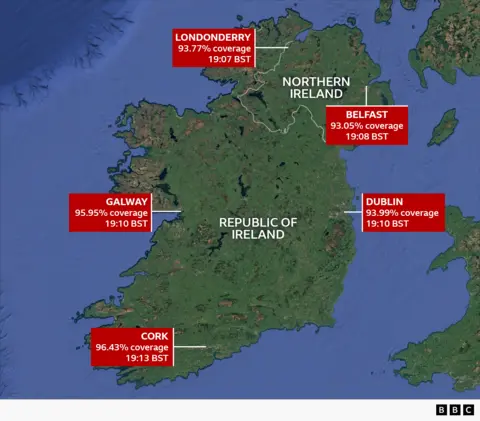
More than 90% of the sun will be obscured across Ireland during the early evening on Wednesday – at its peak, viewers in Belfast can expect the sun to be covered by the moon by 93.05%.
At the observatory, keen observers have gathered for a viewing party on the hill, where everyone can get the best view for the once-in-a-generation event.
'This one wasn't around last time'
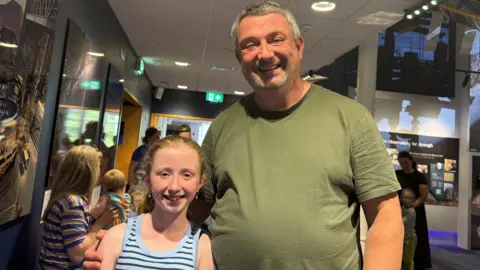
Ed Ronayne and his daughter Genevieve from County Tipperary said they are "very excited" to see the eclipse from the observatory.
"It'll be really cool," Genevieve told BBC News NI.
"And just to say: 'I've been around for a solar eclipse.'"
Ed said he missed the last solar eclipse in 1999 due to travelling abroad, so he is "really looking forward" to seeing this one.
"And sure this little one wasn't even around so it's her first chance to see it," Ed said.
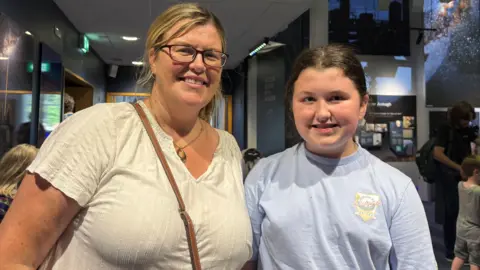
Sharon Walsh and her daughter Mia have travelled up from Dublin for the event.
"We were looking for somewhere to the see the eclipse and just thought it'd be nice to mark such an event," Sharon said.
"There won't be another one until 2090 and I'll probably be dead by then," she joked.
"So it's a once-in-a-lifetime thing."
Mia said she's "really excited to see what it's like" because she has never seen one before.
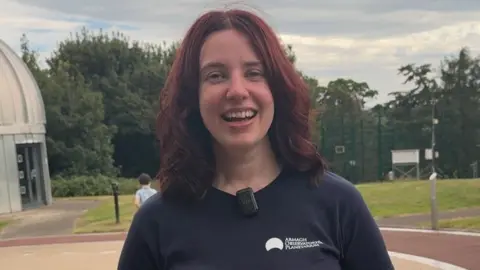
Heather Alexander is a senior education officer at the Armagh Observatory and said it is "crazy to think that a lot of the people coming to see the eclipse weren't even alive back in 1999" - when the last solar eclipse occurred.
"I remember watching that on tv myself and getting solar filter glasses through the newspapers and everything," she said.
"It's so significant because we will not see another eclipse like this again on the island of Ireland until 2090 which is pretty insane," she continued.
"The excitement for this eclipse has been next level, I actually haven't seen anything like it before and I've worked here for eleven years.
"For lack of a better phrase it is astronomical."

In Belfast, a few hundred people are at Queens University to watch the partial solar eclipse.
About 1500 people have registered interest at the university.
Aisling O'Hare, PhD Researcher in Solar Physics, said: "If you can get a clear minute, get your glasses on to take a look to see if moon has moved across the sun."
There are clouds currently covering Belfast but, Aisling O'Hare said "hopefully the clouds give us a bit of break and people can even catch a glimpse of the partial eclipse".
And as if by magic - the sun just peaked through the clouds.
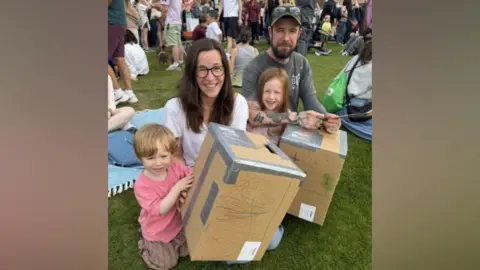
The Martin family told BBC News NI: "This is a once in a lifetime event. We had to come down to see this. The children are very excited to see this event today. It's very cool".
How should I watch the eclipse?
Astronomers have warned people never to look directly at the sun during a partial eclipse.
Even when most of the star is covered, the visible section remains bright enough to cause damage to the eye.
"The problem is that our retinas don't have pain receptors, so you won't know that you're damaging your eyes" Nežič added.
Instead, viewers should use certified eclipse glasses for naked eye viewing, but not while looking through binoculars or a telescope.
Further information can be found here.
People can also watch safely by projecting an image of the sun onto a white card using a telescope, a cereal box pinhole viewer, or even a kitchen colander.
Astronomers have also advised against pointing an unfiltered smartphone or digital camera directly at the sun because the intense light could damage the camera sensor.
"The only thing you can look at with the naked eye is a total solar eclipse and there hasn't been one of those on Irish soil since 1724, and there won't be another one visible until September 2090" added Astronomy Ireland's David Moore.
