Hospital workers warn of outsourcing risks to patients

 BBC
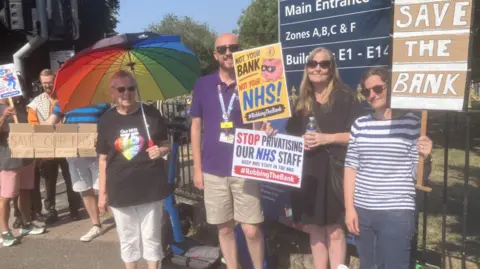
BBCHospital workers and unions have warned patient care could suffer when a private company takes over a service used to fill staffing gaps at hospitals in Bath, Swindon and Salisbury.
Unison warned some members may become less willing to take extra shifts, raising concerns about staffing levels and pressure on frontline services.
From 1 August, temporary staff shifts across the Bath, Swindon and Wiltshire hospital group will be managed by Pulse, part of the Acacium Group.
The Bath, Swindon and Wiltshire Hospitals Group (BSW) said: "It will make booking shifts much more streamlined and accessible which, in turn, will help to increase fill rates and support us in maintaining safe high-quality patient care."
What is changing for NHS workers?
An NHS staff bank is a pool of temporary workers, including nurses, healthcare assistants and administrative staff, who can pick up extra shifts when hospitals need additional cover.
The Bath, Swindon and Wiltshire Hospitals Group plans to bring together staffing arrangements across Royal United Hospitals Bath NHS Foundation Trust, Great Western Hospitals NHS Foundation Trust in Swindon and Salisbury NHS Foundation Trust under a single service run by Pulse.
The group said workers would be able to access a wider range of shifts across multiple locations and that the new system would make booking work easier.
'Fewer staff will take extra shifts'
UNISON said workers are concerned employment protections, pay and pensions could be affected.
Baz Harding, from the RUH branch of UNISON, warned hospitals could lose experienced staff willing to pick up extra shifts at short notice.
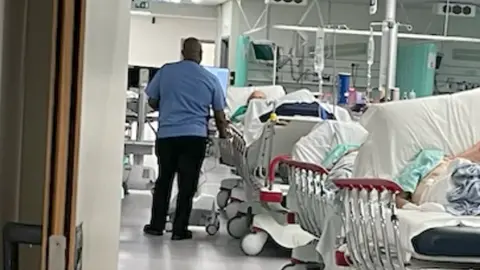
"Corridor care happens in all hospitals and it does happen here unfortunately so having a private company run our bank system, we are not going to have the resilience or the staff with staff memory or hospital memory to actually pick up those shifts," he said.
Unite, which represents ancillary staff, such as porters and cleaners, said workers who currently undertake bank shifts through the NHS would be required to register with the private provider if they wanted to continue using the new system.
Unite general secretary Sharon Graham said: "The way these NHS trusts are treating their overworked and underpaid workers is a disgrace.
"They need to rethink their plans and start treating these workers with respect.
"They will have Unite's full support for as long as it takes."
The union has also questioned whether the outsourcing will deliver the savings promised by the trusts and raised concerns about the long-term impact on staff retention.

Former RUH public governor Nicola James said bank workers provided "vital infill" to emergency departments at short notice.
"It's already at crisis," she said.
"If this falls apart, we are going to have a critical piece of our infrastructure disintegrate."
Hospitals defend changes
Unite has also raised concerns about the financial position of Acacium Group, the holding company for Pulse.
The credit ratings agency Standard & Poor's recently downgraded Acacium and warned its current capital structure was "unsustainable", citing high levels of debt, weakening liquidity and an increased risk of a debt restructuring or default within the next 12 months.
Acacium said it was undergoing a lender-backed restructuring that would reduce borrowing, bring in up to £25m of new funding and improve its financial position.
However, S&P has also said it expects Acacium's creditworthiness to improve significantly once that restructuring is completed and plans to review its ratings based on the company's updated financial position.
Acacium said the proposed deal would not affect its operations or its ability to provide services.
But James, told the BBC that if the company did collapse the risks would be passed to another provider and "even more protections for workers will be lost, and there will be no safeguards."
Trusts defend changes
BSW Group said the changes would create a single staffing service across the three trusts.
A spokesperson said the new arrangements would allow workers to access a wider range of shifts across multiple locations and make booking work "more streamlined and accessible".
They added that "full financial due diligence" carried out before the contract was awarded.
The group said the changes would help increase staffing fill rates and support patient care.
It said that said most bank workers also held permanent NHS contracts and would continue to receive NHS pension benefits through those roles.
The spokesperson added: "However, we understand that some workers may find these changes unsettling and we are supporting staff through this transition.
"We also encourage staff, where possible, to apply for suitable substantive positions as they become available."
The hospitals group said move was expected to deliver nearly £5m in savings, helping it meet a wider financial improvement target of £117m.
It also rejected suggestions that patient services would be affected.
"The move to a single outsourced temporary staffing service will not vary the provision of service for patients," the spokesperson said.
The group said the Department of Health and Social Care had confirmed the decision was not a proposal to change NHS services.
Follow BBC Bristol on Facebook, X and Instagram. Send your story ideas to us on email or via WhatsApp on 0800 313 4630.
