Five takeaways from Canada's new AI strategy

 Reuters
Canada's government has released a much-anticipated national artificial intelligence (AI) strategy, mapping out how the country plans to adopt the new technology over the next decade.
It comes amid broader public concerns over trust of AI and its impact on privacy, safety and future job security.
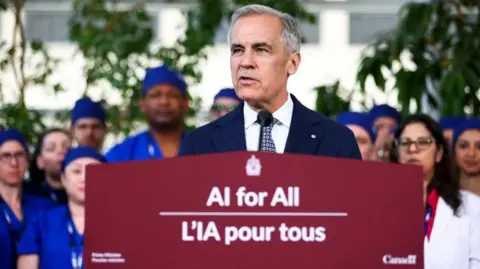
Announcing the strategy on Thursday, Prime Minister Mark Carney said the arrival of AI is inevitable. "It is already changing how we work, how we learn, and how we connect," he said.
It includes more than C$2bn ($1.4bn; £1bn) in spending for programmes to increase AI literacy and scale up its use by businesses and government.
It also puts emphasis on keeping AI talent in Canada, acknowledging an "uncomfortable reality" that the US has been a more attractive place to set up shop for Canadian AI pioneers.
Here are some key takeaways on what is included - and what isn't - in Canada's AI strategy.
Canadian sovereignty through AI
Sovereignty has been top of mind for Canada ever since US President Donald Trump began referring to it as the "51st state", and its AI strategy is no different.
It names protecting Canada's sovereignty as a key objective and underlines ways that the country can reduce its reliance on "foreign providers" for its AI needs.
The strategy notes that Canadian companies store sensitive data in foreign jurisdictions, and that, in some cases, Ottawa is relying on infrastructure that Canada does not own.
In announcing the strategy, Carney warned that "AI could be weaponised against us".
Ottawa is proposing building what it calls a "world-leading" public supercomputer that would be secure and accessible for Canadian researchers and businesses.
It also wants to support the building of "large-scale AI data centres" to serve Canadian clients, with a goal of significantly enhancing computing capacity by 2030.
Stopping the AI brain drain
Canada is known for its highly educated population, but its close proximity to the massive US economy has meant it has struggled to retain its talent, particular in the AI sector.
Geoffrey Hinton, the Canadian researcher and Nobel Prize winner nicknamed the "Godfather of AI", sold his company to US tech giant Google and had worked for the tech firm for years.
Another Canadian talent, Ilya Sutskever, co-founded OpenAI.
The AI strategy promises to fund research fellowships and increase the number of research chairs at Canadian universities focused on AI.
It also wants to attract highly skilled AI workers from elsewhere by offering them a path to accelerated entry and permanent residency to Canada.
The country is also pledging C$500m in investments to Canadian AI companies, which, according to the strategy, would give the government the chance to take equity stakes.
Notably, the strategy promises that 250,000 jobs will be created by scaling up AI across sectors. It does not quantify, however, the number of jobs that could be lost through rapid AI adoption.
Scalling up AI from business to healthcare
Only 12% of Canadian businesses used AI between mid-2024 and mid-2025, according to government data. Ottawa believes that number should be much higher, with a plan to hit 60% by 2034.
The strategy includes C$500m in financing for businesses to help them incorporate AI tools, and another C$50m for creators to encourage them using AI "on their own terms".
It also puts a big emphasis on using AI to support Canada's healthcare sector. Carney announced the strategy on Thursday with several healthcare workers from a Toronto hospital standing behind him.
A big issue in Canadian healthcare has been long emergency room wait times and lack of access to general practitioners.
The government wants to fix that with C$200m dedicated to improving health outcomes through AI, including by using the technology to "lighten the administrative burden on physicians".
Carney noted that nearly three-quarters of EU countries are "already using AI-assisted diagnostics to support medical imaging and to detect disease".
Training Canadians on AI
The public is split on how it feels about AI, with 34% believing it is good for society and 36% believing it is harmful, according to government polling.
Half of Canadians regard AI as a threat to humanity, the strategy said.
Canada also ranks low among other nations when it comes to AI training, literacy and trust, according to a KPMG University of Melbourne global study.
One reason for that, the government said, is lack of AI literacy among the public, writing in the strategy: "For Canadians to benefit from AI, they must first learn to use it."
It is promising to create what it calls a national AI literacy initiative that will offer "entry-level AI training" to all Canadians. It will do so partly by partnering up with public libraries, it said.
Sparse details on addressing AI safety
Ottawa has promised new AI laws to protect consumer privacy and children's safety, though it did not offer details on how it plans to do so, or when.
It also promised to modernise Canada's online safety laws to reflect the new reality of AI.
Safety and AI became the focus of headlines in Canada earlier this year, after it was revealed that the suspect of a February mass shooting in Tumbler Ridge, British Columbia, had used ChatGPT to discuss gun violence months before the attack.
OpenAI has said it was aware of the suspect's activity but it did not alert law enforcement, prompting an apology from CEO Sam Altman.
OpenAI executives were summoned to Ottawa, and officials floated the possibility of introducing new laws if the company did not quickly implement changes to its safety protocols.
Carney said Canada has to be "honest about the risk that AI poses to Canadians", including "deepfakes, unsafe chat bots and AI-generated disinformation".
The lack of specifics was criticised by the Conservative opposition.
"The safety and security that was promised in this is nowhere to be found in the document, certainly no details," MP Melissa Lantsman told reporters.
