'We must prioritise seaside disability access'

 Juliette Parkin/BBC
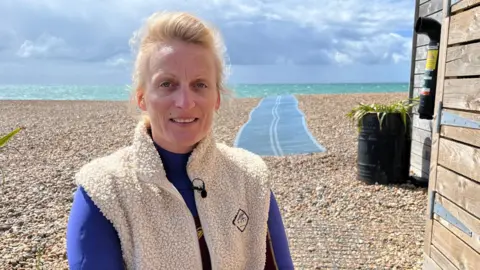
A wheelchair user from Brighton says she dreams of being able to wake up and decide to go swimming in the sea.
Peyton Vellaa swims at the city's Sea Lanes beachfront pool and gets in using special equipment - but the sea, just metres away, remains out of reach.
"I would need multiple volunteers to enable me to get into that water, and then you need equipment and there are certain safety aspects," Vellaa said.
In a study presented to the government on Monday, just 13% of wheelchair users and people with limited mobility around the UK said they were able to reach the water.
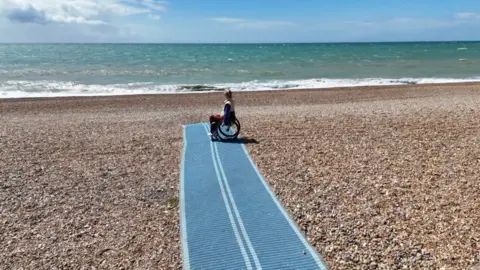
The beach in Brighton's Kemptown area has a boardwalk, wheelchair mats and wheelchairs suitable for pebbles.
But Vellaa, a disability ambassador for the south coast, said: "I can't get down to the shoreline and I'm unable to get down to the sea and swim myself.
"If you wake up in the morning, you think, 'I'm going to go swimming today', I would like to have that access.
"I'd like to be able to have the equality to say I'm getting up and I'm going swimming, getting into the water, it gives you such freedom."
 Juliette Parkin/BBC
The study, by the Beach Access Project and the University of Brighton, heard from 1,071 people around the UK with varying disabilities and long-standing health conditions.
Of those, 54% said they could not access a beach at all during their most recent visit, while 98% said they wanted to visit beaches more often and 85% hoped to reach the water's edge.
The research was led by Will Behenna at the Beach Access Project in collaboration with PhD researcher Sadie Rockliffe and Dr Catherine Kelly from the university.
'Life-changing'
Behenna, who is based in Bournemouth, said the UK had fallen behind other countries when it came to beach accessibility.
"If we look at Spain and France, they have been providing beach access for nearly three decades," he said.
"They have guidelines, they have regulations and standards. They provide programmes across the country.
"It's amazing that you can just rock up at a Spanish beach, work with the lifeguards and they'll help you in and out of the water.
"It's a service they provide and it's really life-changing for so many people."
 Juliette Parkin/BBC
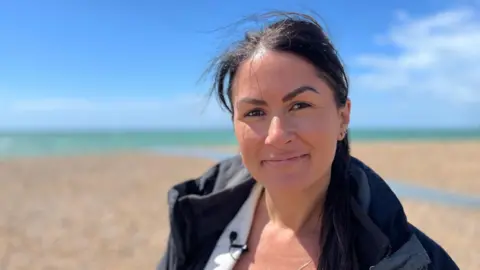
Rockliffe has carried out extensive research on improving aquatic access for people with a visual impairment.
She said she hoped these latest findings would encourage policy makers, councils and coastal organisations to prioritise change.
"With research, we help to make change and we try to change policy, implement recommendations, and really make communities more inclusive and accessible for everybody," Rockliffe said.
The Beach Access Project and the University of Brighton are calling for coordinated action across the UK, urging councils and coastal organisations to prioritise changes that enable more people to safely reach the water and fully enjoy the beach.
A government spokesperson told the BBC: "No-one deserves to be held back or treated unfairly because of their disability.
"As part of the Equality Act, reasonable adjustments must be considered before a disabled person needs to access services or facilities, to ensure they are accessible.
"We continue to work with disabled people and relevant organisations to ensure that their needs are met."
Mitchie Alexander, cabinet member for communities, equalities, public health and adult social care at Brighton & Hove City Council, said beach accessibility for all was "incredibly important".
She said the local authority had invested in improving access, including by installing a boardwalk in Saltdean, a beach deck and seating close to a new Changing Places facility and a fully-accessible seafront park in Hove.
She added: "We're also installing a fully accessible lift as part of the restoration of Madeira Terrace which will make it far easier for people to access the front from Marine Parade and connect the beach in Kemptown to our local bus network."
Alexander said the council "welcomed" the opportunity to meet the Beach Access Project regarding its research.
Follow BBC Sussex on Facebook, X, and Instagram and listen to BBC Radio Sussex on Sounds. Send your story ideas to southeasttoday@bbc.co.uk or WhatsApp us on 08081 002250.
