Tears of 'Widow of Glencoe' revealed by restoration work

 Egan, Matthews & Rose, 2025
A painting depicting the aftermath of the Massacre of Glencoe has been restored by Dundee-based conservators.
Almost 40 members of Clan MacDonald of Glencoe were killed in February 1692 after soldiers were ordered to attack them.
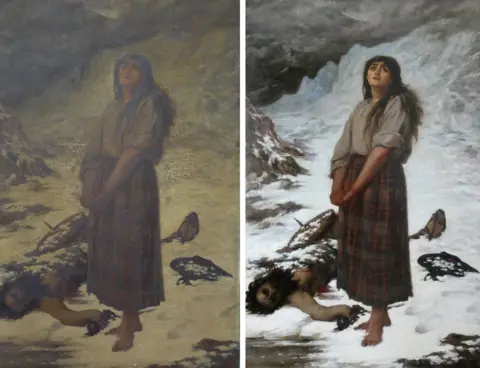
The painting, known as the Widow of Glencoe, shows a grieving woman standing next to the body of a man at the foot of a mountain with snow covering the ground.
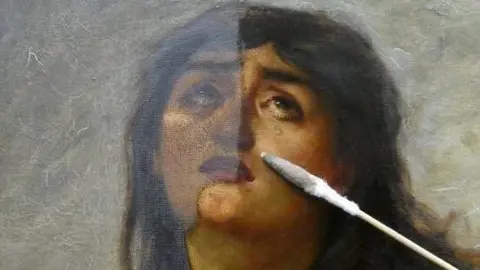
Catriona Davidson, of Glencoe Folk Museum, said the "incredible" restoration of its painting had removed centuries of dirt - and revealed fine details, including a tear on the woman's cheek.
Generations of a family in Luxemburg had owned the 19th Century artwork before they donated it to Glencoe Folk Museum in 2023.
 Egan, Matthews & Rose, 2025
The painting is not signed and the only clue to who painted it is a motif called a monogram. Glencoe Folk Museum said it was believed the painter may have been an artist called James Goldingham.
There is a record of the artwork being exhibited at the Royal Academy of Arts in London in 1881.
Conservators Egan, Matthews & Rose completed the restoration as part of a major revamp of the museum.
Davidson told BBC Scotland News: "The detail they have pulled out of the painting is just incredible.
"The snow is a pure white it wasn't before. There is a tear on the woman's face that you couldn't really see before. It's an incredible transformation."
A spokesperson added that further research would be done to confirm the artist.
Glencoe Folk Museum, which is housed inside two heather-thatched cottages in Lochaber, was set up more than 50 years ago by local women who stood in front of bulldozers to save the cottages from demolition.
It is home to 6,000 artefacts and its collection includes Jacobite relics and memorabilia from the two World Wars.
Work on a £3m revamp started last month and the new-look museum is set to open next spring.
Exiled king
An estimated 38 people were killed in the Massacre of Glencoe.
The MacDonalds were targeted because of their support for the exiled King James VII of Scotland, who was also James II of England before he was deposed in 1688.
The clan backed the restoration of the Stuart dynasty to the British throne and had taken part in the first Jacobite Rising of 1689.
Historians say they were late delivering an oath of allegiance to the Protestant King William III, and had been branded as rebels by the secretary of Scotland, Sir John Dalrymple.
