Holyrood leaders 'childish' for excluding Reform, MSP says

 PA Media
Reform UK Scotland has accused Holyrood's other parties of "childish" tactics after they ruled out working with Malcolm Offord's group in the new parliament.
The SNP, Conservatives, Lib Dems, Greens and Labour have said they will not seek to co-operate with Reform after the party made its electoral breakthrough in Scotland last week.
SNP leader John Swinney has asked the leaders of each of those parties for talks as he seeks to form a new government, but not Reform Scotland chief Offord.
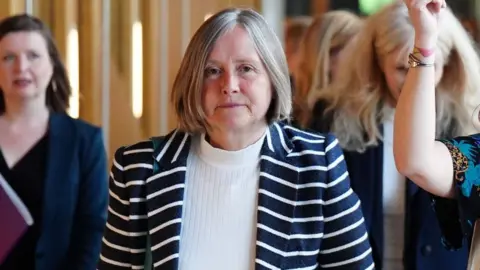
Helen McDade, one of Reform's 17 new MSPs, called for other parties to stop "posturing".
The SNP won a fifth successive Scottish election, returning 58 MSPs. Reform and Labour tied for second with 17 MSPs each, followed by the Greens on 15, the Conservatives on 12 and the Liberal Democrats on 10.
McDade, elected to represent Mid Scotland and Fife, said the result showed that voters wanted parties to work together, and that Reform was "open to that".
"Obviously, many of our aims may not align but many of our aims should be aligning – making Scotland better, getting our economy back on track, balancing private sector enterprise with the public sector," she told the BBC's Radio Scotland Breakfast.
"We live in a democracy and people have voted," McDade said, arguing that it would "play very badly" for other parties if they refused to work with Reform.
"This is childish," she said, urging party leaders to stop "posturing".
McDade also claimed that other parties had said "dreadful things" about Reform politicians, potentially increasing the risk to them when in public.
While Holyrood parties rarely have formal co-operation agreements, they are expected to work together in committees and in the chamber to scrutinise, amend and pass legislation.
It is yet to be seen to what extent other parties will refuse to co-operate with Reform, which will have a prominent role in committees and at set-piece events such as First Minister's Questions.
 PA Media
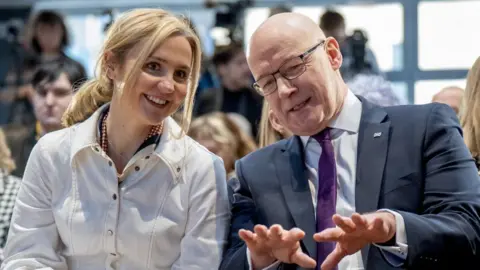
Mairi McAllan, a former SNP cabinet minister who is widely tipped to become the next deputy first minister, said Swinney had been clear during the campaign that the SNP "will have absolutely nothing to do with the politics of Reform".
She accused Reform of peddling "hatred and division" and said the party's rhetoric had put ethnic minorities at risk.
McAllan added: "We understand that while we will not work with Reform politicians, some people who voted for Reform have done so out of anger and out of fear ... we will speak directly to them so they don't have to be angry and they don't have to be afraid and we will work to improve their lives."
She denied that Swinney was hypocritical to work with Donald Trump - with the first minister flying to Washington DC for talks with the US president last year - while refusing to countenance talks with Reform.
McAllan said it was important for Scotland's first minister to engage with world leaders on important socio-economic issues.
Swinney's Reform snub
Swinney invited other party leaders to meet with him this week, with the exception of Offord.
He said in a statement: "I am today urging every party other than Reform UK to work openly and constructively with us in the national interest – and I give my assurance that my government will operate on a basis of cross-party co-operation.
"But I have been very clear – we will have absolutely nothing to do with Reform UK. They have nothing to offer the people of Scotland, I fundamentally disagree with their values and many of those who have been elected to represent them have expressed reprehensible views."
Later, Swinney told BBC Scotland News he would fulfil his parliamentary duties of responding to Reform questions and debates.
Citing comments from Reform politicians about immigrants, he added: "But I can't find common ground with people who speak in such a disparaging and hostile way about our fellow citizens."
Scottish Conservative leader Russell Findlay quickly declined Swinney's invitation, dismissing it as a "PR stunt".
During the campaign, Swinney said it was his ambition to hold a second independence referendum in 2028, telling voters that an outright SNP majority was the best route to securing one.
The SNP ultimately fell short of that ambition, returning 58 MSPs out of 129. The vote share for pro-independence parties - the Greens and the SNP - was a little over 40%.
The UK government would need to sign off of a referendum, but it has issued a statement making clear that it remains opposed to both independence and another referendum on that question.
Swinney described that as "intransigence", pointing out that there was now a larger pro-independence majority - counting SNP and Green MSPs - than ever before.
Without setting out in detail how he would overcome the constitutional "logjam", the SNP leader added: "That indicates to me that there is strong support for the people of Scotland being able to decide their own constitutional future and that's the agenda that I will pursue."
Lib Dem leader Alex Cole-Hamilton said the election result had left the SNP's referendum plans in "tatters".
He said Swinney would "almost certainly" be reinstated as first minister, adding: "The key question is how we can deliver the change our country deserves, even if the government isn't changing."
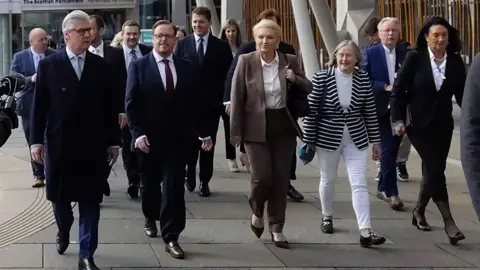
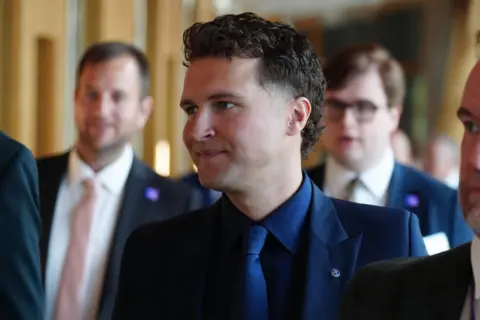
Following a record number of departures from Holyrood at this year's election, 64 new MSPs are being shown the ropes in the parliament on Monday.
They will be officially sworn in on Thursday, with the selection of a first minister and a cabinet next week.
 PA Media
 PA Media
Analysis: Swinney's approach could backfire
With 58 SNP MSPs - seven short of a majority - John Swinney knows he's going to need the support of other parties to govern effectively over the next five years.
He'll need backing for budgets and other key pieces of legislation - and that means taking account of his opponents' priorities in return for their votes.
During the last parliament he emphasised the need for collaboration and consensus - and his post-election rhetoric is in the same vein.
But it seems cross-party co-operation doesn't extend to Reform UK - now the joint second-largest party at Holyrood.
The first minister says he wants to lock the party out of influence at Holyrood, describing its politics as "reprehensible" - but some at Holyrood have suggested the move could backfire.
Hundreds of thousands of Scots voted for Reform - and Swinney's approach could be seen as disregarding their views.
Meanwhile, senior figures in Reform believe their exclusion by the SNP is a huge gift - helping to burnish their anti-establishment credentials, and demonstrate their claim that politicians are out of touch with a large swathe of the electorate.
