David Attenborough's love of London marked on centenary
A birthday message for Sir David Attenborough has illuminated a popular London landmark as part of celebrations marking the beloved naturalist's centenary.
Piccadilly Lights has been taken over by BBC Studios with a message dedicated to Sir David on his 100th birthday.
The message will be displayed throughout the day and consists of a two-minute video dedicated to Sir David from planet Earth, reflecting on his decades-long career.
The broadcaster and natural historian has inspired generations in understanding and protecting the natural world.
His programmes have brought wildlife into millions of homes, shaping how audiences see animals, habitats and the planet itself.
His connection to the city was most recently explored in the documentary series Wild London, which examines the capital's biodiversity.

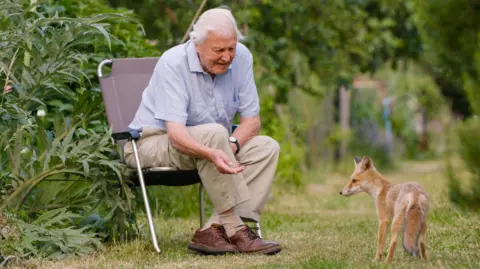 BBC / Passion Planet Ltd / Gavin Thurston
Born on 8 May 1926, Sir David's fascination with nature began in boyhood, when he spent time collecting fossils.
He was educated at Wyggeston Grammar School for Boys in Leicester before studying Natural Sciences at Clare College, Cambridge.
After serving in the Royal Navy from 1947 to 1949, he joined the BBC, beginning a broadcasting career that would span more than seven decades.
In recent years, Attenborough has lived in Richmond upon Thames and has often spoken of his affection for London and its wildlife, from urban deer to peregrine falcons nesting high above the streets.
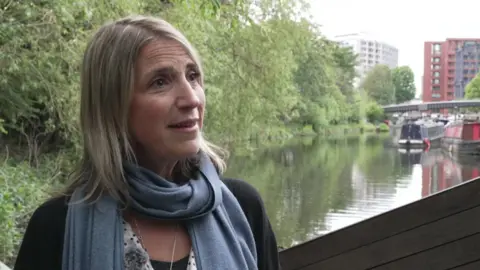
Wild London was co-produced by London Wildlife Trust and Passion Pictures, and executive producer Gaby Bastyra said working with Sir David lived up to all her expectations.
"Being a London girl myself, working with him to enable people to realise that there's wildlife everywhere was an absolute dream come true.
"He's got such an incredible voice, a voice of authority, the voice of knowledge. He created the genre of wildlife television."
Bastyra said that London is "actually amazing" for wildlife - and enjoying nature here is more accessible than people first think.
"Not many people get to go to the Amazon or the Serengeti, but actually there's amazing wildlife stories playing out all around us all the time."
Bastyra highlighted the return of peregrine falcons as a standout conservation success - and a key moment in the Wild London series.
"The fact that there's some nesting on the Houses of Parliament, you know, the most famous London building, and they're right there."
She described Sir David's delight at encountering a peregrine chick during filming, which was something he had never done before.
She said: "David Attenborough turning 100 is incredibly inspirational. The passion he still has for learning, his curiosity in the natural world.
"If you keep learning and you stay interested and you stay curious, you live a long fulfilled life.
"Hopefully his legacy goes on to inspire many, many generations to come."
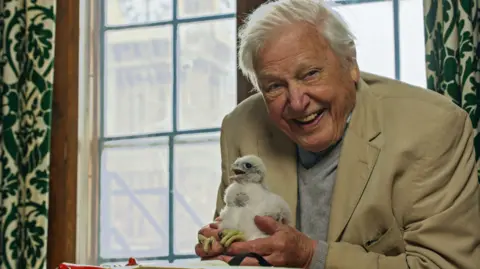 BBC/Passion Planet
Also among those who worked closely with Sir David on Wild London was Dr Sean McCormack, chair of the Ealing Wildlife Group, a veterinary surgeon, conservationist and project lead for the Ealing Beaver project at Paradise Fields.
He said being asked to act as a wildlife consultant was unforgettable and "a boyhood dream come true."
McCormack said Sir David was "everything I hoped he would be" and, "absolutely charming, funny, really nice" as well as "very generous with his time".
"It just incredible to watch him work, you know, age 99 nailing his lines - absolute professional."
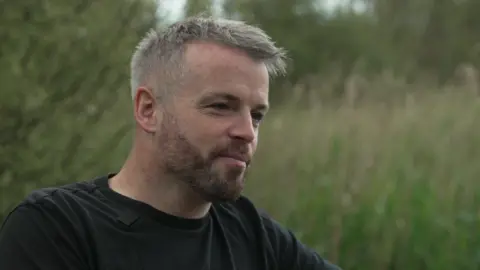
One encounter stood out to McCormack in particular.
"I never thought I would be doing it but I placed a harvest mouse into his hands to release it and the mouse quite liked him and didn't move off his hand.
"You could see him looking at this little tiny mouse with again, this childlike joy and absolutely enamoured with its beauty," he said.
"He wished it well on its new life in the wild. It was authentic, it's genuine. He's the real deal."
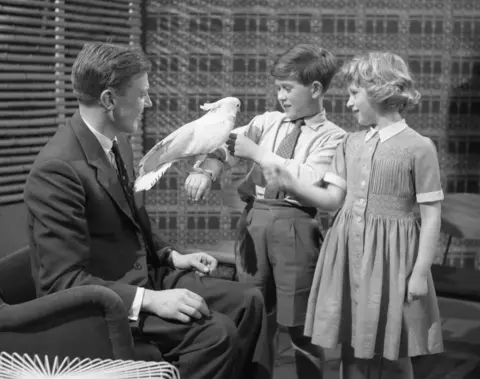
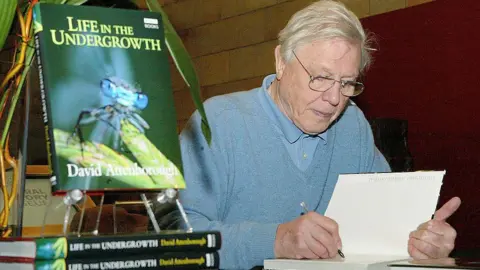 Getty Images
Sir David is a trustee of the British Museum and president of the Royal Society for Nature Conservation. Sir David also served as a trustee of the Royal Botanic Gardens, Kew, from 1984 to 1992, and again in 1996.
Listen to the best of BBC Radio London on Sounds and follow BBC London on Facebook, X and Instagram. Send your story ideas to hello.bbclondon@bbc.co.uk
