Residents say they will fight data and solar farm

 Shaun Whitmore/BBC
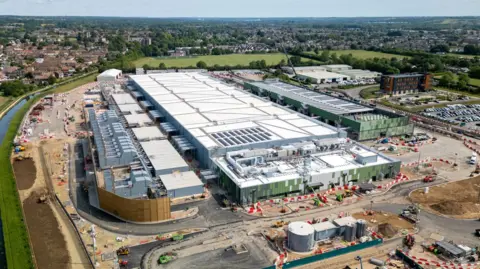
Plans to build one of England's largest solar farms and a huge data centre have been described as "extremely oppressive" for an agricultural landscape.
Some 550 people watched a King's Lynn and West Norfolk Borough Council meeting on Monday, which was also livestreamed, to discuss the infrastructure projects near King's Lynn, Norfolk.
The Longmarsh Green Energy (LGE) developments would cover 4,695 acres (1,900 hectares) of farmland across two sites.
A spokesperson said it would "make an important contribution" to energy systems and supporting online networks.
The council opposed the scheme's approval.
However, owing to the development's scale, it will be deemed a nationally significant infrastructure project, which means its approval will rest with the government rather than the local authority.
 Shaun Whitmore/BBC
Karen Stone, 62, who raised her family in Tilney St Lawrence, Norfolk, said she was "absolutely shocked" by the plans for a data centre and solar farm, especially "the noise, the size of it".
She said: "We made a choice to live here because we watch all the agriculture all through the year.
"And in the last five years, while we've had all of this drought, they've had no drop in yield.
"We heard tonight, if you take all of the land they're talking about, [that's] 25 million loaves.
"We'll want to be paying five or six pound a loaf, will we? When we can't actually get any of that because we don't have the land?"
 Shaun Whitmore/BBC
Lindy O'Dwyer, 66, agreed that data centres should not be built on "prime agricultural land. They can go elsewhere."
She said: "I feel very passionate about it. I'll be asking what next can I do as a person," to oppose the schemes.
Paul Rugg, 60, who also attended the meeting, said: "There's just so many better sites.
"Take a look at France where they're putting solar panels over car parks on top of buildings, you know? It's ludicrous."
 Getty Images
Councillors voted unanimously against the schemes and agreed to make five recommendations including writing to the Secretary of State for Energy Security and Net Zero, asking for local communities to "be at the heart" of planning decisions.
It also said it would evaluate any final government decisions, including pursuing any legal challenges.
Independent councillor, Simon Ring, who is also the authority's deputy leader, said he was a "fan of data centres" in the right place.
"They should be attached to swimming pools, to schools, to villages that have just been constructed," he said.
"Share that heat that's been thrown out into the atmosphere.
"Or better than that, help with our food security. Put a whole stream of greenhouses next to it so we can have all year our food.
"They do that in other parts of this world. Why we're not learning from that is beyond me."
 Shaun Whitmore/BBC
Another councillor, Independent Jo Rust, who is the cabinet member for people and communities, believed the solar panel scheme was a "Trojan horse idea to get the data centre on board".
"And I think for the residents that do live in that area, it's going to be incredibly oppressive," she said.
 Shaun Whitmore/BBC
James Kitchen is a fourth generation farmer. His 600 acre (242 hectares) family farm in Tilney-cum- Islington would border the proposed data centre and solar farm.
The land would also have three pylons crossing the edge of his fields.
Kitchen said: "I'm devastated about the whole thing. Worried about the compulsory purchase, worried about myself, my family."
He said his business uses data, explaining: "It's not what they're proposing here, it's the scale.
"We cannot afford to lose this highly productive land," said Kitchen.
"It is vital for the sake of national food security that this land remains producing food."
He said he was "delighted" councillors voted unanimously to oppose the schemes with no speakers in favour, and said they would "continue fighting .. we won't stop".
 Evolution Power Limited
Natural England, a public body that advises the government, classifies the affected area as grade one, which means it is "excellent quality agricultural land".
Demand for data centres is increasing, partly driven by AI needing more processing power.
At the moment, there are about 477 data centres across the UK and construction researchers Barbour ABI thinks that will increase by about 100.
Most of them will be in London and the south east of England.
The government's Data Centre Covenant says: "Countries that can host and power data centres will ensure their sovereignty, strengthen economic resilience, and be better placed to capture the benefits of the digital economy, and help shape the future of AI."
 Shaun Whitmore/BBC
A spokesperson for LGE said: "Longmarsh Green Energy will make an important contribution to helping the UK build a cleaner, lower cost and more secure energy system as well as supporting the online networks we all rely on - from emails, banking and streaming services to national defence and our NHS records.
"We recognise the importance of local community input into the design of our proposals and are currently consulting on the project prior to submitting a Development Consent Order application."
A public online consultation on the west Norfolk project is open until 26 November.
An application is due to be submitted by April 2027.
It could take six months for the plans to be examined by the Planning Inspectorate and a decision could be made by July 2028.
Do you have a story suggestion for Norfolk? Contact us below.
Follow Norfolk news on BBC Sounds, Facebook, Instagram and X.
