Uber asks customers if they want driverless cabs

 Wayve
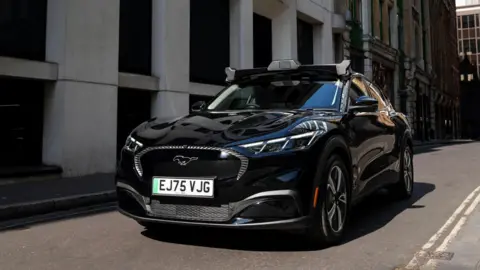
WayveUber is asking customers in London if they want to use driverless minicabs as it prepares to launch the vehicles for the first time in the UK.
The taxi-hailing app is working with British firm Wayve to roll out the first self-driving taxis, with Wayve declaring the technology as tested and "ready to go". They could be launched this summer, and will initially have a human driver sat behind the wheel.
Wayve is seeking formal permission from the Department for Transport (DfT), the Driver and Vehicle Standards Agency and Transport for London to operate these taxis.
The DfT has announced a pilot scheme for driverless minicabs and said firms taking part would be held to strict safety standards.
 PA Media
Following the introduction of the Autonomous Vehicles Act 2024, the government opened an application process for operators in May.
The DfT said the pilot scheme would gather real-world evidence on how self-driving vehicles operate on everyday roads, from navigating busy urban streets to interacting with traffic and carrying passengers safely.
Wayve said it had been trialling the vehicles in London since 2018.
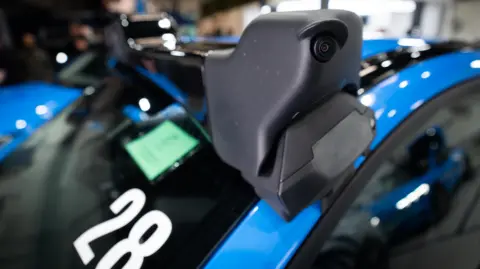
Cars with Wayve systems are fitted with six cameras, a radar and an AI-powered computer in the boot which control their responses.
Kaity Fischer, who leads Wayve's robotaxi business, said: "We're ready to go, and can't wait to get the public into our vehicles to experience Wayve technology first hand."
Fischer described London's roads as the "ultimate testing ground for autonomous technology".
Making a comparison with San Francisco - a common location for rolling out robotaxis – she said London had 20 times more roadworks and 10 times more vulnerable road users, such as pedestrians and cyclists.
Combining that with London's "2,000-year-old streets", which are not in a grid layout and have "potholes and cobblestone paths", creates an "incredible proving ground", she added.
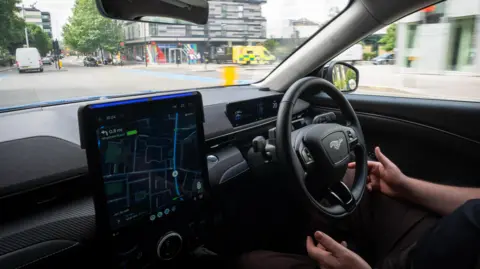
Once launched, a human driver will initially sit behind the wheel ready to take control during journeys while the technology is demonstrated to be safe.
London will be the first city in the world to use Wayve's technology for commercial journeys, under the firm's plans.
The company then hopes to expand to more than 10 cities globally in partnership with Uber, including Tokyo, later this year.
 PA Media
On Monday, Uber launched a "list of interest" on its app, meaning those who join it to be matched up with a driverless ride if they request a ride - which will cost the same as a conventional ride.
Annie Duvnjak, who is in charge of autonomous operations at Uber, said it planned to launch with a "small fleet" of robotaxis in London, before "scaling up over time".
Uber already offers self-driving journeys in the US cities of Austin in Texas and Atlanta in Georgia.
It is working with a number of other firms to launch driverless taxis and some of its drivers in London have held small-scale protests against their use.
Waymo – a subsidiary of Google-owner Alphabet – has also been testing its self-driving minicabs in London, ahead of launching commercial services.
Transport Secretary Heidi Alexander said the technology had "the potential to transform how people travel" by "reducing road danger while driving growth and creating high-skilled jobs across the UK".
She added: "Wayve is a British success story and this partnership with Uber is a welcome vote of confidence in their technology."
Listen to the best of BBC Radio London on Sounds and follow BBC London on Facebook, X and Instagram. Send your story ideas to hello.bbclondon@bbc.co.uk
