How are firefighters coping with wildfires?

 Andrew Matthews/PA Wire
Emergency services have been stretched by several large fires amid continued hot and dry weather, after the nation recorded its driest July on record.
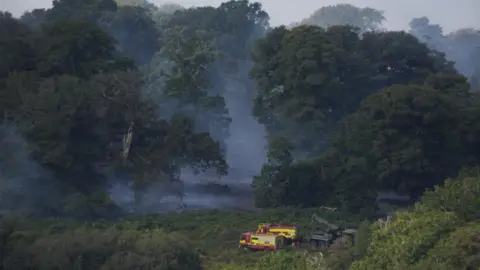
On Sunday, motorists on the A31 in Hampshire abandoned their vehicles as a fire spread from a van to nearby heathland in the New Forest.
At its peak, it was attended by more than 120 firefighters and 26 fire engines.
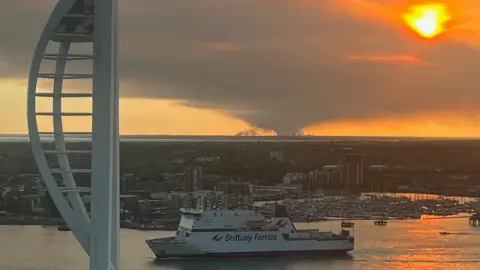
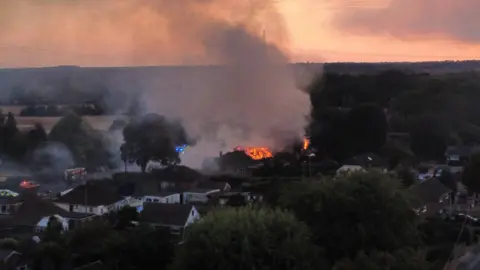
Across the region, other significant fires have put pressure on fire and rescue services in Berkshire, Oxfordshire, and on the Isle of Wight this summer.
A spokesperson for the Ministry of Housing, Communities and Local Government said it was making sure fire services had the resources they needed to tackle fires as quickly as possible and keep communities safe.
There have been difficulties in recruiting on-call firefighters, and a steep fall in overall firefighter numbers.
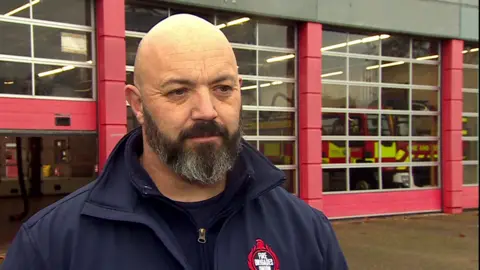
This has led to fewer available fire engines and appliances, increasing pressure on services, according to Mark Chapman, regional secretary for the South for the Fire Brigades Union (FBU).
"Since 2010 we've lost 12,000 [full-time] firefighters, and we're trying to do more with less," he said.
The vast majority of fire stations in Hampshire and the Isle of Wight, Oxfordshire and Dorset rely on retained, or on-call, firefighters, who do not work for the service full-time and often have a day job.
A Freedom of Information request made by BBC South last year showed one-in-five fire stations that depend upon retained crew were unavailable for more than half of the year in 2024 in Hampshire and the Isle of Wight.
In response to concerns, the government has increased the funding available to most standalone fire and rescue authorities in England by 4.7% compared with last year, with services receiving a share of £1.95bn.
 Robert Stiby
 Jas Biggyp Wells
Research has shown rising temperatures and dry conditions, driven by climate change, are also increasing the likelihood of severe fires, with 2026 on course to be the UK's hottest summer on record, according to the Met Office.
Chapman said large rural fires were another factor affecting response times, because they forced services to heavily commit resources, diverting firefighters from cities and towns.
In England, response times are now at an all-time high, having increased by one minute and 18 seconds since 2010-11, according to the most recent government data for 2025-26.
Across the south of England, the picture is broadly similar, although two out of the seven services have bucked that trend.
Response times are influenced by a wide variety of factors, including availability of crew and appliances, geography and population density.
A previous BBC analysis found that response times were deteriorating faster in rural counties, which often require longer drive times, than in cities and towns.
Fire services in different places face different challenges, making like-for-like comparisons with regard to performance difficult to draw.
But data shows that response times in Hampshire and the Isle of Wight have trended upwards, and are now the highest they have been since 2010-11.
The service has also seen the largest increase in its response times out of all seven of the fire services in the south of England.
A spokesperson for Hampshire and Isle of Wight Fire and Rescue Service said its "critical response time" had remained stable at nine minutes and 49 seconds over the past two years.
The discrepancy between this number and the number found in government data stems from the fact that not all the fires in the government's dataset could be classed as critical incidents, according to Hampshire and Isle of Wight's fire service.
The service said it had continued to outperform other fire services operating in regions with similar characteristics, such as population density and rurality, and that fire casualties had reduced from 156 in 2010-11 to 85 in 2025-26.
"It is also important to recognise that fire and rescue services have faced funding reductions and increasing cost pressures over many years," it said.
"These pressures inevitably impact the overall resources available."
Mark Chapman said a strain on resources did not only affect the public, but also the safety of firefighters themselves.
He said some firefighters at the New Forest wildfire had been working for more than 10 hours at a stretch - although they were meant to be rotated out after about five hours.
The FBU is calling for an additional 5,000 full-time firefighters to be recruited across the UK, and an increase in central government funding.
The Ministry of Housing, Communities and Local Government, which is responsible for fire services, said it would ensure fire services had the resources they needed.
A spokesperson said: "This includes making almost £1.95bn available for fire services in England, and investing nearly £100m in the biggest upgrade to national resilience in almost 20 years."
