The deeply contentious debate around what it means to be English


 Getty Images
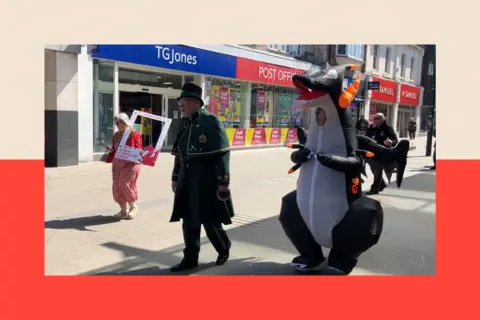
A friendly dragon is waddling along the sun-drenched centre of Swindon, smiling at passers-by. It's St George's Day and the blow-up dragon is on hand, along with Swindon's town crier, to do a bit of PR on behalf of England.
Mid-morning shoppers give the dragon, who was, of course, slain in the legend by England's patron saint, sympathetic looks.
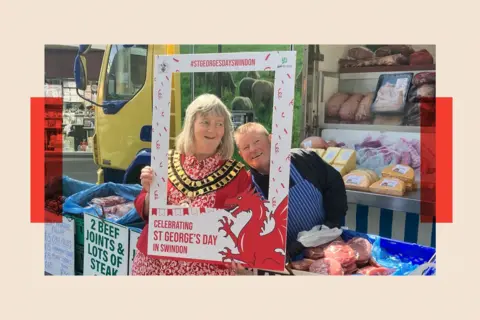
Fay Howard, the then mayor of Swindon, arranged the April parade because she felt the English could do more to celebrate their national day.
The mayor posed for pictures with shoppers in a mock picture frame decorated in the English national colours of red and white. But, ahead of the May elections, there was no sign of the Cross of St George flag.
"I've been careful about using the flag this year because it is an election time and because I represent everybody in Swindon and I want to be fair to everybody in Swindon."
There, in a nutshell, is the dilemma around English identity: a mayor seeking to bring her community together but nervous that the nation's flag could be seen as divisive.
And that sensitivity comes as the perennial debate about English identity has taken on a harder edge since February last year. Influential figures on the right have provoked a highly contentious debate by saying that English identity cannot be acquired. It is, to them, related to ancestry, potentially dating back centuries.
The striking moment last year came when the Russian-born podcaster Konstantin Kisin suggested that Rishi Sunak could be considered British but not English because he is a "brown Hindu". Kisin made his remarks after the political journalist Fraser Nelson told him on the "Triggernometry" podcast that the Southampton-born former Conservative prime minister is as English as "Tizer and Y-Fronts".
A short while after that podcast, the former Conservative home secretary, Suella Braverman, described herself as 'British Asian' but not English. Braverman, who was born in England of Indian heritage, questioned in a Daily Telegraph column how many generations it could take to become English, raising the prospect that it could be as many as five or six.
Englishness can evoke two broad emotions: a benign feeling or divisiveness.
English warmth is epitomised in the lines of its unofficial anthem of Jerusalem: "And did those feet in ancient time, Walk upon England's mountains green".
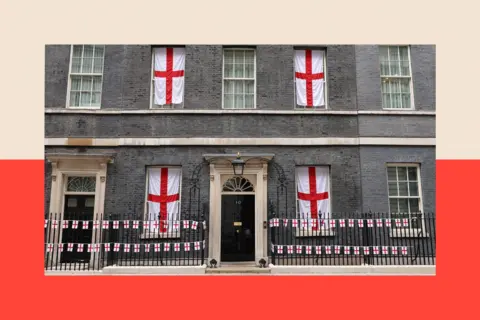
Flags can appear in the spirit of those balmy emotions – cue the World Cup. But sometimes English flags are associated with different emotions. Some took exception to the Raising the Colours campaign last summer when English and Union flags appeared on motorway bridges.
But the debate has been taken to a whole new level with the controversial suggestion that to be considered truly English you need to trace your lineage back multiple generations or even centuries.
Sunder Katwala, who runs the British Future think tank, says he respects Braverman's belief that she is not English. But he takes issue with her suggestion that it could take five or six generations to acquire an English identity.
Katwala, who is of mixed Indian and Irish heritage, sets out what he sees as the flaw in her suggestion: "I think maybe the Huguenots didn't think they were English, but their grandchildren certainly did." Around 50,000 French Protestant Huguenots settled in England in the 17th century to escape persecution.
Katwala says that around 90% of people believe that if you are born in England, identify as English and are brought up in England then you are seen as English.
In the wake of the row over English identity, the group More in Common polled people in March 2025 on attitudes to this subject. The poll suggested that 74% of English people believe that someone can be English regardless of their skin colour or ethnic background.
The value of Englishness
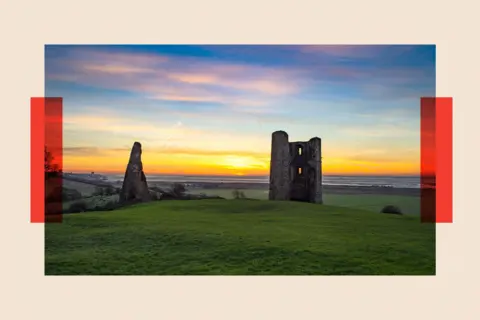
High above the Thames Estuary in Essex, the ruins of Hadleigh Castle have a commanding view over the waterway heading to England's capital city. Work started on the castle in 1215, the same year as Magna Carta, the foundational declaration of English liberty, was signed.
Hadleigh Castle now lies in the Castle Point area of Essex, which recorded the highest number of people within England citing English as their national identity in the last census.
A short walk up from the castle lies the quintessentially English town of Hadleigh. Harriet, who was having a coffee with her daughter Hermione, is clear about two things: she is English and she doesn't like to be made to feel guilty about that. "I am English. Always put it down, even on a job application form, even though you shouldn't, but I do. That's why I probably don't get a job. Because it's not ethically correct, is it? I'm British, but no I'm not, I'm actually English.
"Everyone nowadays gets offended by everything, don't they? And so you want to hold onto something that you're entitled to hold on to despite offending everyone."
England is - of course - the largest nation in what Boris Johnson described as the "awesome foursome" of the UK. And in Great Britain (England, Scotland and Wales) there is a curiosity. In England there is a perennial debate around English identity but a consensus around the constitutional membership of the UK. In Wales and Scotland it is the other way round — consensus around national identity but divisions around the constitutional question.
 Universal Images Group
The feeling that Englishness is not valued is echoed by Matt Goodwin, the author and GB News presenter who came second for Reform UK in the Gorton and Denton by-election in February.
Goodwin cites the Raising the Colours flag campaign last summer when flags flew from motorway bridges. "Many people in England who put the St George's flag up felt that the establishment were now saying they no longer exist."
Goodwin agrees with Konstantin Kisin that Englishness is related to ancestry. "I think of Englishness as being mainly an ethnicity…with a sort of defined ethnic group and ancestry that is quite different from Britishness which of course can encompass different parts of the island. So Englishness…has always been a much more specific, distinctive identity that actually cannot just be transferred from one group to another.
"You cannot just simply walk into England and say I'm English in the same way that I couldn't walk into Japan and say I'm Japanese because the Japanese would say, well, clearly that's not the case. So I view Britishness as a nationality and Englishness as an ethnicity."
Goodwin suggested that being white can be considered an important part of the overall British national identity. "In Britain one of the symbols of who we are is the white British people. Part of the makeup, it's part of our composition as a nation. There's nothing inherently bad about saying that, it's simply the reality of who we are."
Although Goodwin also said earlier in the interview: "Yes, it is possible to be black and be English. It is not as likely as it is to be white British and English, but it's possible."
The Reform UK leader, Nigel Farage, takes a different view to Goodwin. He says he does not want to draw 'ethnic lines' on what being English is.
 Getty Images
But Joe Mulhall, the research director of Hope not Hate, a campaign group focused on combating extremism on what they describe as the far right, has stronger words. "I think the moment we inject any form of ethnic segregation into identity, it becomes a problem.
"Is it about colour? How white do you have to be? How British do you have to be? How many grandparents and all of a sudden you end up in some pretty nasty and pretty dangerous sorts of graphs of histories and bloodlines and all these sorts of things that we thought we had confined to history."
Ancestral importance
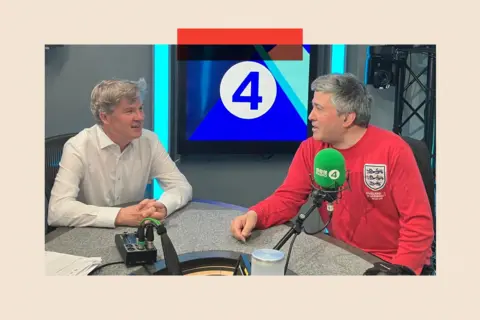
The leader of His Majesty's Opposition is in an apologetic mood. Kemi Badenoch is running late for her interview with Radio 4 because she wanted to prepare carefully for an area close to her heart: national identity. The interview took place on 20 May, before political debate erupted over policing, following the release of bodycam footage showing the handcuffing of murdered teenager Henry Nowak as he lay dying.
Badenoch took issue with Matt Goodwin's stress on ethnicity as the key factor in defining Englishness. The Conservative leader, who was born in England to Nigerian parents, said: "How we define Englishness, in my view, is very complicated. There are two sides to it. There is a side that is down to ancestry, ethnicity, your parents being from here perhaps for hundreds, if not thousands of years. And there's another side of it, which is civic, which is about the culture, which is about the values, the behaviours, the norms, the commitments to place. And I think those two things go side by side."
A leader with a reputation for speaking her mind in plain terms, Badenoch questioned the way some podcasters have, as she put it, taken to policing identity. "I think that we need to be worried," she told me.
But elements of the left do not escape censure. She describes ethno-nationalism – the belief that national identity is linked to ancestry – as a backlash against those who attack English identity by using phrases like "white privilege".
Badenoch raises concerns about political parties using what she calls a political conflict to target voters from one community. No party was mentioned in her Radio 4 interview. But in the wake of the Gorton and Denton by-election in February she said it was "appalling that separatist campaigning was carried out in Urdu by the Green Party".
The Conservative leader then issues a stark warning: "Parties which do that, politicians who do that, they may get to benefit in the short term, but in the long term, that's how you end up with civil war."
The Green Party were approached for comment.
Across the political spectrum and another politician unafraid to take aim at the left and the right is adjusting her Zoom link to speak to me on Radio 4. Lisa Nandy, the Labour culture secretary, is speaking from her Wigan constituency which was proudly festooned with bunting during the late Queen's Platinum Jubilee in 2022.
Nandy was dismayed by some Labour colleagues in Westminster who raised eyebrows at the celebrations. "I can't understand it really because this is about celebrating, being proud of who you are, where you're from, coming together and being, making common cause with people. I'm just not sure what could be more left-wing than that really."
The culture secretary, who is of mixed Indian and British heritage, has no truck with the idea that nationality has to be related to ancestry. "I do think it is a bit offensive to be honest. But I also think if it's designed to sort of appeal to working class communities like mine in Wigan, I don't think it has that effect at all. I think people just think it's weird."
Back at the St George's Day celebrations in Swindon, opinions are divided. Jo is thinking warm, bucolic thoughts as she observes the ragtag procession. "Leather on willow, country pubs and just the loveliness of England," she muses wistfully.
But across the street Ethan was not impressed although his two-year-old did enjoy the free chocolate. "It could be a bit more extravagant," he said of the parade. "Everything else can be celebrated but us.
Swindon, for so long a political bellwether, is perhaps providing a parable of Englishness. The town's civic leaders have been working hard to encourage a benign identity. But England is a nation divided over its identity and even over how to celebrate its patron saint.
England's Identity Crisis, 1.30pm on Sunday 7 June on BBC Radio 4 and BBC Sounds
Lead image: Getty

BBC InDepth is the home on the website and app for the best analysis, with fresh perspectives that challenge assumptions and deep reporting on the biggest issues of the day. Emma Barnett and John Simpson bring their pick of the most thought-provoking deep reads and analysis, every Saturday.Sign up for the newsletter here
