'Dream' Roman mosaic find dug up from farmland

 Cotswold Archaeology
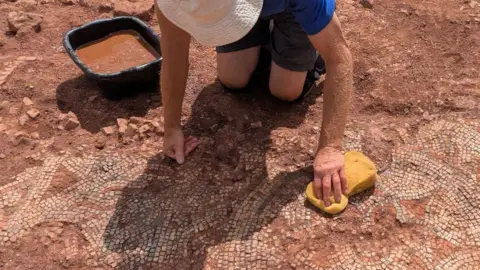
A mosaic discovered in the remains of a Roman villa has been excavated from a farmer's field by archaeologists.
The patterned tesserae floor was part of a complex first found 16 years ago near the village of Sampford Peverell, Devon, by local metal detectorist John Hill.
Working with the University of Exeter and charity Cotswold Archaeology, volunteers and students have slowly revealed the site and lifted the mosaic from the field, which was regularly ploughed by farmers.
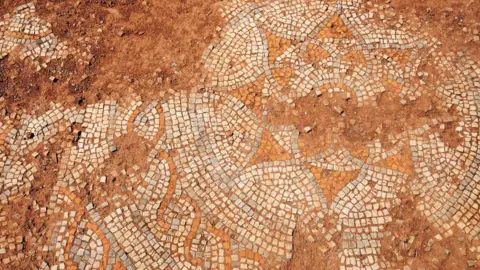
The tiles have revealed a central flower design which will be preserved and go on display at the Tiverton Museum of Mid Devon Life along with other finds from the dig.
Hill said it was "a dream" to find the items with his metal detector.
"I realised it was something large when I found the first coin in the top corner [of the field] and then went on to see tesserae lying everywhere," he said.
"I mentioned to the farmer he might have a Roman building up there and he said to me 'no, I've been ploughing there for years and there's nothing there', although he did say it used to jump up and down when he went over it with the rake."
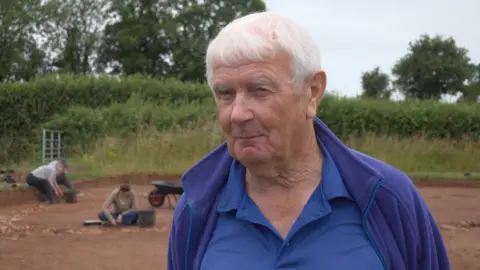
Landowner Ron Venner said the area had been ploughed since his family bought it in the 1950s and he had not seen anything before.
Hill, who has been metal detecting for 40 years, said he was delighted the site was being properly excavated and finally able to give up its secrets.
"It's taken 16 years to get everyone here to do the dig," he said.
"I'm nearly 80 now, so I thought I wouldn't possibly see it in my lifetime."
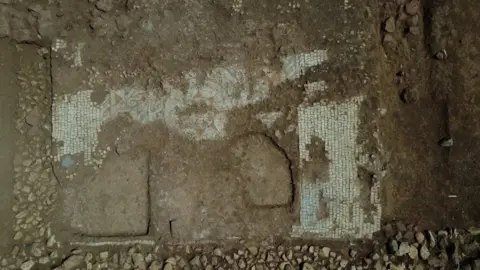
University students and volunteers are two years into a five-year research project called Saving Halberton's Ancient Roman Environment to slowly reveal the site.
 University of Exeter Archaeology and History Department
 Leif Isaksen, University of Exeter
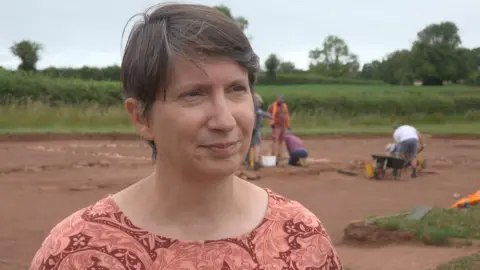
Dr Susan Greaney, lecturer in archaeology at the University of Exeter, called the area between Halberton and Sampford Peverell "an important Roman site" which included a large villa with agricultural buildings and a bath house.
She added the villa would have been the centre of a large estate.
"In Devon, we are very much on the edge of the Roman Empire and Roman villas here are really rare," Greaney said.
"It's even rarer to have one with a mosaic.
"This would have been a really high status family home."
While Roman villas are more common in areas such as Gloucestershire and Hampshire, members of the excavation group are trying to find out if there is any connection with the legionary city of Exeter or military forts in Tiverton or Cullompton.
This is not the first thing Hill has found.
He used to live in Dorchester, which has a rich Roman heritage, and helped discover a 2,000-year-old Iron Age burial site near the Dorset town.
He said: "I just love history, it's a super hobby."
