Could more schemes follow Reading Hydro's example?

 BBC
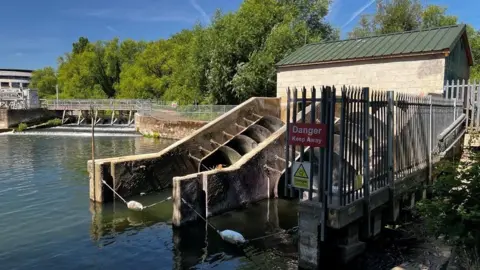
BBCThe group behind a hydro power project on the River Thames has said its success could become a blueprint for similar schemes in the future.
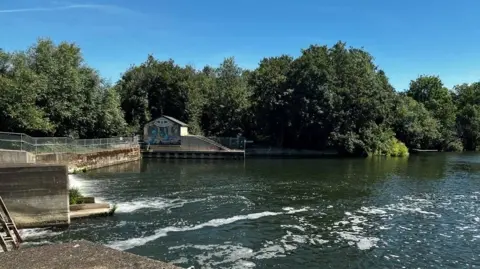
Reading Hydro raised funds to build two turbines beside Caversham Weir, in Reading, which have been generating electricity for the past five years.
But its founder said it had become increasingly challenging for small hydropower projects to be developed, due to high costs and difficulties gaining planning permission.
The Department for Energy Security and Net Zero said that it welcomed "the supportive role hydropower plays in our clean power mission as a small-scale technology".
The two turbines, which cost £1.15m to build, were funded mostly by individuals who live in Reading.
Reading Hydro has been selling electricity to the nearby Thames Lido since 2021, with any remaining power sold to the national grid.
During most summers it has to halt operations when water levels are too low.
When the hydro power station is running at its maximum capacity, it can produce 1.1MWh each day - enough power to run more than a hundred homes.
It is the most recent hydropower station to be built on the Thames, with Sandford Hydro in Oxford being launched in 2017.
 Tony Cowling
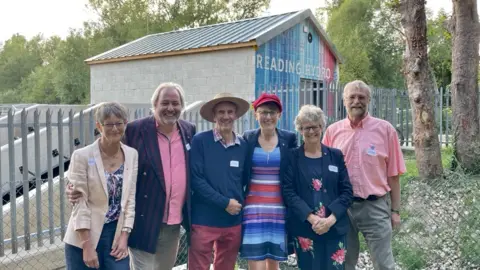
Founder Tony Cowling said the Reading Hydro team had been asked for help by other organisations "trying to develop a hydro power scheme in their town or village or locality some near London as well".
"The problem with building a hydro power station is that there are high costs to develop the scheme before you can get it in a fundable stage," he said.
Reading Hydro benefited from the government's feed-in tariff (FIT) scheme, having secured approval before it closed to new applicants in 2019.
It was designed to promote the uptake of renewable and low-carbon electricity generation, and participants were paid for the energy they generated.
Under the FIT scheme, Reading Hydro could sell its electricity to businesses such as Thames Lido while also receiving feed-in tariff payments
The group told the BBC the scheme funds up to two-thirds of their financial model, and without it the project would be "dead in the water".
But Cowling said he had been helping other hydroelectric projects to become financially viable without the tariff.
"It is quite difficult to build new hydro power stations, but not impossible," he said.
Dr Mehdi Shahrestani, a renewable energy expert at the University of Reading, said that renewable power projects were becoming more significant for the UK's electricity needs.
"There needs to be some major investment in the power grid if this is to be scaled up," he said.
"Some of the early incentives, such as feed-in-tariffs, have helped to encourage early take-up of technologies such as solar PV and small-scale hydro schemes.
"But the subsidies were cut by the UK government when the costs of installing solar PV, in particular, tumbled."
However, he said that the cut in subsidies had encouraged groups to think outside the box, such as "designing sustainable energy generation sites more local to the demand, and encouraging the use of storage technologies".
He said developing a small-scale hydropower scheme also required careful consideration of river flow, environmental impacts, grid connection and overall financial viability.
He added: "The most common barriers to approval are environmental and regulatory concerns, particularly around river ecology, fish migration, water quality and flood risk, alongside the costs of connecting generation to local energy demand."
Reading Borough Council said hydro projects involved numerous complicated applications for licences from the Environment Agency and other bodies.
"Whilst the council supported the first hydro scheme on the River Thames and would look favourably upon future schemes, depending on their suitability, finding suitable locations remains challenging," a spokesperson said.
The Department for Energy Security & Net Zero said that the UK needs to get off "the fossil fuel rollercoaster and onto clean, homegrown power we control".
