TV licence fee is 'yesterday's model', new BBC director general says

 BBC
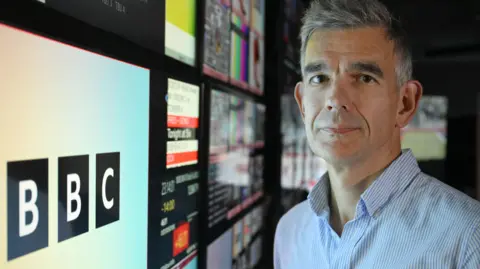
BBCThe BBC's new director general has described the traditional TV licence model as "a busted flush" and "no longer fit for purpose".
In his first major public appearance since taking over the BBC six weeks ago, former Google executive Matt Brittin told MPs that the licence fee is "yesterday's model".
The BBC receives most of its funding from the £180-a-year TV licence, but the number of households paying has declined in recent years, and the broadcaster is discussing reform of the system with the government.
Brittin said: "We can and should be doing as much as possible on [enforcing] licence fee collection under the current model, but it's yesterday's model, it's a busted flush, it's no longer fit for purpose, and that's why we need to make the case for the BBC and a shift of the licence fee model."
He did not specify what he wants to replace it, but he and BBC chair Samir Shah suggested the government should reconsider a compulsory household levy, which it previously ruled out.
Brittin told the House of Commons the Culture, Media and Sport committee on Wednesday that such a levy could be collected through utility bills such as broadband, mobile or electricity.
If 100% of homes paid through such a scheme, the fee could be reduced from its current level, he said.
"The challenge is it's been ruled out, and I can understand the concerns about cost of living and so on, on households, but I think it's got merits and others have found it to have merits," Brittin said.
Shah said a levy "would solve a lot of problems for us, and we're certainly open to it", but admitted it "could be seen as, and is effectively another tax".
Ads or subscriptions 'would change programming'
Currently, a TV licence is legally required to watch TV channels on any TV service, watch live TV on streaming services, or use BBC iPlayer, according to TV Licensing.
But licence fee payment has dropped to 80% of households, Brittin told the committee.
There is an ongoing debate about an alternative system, and the government is considering options including allowing the BBC to be funded by adverts or subscriptions.
However, the director general said those systems would be likely to result in the BBC cutting back on services that generate less commercial revenue, such as children's shows like Newsround and local news.
"Some of these things would be very, very hard to fund under a commercial funding model for the BBC," he said.
Shah also said "our drama would become increasingly narrowly focused on things that drive subscription" under a Netflix-style system.
"We would stop being universal, we'd actually stop being the BBC that we know," he added.
The debate about the BBC's future comes at a critical time for the corporation, which is making about 2,000 roles redundant - roughly one in 10 staff - in order to make £500m savings.
Its current royal charter, which outlines its public mission and funding arrangements, expires at the end of 2027 and is currently under public review.
Huw Edwards 'should return money'
In the same meeting, the BBC bosses also fielded questions about other topics including long-running attempts to recover £200,000 from disgraced former news presenter Huw Edwards.
The BBC has asked Edwards - who resigned in 2024 on medical advice - to hand back the salary he earned after being arrested on child abuse image charges.
Shah noted "if he has an ounce of moral rectitude he should return the money".
There have been reports that the BBC has given up hope of clawing back the money, but Shah said: "No we have not abandoned hope. This is licence fee money it doesn't belong to him."
On a separate note, Brittin defended the number of appearances by Reform UK on BBC One's Question Time, and was asked about coverage of a Clacton by-election after Reform leader Nigel Farage said he would resign but stand again.
Labour, the Conservatives, the Liberal Democrats, the Green Party and Restore Britain have all ruled out contesting the seat - leaving the prospect of Farage facing novelty candidates like Count Binface.
Asked whether all candidates would receive equal coverage, Brittin replied: "You can look at our guidelines and we'll happily discuss when the eventuality arises, including whoever's standing."
Elsewhere, Brittin also pointed to the BBC's broadcast of England's dramatic win over Mexico at the World Cup in the early hours of Monday as an example of the broadcaster "bringing the nation together even in a world of technological fragmentation".
A peak audience of 9.1 million people tuned in to watch the game on TV and BBC iPlayer.
Asked how many people had used a QR code shown on screens during the World Cup to buy a TV licence, Brittin said he "can't give you the precise numbers", but there has "been a lift in licence fee payment" during the tournament.
Also on Wednesday, the BBC announced it has grown its global audience to reach over half a billion people every week for the first time since contemporary records began.
Across BBC News, the BBC World Service and content distributed by BBC Studios, the BBC saw its international audience grow to 502 million people - up 11% year-on-year.
Update 10 August: We have amended this report to make clear exactly which services a TV licence is needed for.
