The Tinder clinicians - swiping to deal with ambulance calls attracts global attention

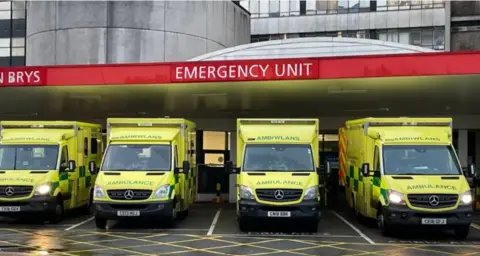 BBC
BBCAn elderly cancer patient, unconscious at home, surrounded by her worried family, and a five-month-old baby who has been covered in shower gel by their autistic sibling.
These are examples of calls received by control room staff - and they have to decide who really needs an ambulance.
I spent a day in one of the control rooms, speaking to staff and listening to some of the 999 calls - acutely aware that pressure on this service often leads to complaints about lengthy waits.
The way they are dealing with these calls is attracting attention from around the globe - I wanted to find out how it's going, and if Wales is an outlier or an innovator?
Calls are put into categories - purple and red as the most urgent, orange for things like heart attacks and strokes, then yellow and green for lower priority calls.
And most will require a closer look by a trained specialist.
"Some colleagues refer to us the Tinder clinicians," said one clinical navigator.
He then explained that by swiping left, calls are placed in the stack requiring further triage by a nurse or paramedic, but a swipe right means they're in the wait for an ambulance.
The majority of calls in Wales, though, don't get an ambulance.
But nor should they.
There was one from a woman in her 40s going through alcohol withdrawal begging hostel staff for help, then an elderly man, who had fallen at home, with his frail wife unable to move him.
In a typical month, around 50,000 calls will come in - each with their own personal emergency.
But on an average day, just 2.6% are deemed the most life-threatening "purple calls" which warrant a blue-light response in a target of six to eight minutes.
Different solutions have been designed for those who may not benefit from a trip to A&E, freeing up finite resources for those who definitely would.
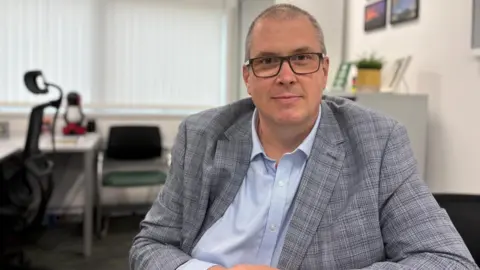
"I only want to send an ambulance when we really know that person needs to be transported somewhere urgently," said the Welsh Ambulance Service's executive director of paramedicine Andy Swinburn.
He believes if more patients in a "yellow" category can be managed in the community, without a transfer to the emergency department, it frees up capacity for the fleet to be sent to heart attacks and strokes.
The Welsh Ambulance Services Trust has evolved in recent years to include remote assessments, video calls, advanced solo paramedics who can treat and discharge patients at home - even volunteers - to help deal with the sheer volume of less urgent calls.
It's not just about easing pressure on their own service, Swinburn said.
It reduces the impact on the whole NHS, but just as importantly has better outcomes for patients.
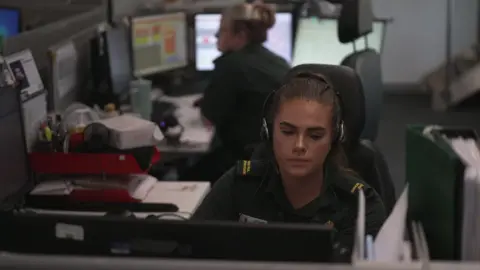
Abbie Williams is a call-taker supervisor and has worked in the Cwmbran, Torfaen, control room since 2019.
When she started there could be as long as an hour between calls.
"Now you hang up and you're straight on to the next call," she said.
The recent spells of hot weather has increased demand, with predictable symptoms of heat stroke, beach and waterfall-related injuries and an influx of fatal car crashes, she said.
But another pattern female staff in particular face are calls featuring threats of violence - even sexual violence.
"We've had in the past a regular caller who is always abusive and sexually inappropriate to females - you put a male on the phone and he hangs up," she added.
But it's still a job she enjoys, particularly when she knows she's made a difference in a person's life.
In the time I spent with her, calls categorised as "orange" - still serious with the need for a face-to-face assessment - on average were waiting between 50 minutes in Powys and 90 minutes in Swansea Bay.
For the woman in alcohol withdrawal, the call was put through to the 111 service, where the "press 2" team handling mental health calls could access addiction support.
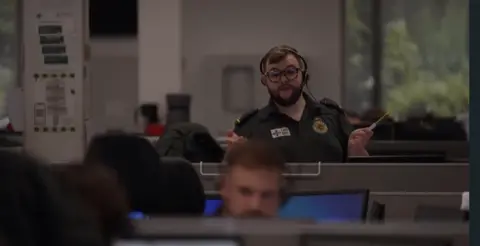
There is also the work of the clinical navigators - clinicians reviewing notes taken by the call handler to weed out those in need of a rapid response.
"They are already identifying 70% of our hearts attacks from two paragraphs of text," said Swinburn.
"As experienced, well-educated clinicians they are spotting things and differentiating between indigestion and a heart attack."
With six on shift each day, they spend on average 90 seconds reviewing the calls, meaning they can get through as many as 1,000 in a 12-hour period.
They also monitor the waiting calls to ensure nothing has been missed.
"One of the main reasons our role exists is to make sure people get the right response," one told me.
"There's a lot of 999 calls that don't necessarily require an ambulance to turn up on blue lights - but 999 is their first port of call.
"We're making sure those people get the help that they need."
As he talked me through the call he was reviewing, he explained it was a "high intensity service user" who called as many as 10 times a day, every day, for months.
"It's more common than you think," he said.
In May alone, official data showed that 304 frequent callers to the Welsh Ambulance Service generated 2,999 incidents.
Each call takes time, and has to be taken seriously.
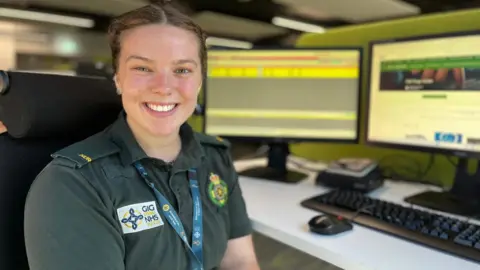
The elderly caller in mid-Wales who had slipped on decking was put through to the falls desk - initially set up as a pilot to handle around a thousand calls a day of this nature.
But the results quickly pointed to some significant gains.
Ruth Baker is an integrated care clinician - a registered nurse by training, who joined the ambulance service a year ago.
She explained people are told in their initial call to remain on the floor as a safety precaution, but the falls team can determine whether it's safe for them to be lifted.
If assistance is required, a falls responder such as St John Ambulance, can be deployed.
"We find that the longer patients are on the floor, the longer that they'll be in hospital for," she said.
For those who need to wait for assistance, she said advice is also offered on keeping them hydrated, fed and comfortable.
These types of "lower acuity" calls are categorised as either "yellow" or "green" where further assessment can be made.
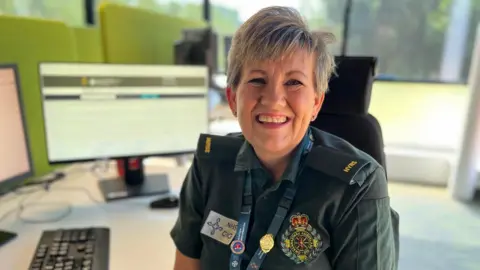
They will typically be assessed by the care planning desk, where "integrated care clinicians" like Amanda Morgan - another registered nurse - can speak to patients and determine what type of service would meet their need.
"We're not about stopping ambulances being sent to patients, we're more about getting the right help to the patient at the right time," she said.
She explained the volunteers - or community welfare responders - are trained to monitor things such as blood pressure and oxygen levels, aiding the decision-making of clinicians back at base.
Each of these changes have been brought in to relieve pressure on the traditional ambulance, which takes patients with a critical need to A&E.
In the last year the targets for the most urgent, life-threatening calls have changed, with the introduction of "purple" and "red" categories which focus more on patient outcomes rather than how quickly the paramedics arrive.
Swinburn said it has helped highlight the role played by bystanders in the seconds following a cardiac or respiratory arrest.
There's been a greater uptake in CPR done before ambulance staff arrive, he said, as well as a "dramatic uptick in the number of public access defibrillators that are registered".
"I'm seeing a gradual improvement in the cardiac arrest outcomes, the number of people helping us in terms of resuscitating patients - these were focuses we simply never had before because we were chasing an eight-minute target," he said.
A year in, he said there is still a long way to go and too many patients are still being placed in the red category, only for paramedics to arrive and find the patient can be managed in the community.
The changes set Wales apart, and while he is getting interest from peers in Canada, Australia and New Zealand, I ask him if there's a gamble here - could Wales be seen as an outlier rather than an innovator?
"I wouldn't use your term 'gamble' but the reality for me is we can't just keep doing what we've always done and expect something's going to change," he added.
