Minister would consider 'knife amnesty' after teenagers guilty of murders
Justice Secretary Neil Gray has said he would consider running a "knife amnesty" following the convictions of four teenagers in two fatal stabbing cases.
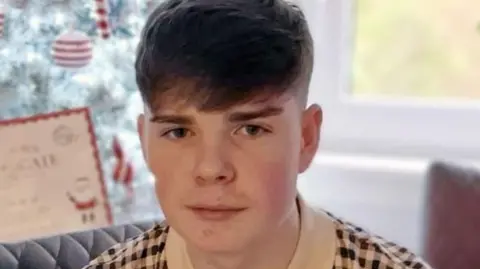
The SNP minister described the murders of Kayden Moy, 16, and John McNab, 22, in Irvine and Edinburgh last year as "shocking" amid concerns over rising levels of knife possession among youths in Scotland.
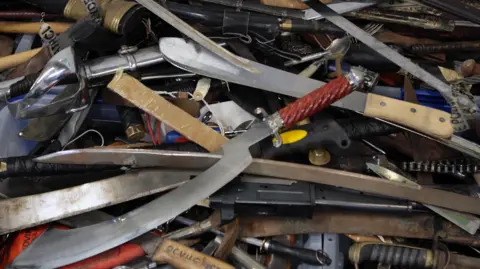
During the last amnesty in 2006, people handed over more than 12,500 blades to police without facing criminal charges - they included machetes, swords, meat cleavers, bayonets and axes.
Gray said conversations with police on tackling knife crime were ongoing, but added the Scottish government was committed to taking a "preventative" approach.
Figures from the Scottish Violence Reduction Unit (SVRU) showed a 15% increase in knife possession among 11 to 15-year-olds between 2019/20 and 2024/25.
All four youths convicted of the killings of Moy and McNab were aged 18 or younger.
Jay Stewart, 18, and a 15-year-old who cannot be named for legal reasons, were found guilty of murdering Moy following a dispute between rival groups on Irvine Beach on 17 May 2025.
Another teenager, Cole Turley, 18, pleaded guilty to the murder before the trial at the High Court in Glasgow began.
A 17-year-old was sentenced to life with a minimum term of 17 years for the unprovoked murder of McNab on Great Junction Street in Leith on 2 September.
The teenager, who cannot be named due to his age, also pleaded guilty to the attempted murder of a 16-year-old on the city's Portobello Beach months earlier.

 Police Scotland
Gray told BBC Scotland's The Sunday Show that the murders were not isolated incidents.
He did not rule out re-running the "bin a knife" campaign put in place 20 years ago, which saw those in possession of weapons given the opportunity to hand them over to police.
However, he said the government's focus remained on ensuring young people "never picked up a knife in the first place".
"Of course we would consider the likes of knife amnesties if that is something the police and other partners feel is helpful," he told the programme.
"We must do all we can to prevent young people picking up a knife in the first place and involving themselves in gangs and ensure there is diversionary activity, that is where our investments are targeted."
 Police Scotland
The 2006 campaign saw 12,645 weapons deposited in more than 200 special bins at police stations across the country.
A previous amnesty named "Operation Blade", run in the former Strathclyde policing area in 1993, saw about 4,500 weapons voluntarily given up.
McNab's killer was on bail for the Portobello Beach attack at the time of his murder.
His mother, Lisa Petrie, has called for tougher bail restrictions for those accused of inflicting serious injuries with knives.
The SNP made Petrie's campaign to increase public availability of "bleed kits" a manifesto pledge leading up to the Holyrood election.
 Lisa Petrie
Gray said bail conditions were under "constant review" but added it was ultimately up to individual courts to implement them.
"Work will continue to ensure there is clear deterrents in terms of the punishments meted out by the law," he said.
"We continue to keep under review the tests for bail conditions and the guidance that is available is under constant review to ensure that is got right.
"We've set forward guidance that when bail conditions are considered, public safety and the safety of the victim in the original incident are considered and are central to the consideration."
'Fear and peer pressure'
Former gang member Kevin Martin, who now works with a youth organisation in Glasgow, said those carrying knives were doing so "out of fear and peer pressure".
The Scottish Violence Reduction Unit was initially set up to tackle a huge wave of knife crime which saw Glasgow become Europe's murder capital in the early-to-mid-2000s.
Martin left gang activity after a trip to South Africa organised through the SVRU.
He told The Sunday Show funding shortages risked undoing the unit's previous work.
"I think we did make progress for a long time, but I feel as if we are going back the way," he said.
"Post-Covid, funding streams have been so much more limited, which is having a knock-on effect, so we are being reactive to crimes, rather than pro-active.
"We need to break the cycle. We need to go back to the old tradition with youth work, where we go into schools and meet them where they are at, give them education."
He added: "We lost two years with the community organisations shutting down during Covid. I think we are seeing the product of that now."
 PA Media
Scottish Labour's justice spokeswoman, Pauline McNeill, said the SNP had to take responsibility for the increase in violent incidents.
"This rise happened on their watch," she said.
"The Scottish government needs to urgently bring forward a renewed strategy on violent youth crime."
"Young people and their families are paying the ultimate price for the SNP's failure in our justice system and it cannot continue. How many young people have to die before the SNP take action?"
The Scottish Conservatives' justice spokesman, Stephen Kerr, accused the Scottish government of "abandoning the zero-tolerance approach" to knife crime.
He added: "The prevention, education and early intervention that once helped drive knife crime down have been weakened.
"Diversionary activities closed during the Covid pandemic and the Violence Reduction Unit had its budget cut.
"The message is that carrying a knife will not necessarily result in serious consequences."
