London Tube driver strike to begin at midday

 Getty Images
London Underground services are set to be face significant disruption as the first of two 24-hour strikes by some Tube drivers begins at midday.
Members of the Rail, Maritime and Transport (RMT) union, which represents roughly half of drivers on the Tube network, are striking over a Transport for London's (TfL) voluntary proposal to allow train operators to move to a compressed four-day week.
The RMT said the working day would be too long under the plans, risking driver fatigue and compromising safety.
TfL said the industrial action was "completely unnecessary" while Aslef, another Tube driver union, supports the deal as "exactly the sort every trade union should be trying to achieve".
The industrial action runs from 12:00 on Tuesday for 24 hours to be followed by a second 24-hour period beginning on Thursday and ending midday on Friday.
The strikes will see the Piccadilly and Circle lines closed entirely, as well as the Metropolitan line between Baker Street and Aldgate. Central line services will not run between White City and Liverpool Street.
Other lines that do run will be offering a significantly reduced service.
For more details on the impact of the industrial action on your commute, click on the explainer below.
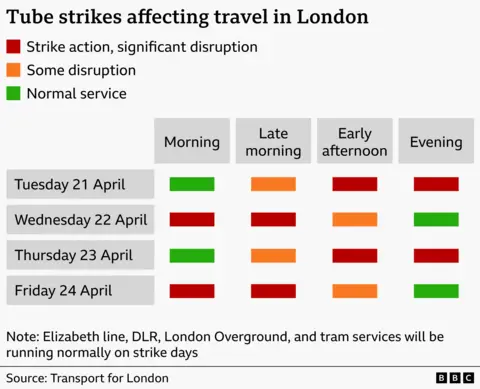
London Underground said there would be "significant" disruption on most Tube lines but the level experienced would not be as severe as the strikes in September when members of both the Aslef and RMT unions took part.
Under the compressed four-day week proposals, which are being trialled voluntarily on the Bakerloo line, most drivers would see their working week reduced from 36 hours to 35 hours.
Their contractual hours would remain the same because paid meal breaks would be introduced.
The RMT said the longer days risked driver fatigue and instead called for a 32-hour four-day week for the same salary.
The union's London transport regional organiser Jared Wood said the negotiations with TfL left his members feeling "there is absolutely no alternative but to proceed with the strike action".
TfL said drivers could remain on a five-day week if they wanted to, pointing out that the change was voluntary and called for the strikes to be called off.
An Aslef spokesperson said the union was "surprised" the RMT was striking, adding: "It will be the first strike in the history of the trade union movement designed to stop people having a shorter working week and more time off".
Listen to the best of BBC Radio London on Sounds and follow BBC London on Facebook, X and Instagram. Send your story ideas to hello.bbclondon@bbc.co.uk
