Paterson patient 'let down at every point'

 Norman Taylor
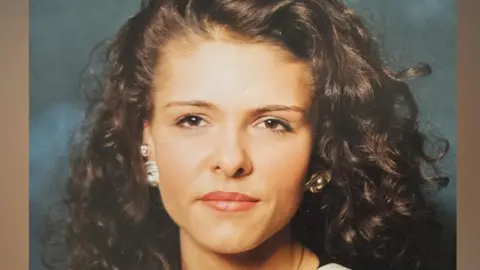
A former patient of jailed surgeon Ian Paterson who died aged 29 "was failed at every touch point", her husband has claimed.
Tracey Taylor from Solihull is believed to be the youngest of the 68 patients whose deaths are being investigated at inquests.
She was diagnosed with breast cancer after having a lump removed by Paterson in 1998, but died in December 1999 after the cancer returned and spread to her bones.
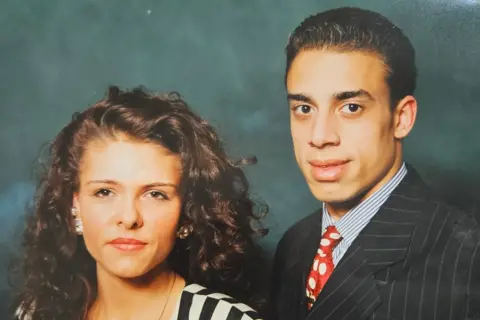
In a letter from husband Norman Taylor to the coroner, read out at the inquest, he said: "The fire was already burning before he arrived, he decided to let it take hold."
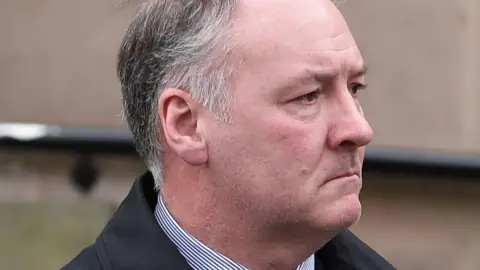
Paterson was jailed for 20 years in 2017 after being convicted of wounding patients by way of botched and unnecessary operations.
Appearing at the inquest via video link from prison, he started the proceedings by making an application to the coroner to only attend two inquests a month.
Currently, there are six inquests scheduled for July.
He cited "physical and mental health reasons", adding that he was almost 70 years old and could not handle more than two a month.
"As you've denied me legal funding, I don't want to use my limited resources," he said.
'Like a botched job'
 Norman Taylor
The inquest heard that Taylor had been concerned about lumpiness in her breast for around 12 months.
Her GP told her she had a fibroadenoma, a benign lump that was not cancerous, but she was eventually referred to Solihull Hospital where Dr Mukesh Sinha echoed the GP's diagnosis of a fibroadenoma.
Four months after her referral, Taylor met Paterson for the first time when he removed the lump from her breast.
Unfortunately, the lump turned out to be grade three breast cancer.
A sample had previously been taken from her breast with a needle and was found to be unusable, but this was not repeated and the cancer was not detected until Paterson removed the lump.
 PA Media
Paterson then performed a wide local excision, meaning some of her breast was conserved.
Norman Taylor told the BBC that Tracey had wanted a mastectomy but that Paterson had told her she was "too young for the operation".
Metastases in the bone were later found and a recurrence of cancer was detected in her breast in 1999.
However, the inquest saw a note from a radiologist to Paterson, which said he had avoided giving her this diagnosis.
Dr Chris Fletcher said he had told her that the results of her mammogram were proving "difficult to assess" but showed "no major problem" and that her biopsy would point to further treatment - despite the fact the radiologist admitted to Paterson in the note that the results showed there were cancer.
After the diagnosis, Paterson performed a mastectomy and a plastic surgeon undertook an immediate reconstruction.
Norman Taylor told the BBC that Tracey was distressed by the results of the surgery.
"It just looked like someone had done a botched job," he said, adding that she burst into tears upon seeing the results.
Later that year, Tracey was transferred to a hospice and she died in December 1999.
 Norman Taylor
Criticisms
A report from a panel of medical experts referenced at the inquest made several criticisms of Tracey's care, but several of these were before Paterson's involvement.
This included the "general failure to investigate [the lump] with sufficient urgency", saying it caused a four-month delay to her treatment, and that radiotherapy was not performed on her breast after the second operation.
The failure to repeat the biopsy sample that was declared to be unusable was also criticised.
In reference to Paterson's course of action, the report said his decision to offer the surgery he did to Tracey was inappropriate, due to the number of lymph nodes that were involved.
'The light of my life'
 Norman Taylor
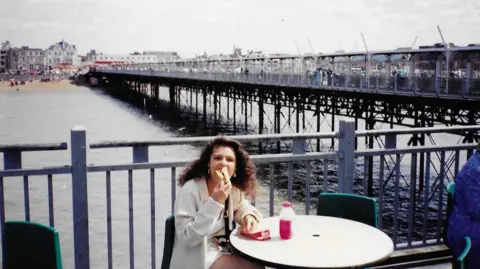
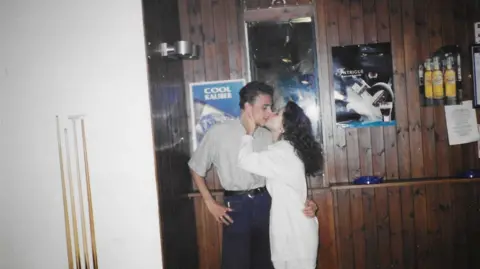
Norman Taylor described his wife as "a truly sensational woman" who had a "zest for life".
He added that she was someone who could light up a room and that he could not have hoped to have met a better woman.
"She was the light of my life," he said. "I knew at 16 I'd met the right person."
Tracey had been a recognised graffiti artist in her teenage years, working with music producer Goldie in the late 1980s. Later, she worked in the jewellery trade.
She then became an area manager at the high street retailer River Island.
"She traded the baggy jeans and spray cans for a boardroom suit, and never once lost the directness that made both of them fit," her husband said.
The couple had longed to be parents, a journey they were never able to embark upon.
"She was denied the opportunity of a child through illness," he said.
"There were hard days. She was human, and she felt them. But she believed in carrying on and she did - right to the last breath.
"Because giving up was not, and had never been, in her nature."
Follow BBC Birmingham on BBC Sounds, Facebook, X and Instagram.
