Tudor fort to be uncovered during coastline dig

 Colchester Archaeological Trust
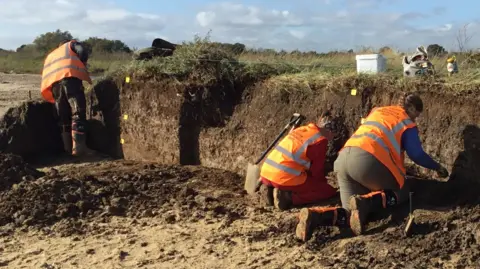
Archaeologists are planning to uncover the site of a coastal fort built under the rule of Henry VIII.
The Tudor blockhouse was built in 1543 to defend the mouth of the Colne estuary on Mersea Island, Essex.
A small artillery garrison of 12 guns was once held at the site.
Volunteers have been invited to join the five-week dig from 29 June, and Tony Calladine, of Historic England, said: "This rare structure must be investigated and recorded now so that its story can be shared with future generations."
The blockhouse's cannons were removed in 1553, but the fort was repaired to counter the Armada in 1588 and played a part in the Civil War in 1648.
It was also used briefly as a court, where fishermen were prosecuted for dredging out of season.
Oliver Cromwell later ordered its demolition, but the structure survived after opposition from the landowner.
 Colchester Archaeological Trust
"The Mersea blockhouse is a remarkable survivor," said Calladine.
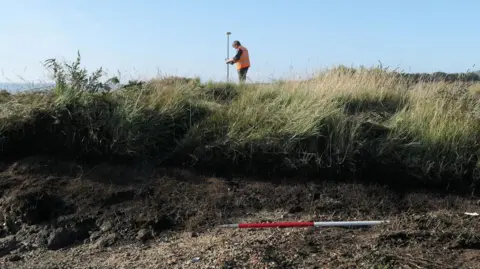
"Built to defend the English coast in the Tudor period, over centuries it has endured the impact of the sea, weather and the passage of time."
The excavation at Cudmore Grove Country Park has been planned by Essex County Council, which wants to record the site before it is lost to coastal erosion.
Colchester Archaeological Trust (CAT) will lead the dig, which has been funded by the Department for Environment, Food and Rural Affairs.
Instead of the typical stone structure, the defences were constructed of mud and wood.
Adam Wightman, director of CAT, said: "This is a rare opportunity not only to investigate an important Tudor coastal fort, but to involve people directly in the process of discovery."
Do you have a story suggestion for Essex? Contact us below.
Follow Essex news on BBC Sounds, Facebook, Instagram and X.
