'Atrocious' decision to close primary as fall in pupils puts more schools at risk

 Roseheyworth PTFA
Parents who battled to keep a primary school open say the decision to close it has left them worried about their children's future, as low birth rates cause pupil numbers to plunge.
Blaenau Gwent councillors voted to close Roseheyworth Primary School campus, part of the Abertillery Learning Community, citing budget pressures and shrinking school rolls.
Experts have warned that a projected 15% reduction in pupil numbers in Wales by 2041 may mean more school closures or mergers, with a quarter of school places unfilled in some Welsh councils in 2024.
But parent Kirsty Lloyd said families were "angry and upset" and closing a school should be the "last thing" done to save money.
Earlier this month councillors voted to close the Roseheyworth Road site next September, which means pupils will then have to transfer to one of the two other primary schools which form part of the Abertillery Learning Community (ALC), an all-through facility for children aged three to 16.
Blaenau Gwent County Borough Council said closing the school would reduce ALC's total capacity from 980 to 770 pupils, and address a £900,000 deficit.
But Lloyd, co-chair of Roseheyworth PTFA (Parent, Teacher and Friends Association), who has two children at the school, said parents were "afraid about what's going to happen with the future of our children".
"I don't think saving money should come from closing a school - definitely not.
"It affects so many different people. It bewilders me to be honest with you."
Fellow parent Natalie Grote said children like hers, with additional learning needs, would struggle with being "uprooted" from their original school environment, calling the decision "atrocious".
She said the children were "really sad": "They don't want to leave their little school."
Figures show there were 460,091 pupils in local authority schools in Wales in January 2025, down 5,749 on the previous year.
Welsh government projections anticipate a significant drop - to 390,900 pupils - by 2041.
Luke Sibieta, research fellow for the Institute for Fiscal Studies, said notable falls in pupil numbers were already being seen in primary schools across the UK and the same trend would later become apparent in secondary schools.
"Most schools are funded on a per-pupil basis, so fewer pupils means less money going into school budgets
"That makes some schools potentially financially unsustainable."
Sibieta said decision-makers faced a choice to either "maintain current spending levels and have smaller schools and smaller class sizes" or "cut the number of teachers and cut the number of schools in line with falling pupil numbers".
He said pressures on public finances may make it "more attractive to cut education spending".
However, last month a teaching union argued the government should see falling pupil numbers as a "historic opportunity" to reduce class numbers - with England having some of the largest class size in Europe.
The Welsh government said it is working closely with local authorities who are responsible for planning school places.
It has promised to review a policy which sets out a presumption against the closure of rural schools "to ensure decisions are guided by the best interests of learners."
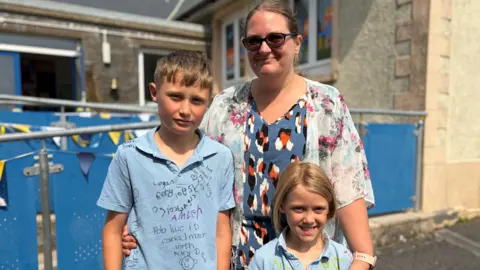
Ysgol Clydau, a small school in north Pembrokeshire closed its doors for the final time, as term came to an end in July.
Mum Sarah, who has two children at the school - which had 24 pupils on the roll at the start of the academic year - said it was "very, very sad".
"The school is a thriving school, despite pupil numbers dropping recently," she said.
"We've had a lot of children leaving because of the threat of closure. It's just a shame – it's heart-breaking.
"Our community will not be the same again, and the village won't be the same again.
"I know the pupil numbers are dropping and it's all about finances, but there's more to education than finances and the investment should be put into schools".
Her 11-year-old son, Tristan, is moving on to secondary school in September but he felt "a bit sad" about his six-year-old sister having to transition to a bigger school.
"It's a small, nice, close school," he said, on the final day of school. "My sister has to move school now and it's probably going to be quite hard for her."
Pembrokeshire Council said it had an ageing population with pupil numbers falling by more than 2,000 since 1996, with a "significant decline" in pupil numbers in the Preseli and Tenby areas.
"The decline is impacting the number of surplus places, and this is more acute in rural areas and tourist areas of the county," the council stated.
"It is impacting significantly on small schools and is driving more competition between schools for pupil numbers.
"The council has been working for several years on school rationalisation and modernisation, through a series of school organisation proposals".
What's happening to pupil numbers across Wales?
Population projections suggest that all local authorities, other than Newport (up 0.7%), will see a decrease in the number of children and young people aged 0 to 15 between mid-2022 and mid-2032.
The areas projected to see the largest percentage decreases are Anglesey (down 16.6%), Wrexham (down 14.5%), and Caerphilly (down 13.4%).
Cardiff Council said the city was expected to grow overall, but some primary schools could see rolls drop by around 20% by 2029.
It said it planned strategically and monitored demographic trends.
Gwynedd council said almost a quarter of the county's school capacity was unfilled in 2024, equivalent to more than 4,700 surplus places.
"As a result, it is likely that some schools will face increasing challenges in the years ahead, including lower learner numbers, smaller classes with a wider age range, and growing pressure on school budgets," a spokesperson said.
It said any changes would be guided by "securing the best possible opportunities for children and young people".
Caerphilly County Brough Council has established a Sustainable Communities for Learning working group to review the challenges of declining pupil numbers and the growth in surplus places in primary schools.
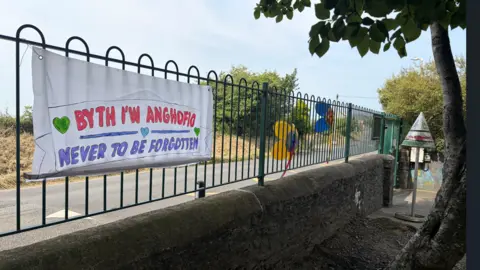
In 2021, Audit Wales determined schools would face an "alarming challenge" because of declining birth rates.
The demographic trend is seen across the UK, and internationally, but the audit highlighted the presence of numerous small primary schools (less than 100 pupils) and secondaries (less than 700 pupils) in Wales "partly because of rurality and because it operates a split system with Welsh, bilingual and English-medium schools".
"In future, falling pupil numbers may mean that some schools may become unviable - leading to schools merging or even closing" it stated.
The Welsh government said demographic trends are influenced by a range of factors.
"The best way to strengthen Wales' long-term prospects is to create more economic opportunity," a spokesperson said
"Through our mission to boost productivity, we aim to create thriving communities where people can access good jobs and higher pay".
