Novel analysis reveals playful side of Alan Turing

 PA Media
A story written by World War Two codebreaker Alan Turing suggests he was a man with playful humour embracing his homosexuality, according to new analysis.
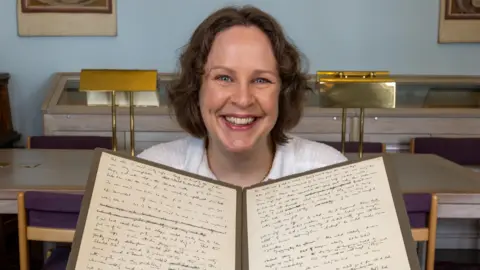
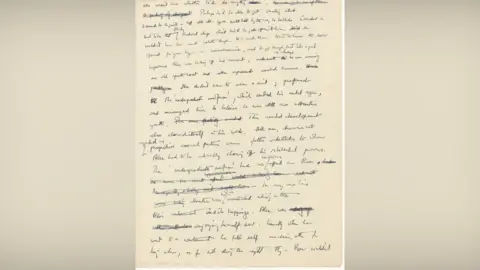
The six-page hand-written short story, Pryce's Buoy, has been transcribed in full for the first time and studied by Sarah Dillon, professor of literature at the University of Cambridge.
Dillon said the story offered fresh insights that challenge the view of Turing as an isolated, lonely genius.
"We've distilled a version of Turing that is a two-dimensional stereotype," she added.
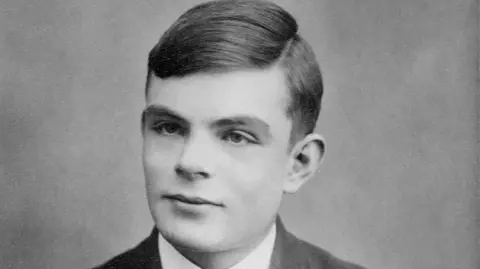
Turing played a crucial role in the Allies' victory over Nazi Germany in World War Two by helping to crack codes and deciphering the infamous Enigma machine at Bletchley Park.
After the war he produced a detailed design for a digital computer in the modern sense, storing programmes in its memory.
 Getty Images
In the new research, Pryce's Buoy, which was previously unpublished, has been printed in full, with Dillon believing he wrote it in late 1952 or early 1953.
The tale involves Ron Miller, a working-class sex worker, and Alec Pryce, a gay scientist famed for an invention known as 'Pryce's buoy'.
On Turing, she said: "He's come to be seen as socially unaware, entirely concerned with logic and numbers, and pretty isolated.
"His short story reveals a very different man: playful, funny, cheeky, literary, and someone who really liked sex."
 PA Media
Dillon said she believed the story was a direct fictionalisation of a sexual encounter in the 1950s which led to Turing's arrest.
Turing was convicted of gross indecency in 1952 and forced by authorities to take hormones.
He took his own life in June 1954.
Turing was pardoned in 2013 and four years later, the government announced gay and bisexual men convicted of now-abolished sexual offences in England and Wales would also receive posthumous pardons under what was known as Turing's Law.
"Turing died when he was only 41, and in those years running up to his death, he was trying to understand himself and his world," Dillon added.
"Literature offered him a really powerful way of doing that.
"This was the moment when he really felt a release, a chance to be more creative and playful."
Dillon also found that Turing copied the style of a gay novel, Hemlock And After, by fellow Bletchley Park veteran Angus Wilson.
She argued it was the novel Turing needed to read at a pivotal moment in his life, adding that it must have been a "powerful moment for Turing amid so much trauma".
Do you have a story suggestion? Contact us below.
Follow East of England news on X, Instagram and Facebook: BBC Beds, Herts & Bucks, BBC Cambridgeshire, BBC Essex, BBC Norfolk, BBC Northamptonshire or BBC Suffolk.
