'I was stalked for 10 years - the law needs improving'

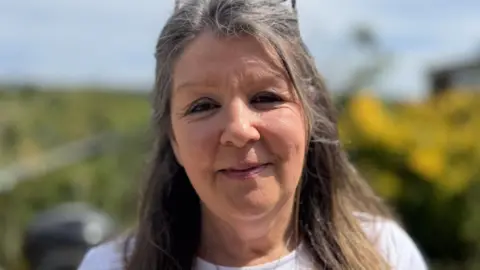 Charlie Rose/BBC
When Lorraine Mitchell's stalker was finally deported she said she felt like a "massive weight" had been lifted from her shoulders and she could breathe again.
But two years later she feared Sherzad Salih, who terrorised the mother-of-three for 10 years, had returned to Sussex, when she noticed she was being followed by a silver car.
"I caught a glimpse of the driver and he looked very much like my stalker," she said.
But Mitchell said Sussex Police couldn't reveal whether Salih was back in the UK, which made her feel like he was being protected.
The force said it worked hard to give victims necessary safeguarding information "in line with relevant legislation and statutory guidelines".
Mitchell said: "It would have been nice to have been told 'no definitely he's not been back in the UK', but the police officer wasn't allowed to tell me that," she said. She added that the officer could tell her only that Salih was "not here now".
Speaking as the government reviews the criminal law on stalking, she argues that in certain circumstances when there's a risk to safety, there should be exceptions to data privacy rules.
The Home Office said police could share information in exceptional circumstances where there is an immediate risk to someone's safety or public protection.
It added that victims' safety was taken "extremely seriously", and it would continue to explore ways to ensure they feel safe and supported.
An independent review of stalking laws was led by Richard Wright KC, the barrister who successfully prosecuted the killer of Alice Ruggles.
Mitchell, who helps other stalking victims, wants improved training for police officers, a better understanding of SPOs which a BBC investigation found were hardly being used, and every case treated as a potential homicide.
She would also like more support for those who may be worried that coming forward "will poke the bear" and "make the stalker worse", and the chance for victims to know if their partner has a criminal past in the same way the Domestic Violence Disclosure Scheme works.
Salih began stalking Mitchell in 2007 after he approached her in a car park.
"He told me he'd been watching me for two years," Mitchell said, adding that he would stop her when she was walking the dog, at the supermarket, or he would park his car next to hers.
She said the unwanted attention from Salih included messages and flowers.
"Every time I rejected him my car would be damaged, my tyres would be let down. He also started following my daughter as well," she added.
"He didn't lay one finger on me. There was no physical contact at all. It was just unwanted attention.
"But my instincts were saying something's going to happen and he's going to really hurt me."
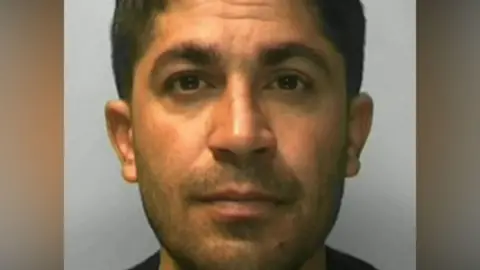 Sussex Police
Mitchell said at the time she was being stalked, police treated each incident in isolation rather than recognise a pattern of behaviour.
In 2017 Salih was sentenced to four years in prison, and was deported in 2022 after several appeals.
Sussex Police said the way the force approaches stalking has "evolved significantly over the last 20 years".
Det Ch Insp Jo Cooper said: "Sussex Police remains one of the leading forces in its use of Stalking Protection Orders (SPOs), with each managed by a dedicated officer and overseen by our award-winning Complex Domestic Abuse and Stalking Unit."
SPOs prohibit activities such as entering certain locations or making contact, and are designed to protect victims at the early stages of an investigation into alleged stalking.
Cooper also said stalking specialists were "embedded in all areas of the force", and officers received regular training including from external experts.
About 1.4 million people aged over 16 experienced stalking in 2024, according to the Crime Survey for England and Wales.
The government agreed to look at the criminal law on stalking, following a campaign by victims.
The Suzy Lamplugh Trust published a stalking super-complaint on behalf of the National Stalking Consortium.
Saskia Garner, the trust's head of policy and campaigns said it was "extremely concerning" that around 2.1% of stalking cases reported to the police result in a conviction.
"We speak to thousands of victims of stalking every year and what they tell us is that the response from police and other criminal justice professionals is often lacking, they're not always believed," she said.
'Really dangerous man'
Mitchell said when Salih was sentenced it was disclosed to her that he had a previous criminal history
"Sometimes you feel like you're losing your mind. You think 'am I imagining things that are happening, or am I being over dramatic'?" she said.
"But my instincts were saying that he's a really really dangerous man."
The Home Office said the government was committed to tackling stalking and ensuring victims receive the protection and support they need.
A spokesperson added: "This includes launching a new National Centre for tackling Violence Against Women and Girls and working with police forces to improve how Stalking Protection Orders are used."
They added that the government was "carefully considering" the findings of the stalking law review which have been submitted to the Home Secretary.
Follow BBC Sussex on Facebook, X, and Instagram and listen to BBC Radio Sussex on Sounds. Send your story ideas to southeasttoday@bbc.co.uk or WhatsApp us on 08081 002250.
