The fruit crossing continents and cultures

 Tim Smith Photos
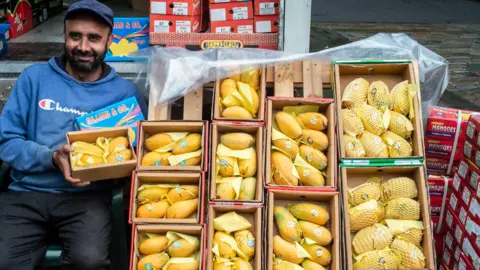
Vans stacked with crates of juicy, ripe mangoes have become a familiar sight on many streets in Yorkshire this summer as shoppers bustle to make the most of the current peak season for prized varieties.
But behind the roadside spectacle is a significant seasonal economy stretching 4,000 miles across continents, and a deeper culinary heritage story spread across generations.
At South Asian supermarkets across West Yorkshire, hundreds of boxes a day of the "king of fruits" are flying off the shelves, with importers, wholesalers, drivers, grocers and dessert shops all sharing in the rush.
Satvir Meen, of the Yorkshire Asian Business Association, explains: "Mango season is hugely important, and across Yorkshire for a lot of retailers it's one of the biggest seasonal trading periods of the year."
She adds: "They often prepare months in advance because they know customers are waiting for specific mango varieties from India and Pakistan. It definitely drives footfall and spending."
Much of the demand, she says, is linked to cultural memory and family heritage. "The emotional connection translates into strong commercial demand, with many customers buying entire boxes rather than individual pieces of fruit."
 Aisha Iqbal/BBC
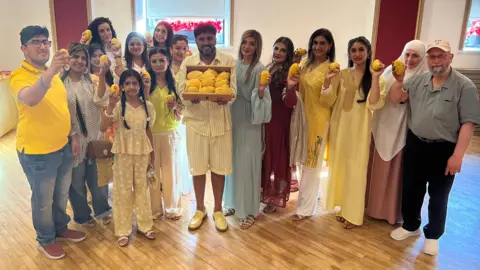
In Bradford, Imran Khan loves mangoes so much that he organised a whole festival dedicated to them.
He believes there are "101 things you can do with a mango" and many of those were on display at the event, with people making and sampling everything from mango trifle to fresh mango lassi to a spicy mango salad and multiple mango cakes.
"We only have a few months of summer, and mangoes come out at that time," he says.
He is referring not just to the British summer, but to the traditional "peak" season for Indian and Pakistani mangoes. The former ends in July, and the latter in September.
Imran's own preference is a fresh mango lassi.
Around him, visitors compare 'how do you eat yours?' methods, swapping memories and sampling the fruit's golden flesh in the multitude of drinks, desserts and savoury dishes on offer.
One visitor explains she always twists her ripe mango open and adds ice cream, while another slices hers thinly and eats it straight from the skin.
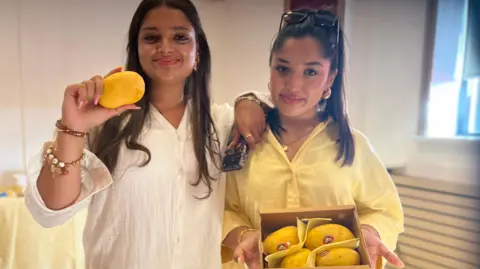
Arissa Khan says her grandfather always buys her mangoes. Her sister Alisha demonstrates what she calls the "Pakistani way": squeeze the fruit like a tube of toothpaste almost, pop off the top and suck out the pulp.
Another woman admits she has never cut a mango herself.
"I only have it if my mum cuts it," she says. "I have it diced because I like to sit in the garden and read, so I don't want to get my hands dirty if I'm holding my book."
Bushra Taimur, visiting from Canada, calls mangoes "the king among all the fruits", but believes their importance goes well beyond their sweet flavour and punch of vitamins.
"It's not just a season, it's a feeling," she explains.
"We all enjoy it among our families. It's like heritage or culture for us. It's the memories we can share with each other."
So how far would you go for a good mango, I jokingly ask one superfan.
"Five miles," she says. "Leeds Road in Bradford is the place. It's the hottest spot."
 Aisha Iqbal/BBC
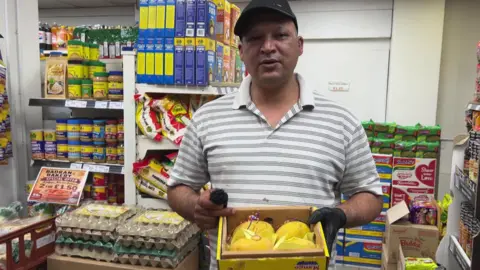
Over at Abu Bakr supermarket in Leeds, demand is again measured not in individual mangoes but in boxes.
Javed, who works at the store, estimates the store was selling 60 to 100 boxes a day at the peak of the season. Some customers, he recalls, take two or three boxes at a time, and keep coming back every other day.
Customer Hussnain is paying for his chosen Chaunsa mango - the most popular variety as the Pakistani peak season enters its final few weeks. For him, the ritual and power of memory again matters as much as the taste.
"We would buy a lot of mangoes, go to our old house, gather all the family members and eat the mangoes," he daydreams, recalling his childhood. "They remind me of home."
The mango's appeal is not confined to South Asian communities.
For Haji Kamara, a Gambian customer at Abu Bakr, it requires little explanation.
"I like them. Simple as that," he says straightforwardly.
"My favourite is Gambian mangoes. I peel a mango and then make it into juice. It's sweet."
Across African, Caribbean and other diaspora communities too, mangoes carry their own tastes, traditions and deep cultural associations.
 Aisha Iqbal/BBC
That obvious emotional pull across communities translates into substantial trade.
In 2024, the UK imported almost 87,000 tonnes of fresh or dried mangoes, guavas and mangosteens, with a recorded import value equivalent to about £223m.
Pakistan and India supplied nearly 15,000 tonnes between them, worth approximately £44.5m, roughly one fifth of the UK's import value for that combined category.
Worldwide exports of mangoes, mangosteens and guavas reached about 2.5 million tonnes in 2024, according to the UN Food and Agriculture Organisation - 3% more than in 2023.
Satvir, from the Yorkshire Asian Business Association, says mango season is a crucial period for many South Asian supermarkets and food businesses.
Customers can be "extremely knowledgeable and particular", she says.
"They're not just buying a mango. They're looking for a specific variety from a particular region, with the right flavour, texture and ripeness."
The benefit does not end at the fruit display. "People buy mangoes, but then do a wider shop at the same time," she says.
"Retailers benefit from increased basket spend as well as higher customer numbers."
The spending extends to importers, wholesalers, drivers, independent grocers, restaurants, cafes, dessert shops and caterers, she adds.
The mango men
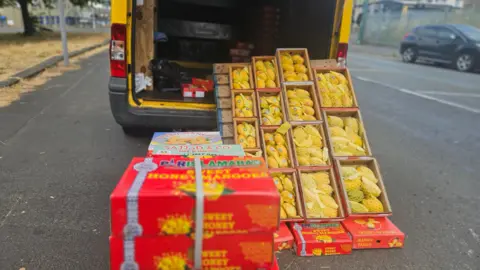
Along Bradford's roads, vans stacked with boxes of mangoes (and occasionally other fruits) have become a feature of the summer.
Customers and mango fans were easy for the BBC to find; persuading a seller to speak was harder, perhaps because questions have been raised in recent weeks about the authorisation of such fruit vans.
After several attempts, seller Jagseer agreed to talk off camera, with only his van photographed.
 Aisha Iqbal/BBC
He says he has sold fruit for two years and thousands of mangoes during the season. On busy days, he believes that between 100 and 200 customers stop and buy.
The reason for the demand is simple: "Wherever you are from, you like mangoes. Everyone likes them."
Bradford Council says it has not identified persistent problems with roadside fruit trading, and previous complaints have not revealed breaches of highway legislation.
It says it can act where there is evidence of an obstruction, safety risk or traffic offence.
The economics of the situation are quite simple for Satvir too.
"I don't think supermarkets and roadside sellers are necessarily competing directly.
"Many customers will use both. They're different parts of the same seasonal mango economy, serving slightly different customer needs."
The vans can concentrate on a few premium varieties and generate excitement around fresh arrivals, she says, while supermarkets offer a broader shopping experience.
"Mango season demonstrates how cultural traditions shape consumer behaviour, support local businesses and create economic activity across an entire supply chain," Satvir adds.
"It's not just about fruit. It's a visible example of how South Asian communities have helped shape Yorkshire's food culture and local economy."
Listen to highlights from West Yorkshire on BBC Sounds, catch up with the latest episode of Look North.
