'We uncovered town's hidden history one letter at a time'

 George King/BBC
History may be about the past, but it is ever present in our day-to-day lives.
From fading, abandoned factory signs to a rusty, old car destined for the scrapyard, it takes many forms, with each piece acting as a portal to a bygone era.
But in a digital age hellbent on us doomscrolling ourselves into oblivion, how often do we actually take time to pause, notice and consider the hidden history that sits idle all around us?
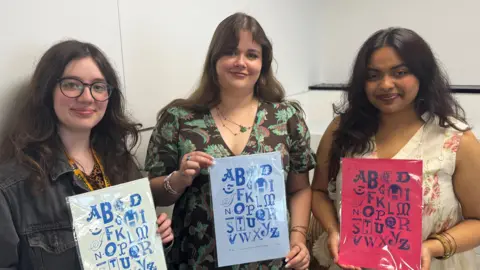
Well, with their latest project, students at the University of Suffolk, with the help of professional graphic designers from the Local Type, are attempting to change that by reconnecting us with what came before.
Through the power and uniqueness of typography, they have explored and researched different parts of Ipswich's past – some forgotten and others completely unknown.
 Supplied
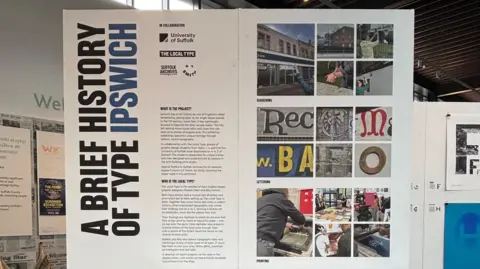
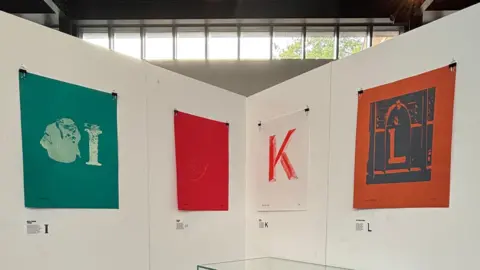
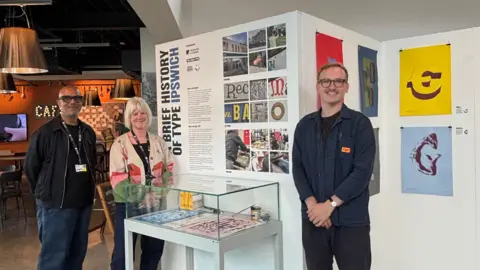
The result is a 26-piece alphabet exhibition, entitled A Brief History of Type: Ipswich, which is on display at the Hold, home to Suffolk Archives.
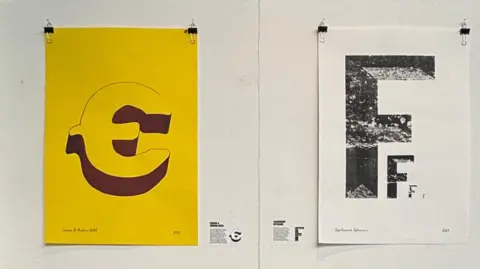
Each screen-printed poster focuses on a different letter found around the town – be it on a door frame, from a business' logo, or chiselled into an archived artefact.
They are accompanied with information about the history behind the origin of the letter and its typography, which is the look and feel of a written word.
 Supplied
 George King/BBC
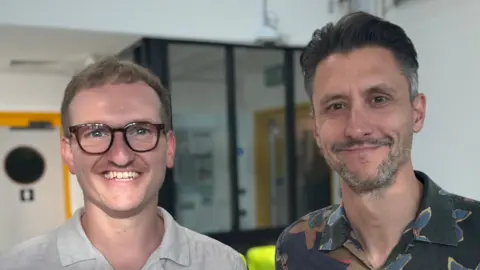
Robbie Steer, 46, co-founder of the Local Type, said: "We look into the history behind some of those letters and then tell those stories that have been forgotten.
"At school, history can be slightly scary, but this is a really nice, easy way into history, and these are really important and beautiful stories in the history of Ipswich.
"It's a really nice, accessible way of connecting to a place where you live or things you've walked past and maybe looked at but never really thought about."
‘Looking around the corners of corners’
Billy Fenton, 30, also from the Local Type, said the project was a "really interesting" way of taking a "glimpse into the past".
“We try to reconnect people with a forgotten history and things that people don't sort of appreciate but are interacted with all the time, bringing that forward into the 21st century by combining it with contemporary design and print," he said.
"In the digital age, where everything's on screens and phones, being able to do things physically helps really connect us with the place that we're highlighting.
"We've got a phrase called looking around the corners of corners, so the more you look, the more you find. And once you start looking, you can't really stop. It’s limitless.”
 Supplied
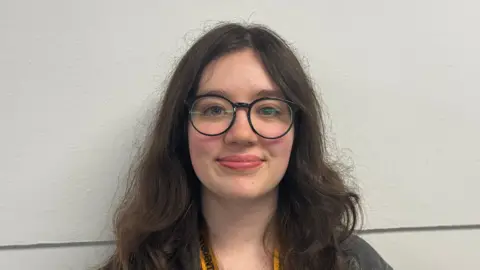
One of the students who took part in the project was 20-year-old Alice Lawes, whose team was assigned the letters R S and T, which they found on Fore Street.
"We got the R from the old record store, S from the swimming baths, and then the T from the old street sign that's on the Spread Eagle pub," she said.
"I've always lived in Ipswich but there are subtle things that I have just never noticed and have missed – so I thought the experience was very, very rewarding."
 George King/BBC
Unlike Alice, Hannah Halls, 20, is not from the town, so found it particularly insightful and exciting to explore and "learn about the area a bit more".
"I ended up in areas I'd never been before and saw buildings I've walked straight past, so learning about the history of them was really interesting," she said.
"One that I remember the most is U being from the Unicorn Brewery.
"I found out that it's actually, despite looking quite modern, got quite a detailed history of being an inn before."
 George King/BBC
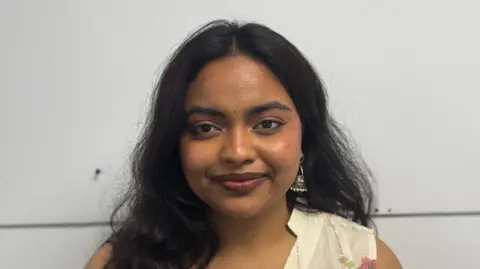
One of the letters 21-year-old Devanshi Kashyap was tasked with finding and researching was Y, which she found on a sign for the Cock and Pye pub.
"Once we delved into the history, we found out that at the height of its popularity in the 18th century it was a cock fighting area before it was banned in 1835," she said.
"And the lettering is from a Mexican illustrator who famously included skulls inside his illustrations.
"So, once we found this information out, we redrew the Y and included a little skull, so I think that was quite an interesting little twist that we added."
 Supplied
 George King/BBC
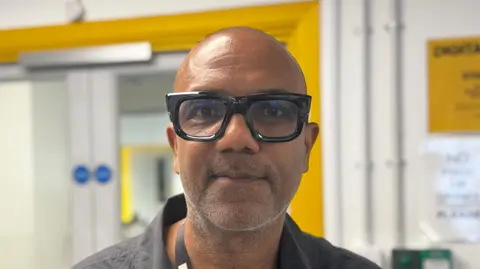
Once the students had identified the different letters and typographies they wanted to find out more about, they took photos of them back to the university's digital studio.
These were transformed into engaging and colourful designs of the entire alphabet before being screen printed with the help of graphic design, graphic illustration and fine art lecturer, Srin Surti.
"Some students came back with image-based stuff relating to type and others came back with something that was very subtle and hardly there," he said.
"It speaks about the visibility and invisibility of history and how it is embedded in our traces in the built environment.
"It was about getting them to think about how they could retain that richness of the image but add that communicative potential of type with it.
"I think it's got a lot of visual impact - the relationship between the colour, the design, and the history of the location is really interesting."
 George King/BBC
Some of the other parts of typography the students gathered came from logos or signs belonging to the likes of Ipswich Town and the Bartrums freight company.
Like all typefaces, at the time of conception these would have been chosen with a specific aim or a message they wished to convey in mind.
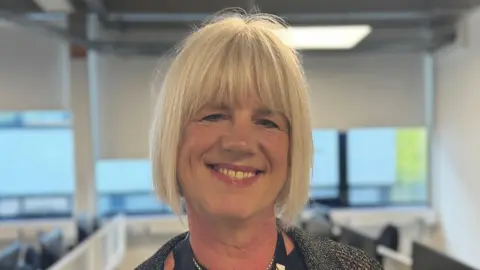
"There are different reasons why we use typefaces in different environments and there's a conscious decision when you choose a typeface," said graphic design lecturer, Jane Hackett.
"For example, if you're talking to children, you'll be choosing a typeface for it to be friendly, approachable.
"Generally, as a rule, you are conditioned through your learned behaviour where you see these type faces [to think a certain way].
"Sometimes we teach the students those principles, but also we look to see how we can disrupt that as well."
Do you have a story suggestion for Suffolk? Contact us below.
Follow Suffolk news on BBC Sounds, Facebook, Instagram and X.
