The 1980s festival which aimed to reverse a city's decline

 Potteries Museum and Art Gallery
Stoke-on-Trent looked lost. By the middle of the 1980s, after nearly two decades of industrial decline, the city was searching for a new identity.
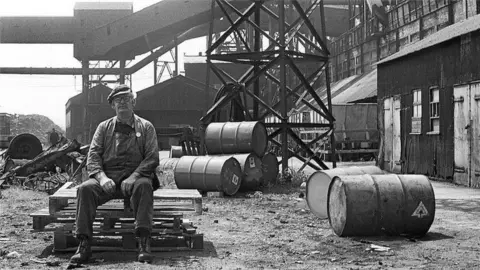
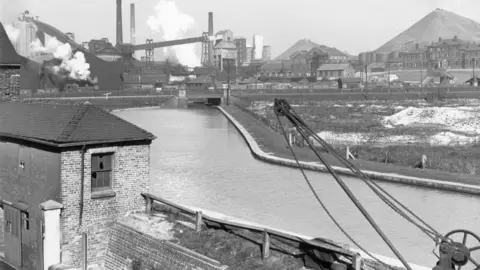
The ceramics industry, which gave the area the Potteries nickname, was soldiering on but, since the 1960s, more than dozen mines in and around the city had closed and, in 1978, the Shelton Bar steelworks shut their main blast furnaces.
The area was not the only place in Britain struggling with the decline and in 1986, Stoke-on-Trent followed Liverpool's lead two years before and hosted a National Garden Festival.
It was an event, the scale of which had never been seen before or since in the city and 40 years ago, on 1 May 1986, the late Queen Elizabeth II cut the ribbon to officially open the event.
"I just remember going to it with the family and spending a lovely day out," said Stoke-on-Trent resident Christine Sherwin.
"There was so much to do – it's a shame we don't have more things like that now, really, in the area."
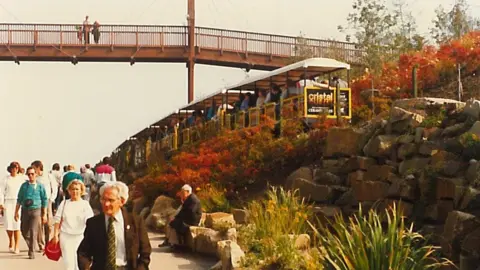
Situated in Etruria, attractions for visitors to explore included 70 themed gardens, a cable car system and monorail plus an on-site cinema.
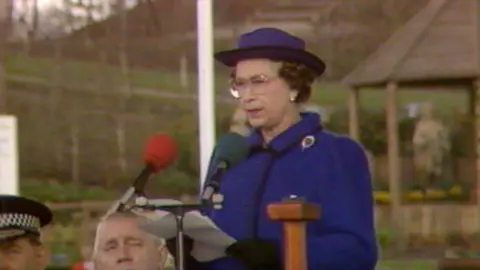
"The festival is intended to give pleasure to millions in 1986, then in turn, lasting benefit to the community," said the festival's managing director David Hancock, in his foreword in the official brochure.
He described it as "the most spectacular leisure event of the year", to provide a boost to north Staffordshire's tourism.
The festival used 180 acres (73 hectares) of reclaimed industrial land which had been used by the steel works, near the city centre.
The event ran until 26 October, the second in a series of biennial garden festival events held around the country with the explicit aim of regenerating derelict industrial sites using horticulture and tourism.
Stoke-on-Trent's followed Liverpool's of 1984, which had been championed by the then-Environment Secretary Michael Heseltine, inspired by similar events in Germany.
 Janine Wiedel
Stoke-on-Trent's garden festival attracted more than two million visitors, to the chagrin of some, as the event two years earlier was estimated to have attracted more than three million people.
Vivien Lovell was responsible for curating the collection of sculptures for the event, with more than 100 dotted around the site.
"It was a very ambitious programme," she said, adding that one benefit was that it let young artists - including college students - experiment.
"It was really giving very young artists their first opportunity," Lovell said.
"They weren't always successful, they didn't have to be, but it was a way of testing out ideas in public.
"Watching the public interact with the works was an absolutely brilliant experience."
 Potteries Museum and Art Gallery
Perhaps a sign of the times, the festival's official brochure included advertisements for cigarette brands alongside those for a number of pottery firms, as well as local tourist attractions.
Keith Greatbatch worked for a builder's merchants at the time and got a half-price season ticket, meaning he visited on a regular basis.
"There was something different all the time, the gardens and the entertainment that was on," he said.
"Me and my wife met up there after work at least once a week; if there was something special on, we'd go more often."
 Staffordshire Record Office
The event was extensively featured across the BBC at the time too, with BBC Midlands Today and Radio Stoke reporting regularly from the festival throughout the summer.
The BBC's Pebble Mill programme also had a dedicated studio at the site, near the Trent and Mersey Canal which ran along the perimeter.
The garden festival even featured on Saturday Superstore, with Keith Chegwin broadcasting from the site two weeks before it opened.
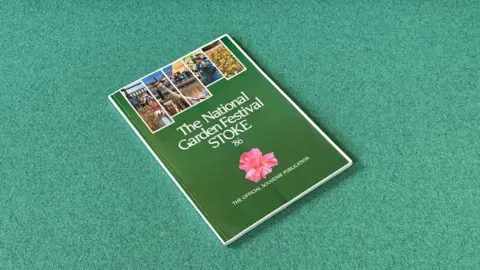
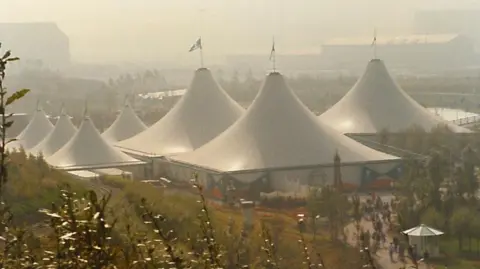
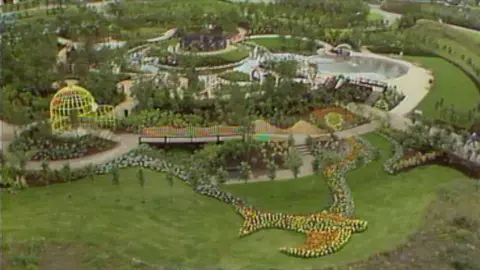
The event was split into five sections – the lakes area, the historic gardens, a gardeners' market, the labyrinth and the woodland ridge.
People were able to travel around by monorail and could view it from above by boarding cable cars specifically installed for the event.
The initial budget was £5.3m but organisers appealed to the government for more and were awarded a further £3.3m.
That figure was later negotiated up to a total of £12.5m, about two-fifths of which came from central government with the remaining 60% split between Stoke-on-Trent city Council and Staffordshire County Council.
By comparison, Liverpool's event cost £13m while similar festivals in Germany were said to have cost between £50m-£60m.
In the years that followed, the area would go on to become home to a retail and business park, along with a dry ski slope and water park.
But did the festival achieve or come close to achieving what those behind it hoped, to reverse a city's decline? What was its legacy?
I will be examining those questions and other issues around the event all next week on the BBC website, after Bank Holiday Monday.
Follow BBC Stoke & Staffordshire on BBC Sounds, Facebook, X and Instagram.
