'It's impacted every job I've had': Women share endometriosis experiences

 BBC
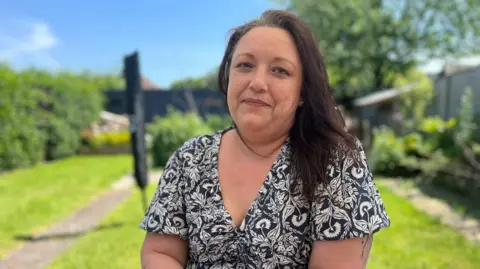
BBC"It has impacted every job that I've had, it has impacted motherhood," says Samantha Hartin as she speaks about endometriosis.
"It has taken up a good half of my life."
Endometriosis - which affects one in 10 women in the UK - is when tissue similar to the lining of the womb grows outside of it.
The condition, which was recently the focus of a documentary by BBC Radio 4 Today programme presenter Emma Barnett, can cause "severe and debilitating symptoms" such as pelvic pain, heavy periods, fatigue and infertility.
According to Endometriosis UK, it takes an average of nine years and four months for a diagnosis - and one in six women with the condition have to leave the workplace.
The All Party Parliamentary Group (APPG) on Endometriosis launched an inquiry to hear first-hand how the condition affects women at work in March.
Endometriosis UK is conducting two surveys - one for women and one for employers - as part of the inquiry and the APPG held its first evidence session on 11 June.
Samantha, from Mansfield in Nottinghamshire, is one of a number of women who have shared their experiences with the inquiry and is encouraging others to do the same.
'Simple measures'
Samantha's symptoms started as a teenager, but she says it took her "frequently collapsing" at home 30 years later to get a diagnosis.
A few months off completing her nursing course, Samantha was fainting and "losing large amounts of blood" during her shifts.
She says she ultimately failed the course in 2011 after she was unable to complete her placement due to her endometriosis.
Her mental health plummeted, Samantha adds, and she was diagnosed with depression.
Later, in 2021, she started working at a supermarket and told her employer in advance about her endometriosis.
But when Samantha started the role, she says she was not allowed to sit down during her shifts or take extra toilet breaks when she bled through her workwear.
When she had a surgery planned for her endometriosis - which would involve six weeks of recovery - Samantha says she was questioned on whether the procedure was necessary.
She handed in her notice the day before the operation, which went ahead as planned.
The 45-year-old mother-of-three no longer works and says she would "probably need four or five days off work every month".
"I can't trust that going into the workplace that I would have the support I would need," she adds.
"The simple measures they could put in place are so small and could make a massive difference."
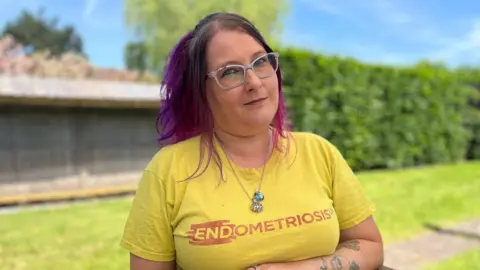
It took Jenni Johnson to black out at work before she decided enough was enough and asked to be moved into an office-based role or reduce her hours.
The 38-year-old, from Sutton-in-Ashfield in Nottinghamshire, had been working as a carer at a mental health facility and says she was eventually let go from her role as an alternative could not be found.
Jenni waited 10 years for a diagnosis - in line with the national average.
A decade later in 2020, she says she underwent a laparoscopy to laser away the endometriosis - but her symptoms only worsened.
"I was starting to lose my mobility and blacking out at work," Jenni adds.
"I bled constantly for two years and I could be in the bathroom for 48 hours at a time. I was scared of losing my job.
"When I had a scan, I had to prove it and they even rang the unit at the hospital to make sure I attended. I felt like a liar."
Jenni was told she would never have children and a year after she left work, she had a total hysterectomy aged 33.
She still experiences severe pain and has not been able to return to work, and now volunteers with Endometriosis UK and runs a Nottingham support group.
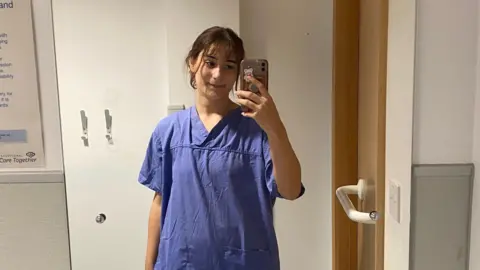 Hollie Langley
Hollie Langley, from Nottingham, is a teacher and due to start work at a new school in September.
The 23-year-old was hospitalised five times with what doctors said was irritable bowel syndrome and ulcers, before she was diagnosed with endometriosis.
She had surgery but it was not successful and the endometriosis has continued to grow, now on her pelvis as well as her bladder, bowel and sciatic nerve.
Hollie was then put into early menopause due to the severity of her symptoms.
She says: "It's quite a vulnerable thing to say at work and as a classroom teacher if I need the toilet, it's an emergency.
"There have been times where I've nearly been in tears in front of a classroom full of kids because of the pain.
"Some days I literally can't move and at least one week of the month I am pretty much incapacitated."
Hollie, who is under the care of eight different NHS services, has since had a further operation.
She hopes to be taken off the menopause medication if the surgery proves successful.
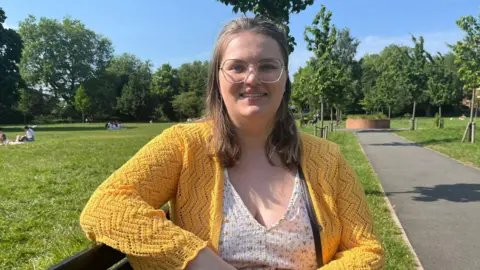
The experiences of Samantha, Jenni and many others are a concern for Laura Beckett, who is a few months off finishing her PhD in astropharmacy at the University of Nottingham.
The 27-year-old started fighting for answers when she was 16.
She says that, when she was 21, she was advised by a doctor to have a baby to "cure" her.
Laura was eventually diagnosed with endometriosis in 2023 after moving to Australia for a year abroad.
"It's been difficult," she says. "I've been lucky that a lot of my work has been fairly flexible but working in the lab and being on my feet all day is extremely difficult.
"I do worry that when it comes to finding a job that the flexibility will be far more difficult to find.
"I'm not sure what I will be able to do next with my pain only getting worse, not better. You do feel inadequate, you feel less than everyone else."
'Practical recommendations'
Steve Yemm, the Labour MP for Mansfield, sits on the APPG on Endometriosis.
He says: "We're trying to work out what is the real impact on women's working lives because we want to understand what we should be doing more.
"I don't think these views have been heard enough."
The inquiry concludes in September and the evidence will be presented in a report later in the year.
"The report will conclude practical recommendations that improve workplace understanding and support, so that women aren't held back or forced out of work because of endometriosis," Yemm adds.
He told the BBC that Labour MP Kirsteen Sullivan, chair of the APPG, has "secured guarantees from government ministers that the recommendations will be considered".
The call for evidence closes on 24 July.
- If you have been affected by any of the issues in this story, you can find information and support via BBC Action Line
Listen to BBC Radio Nottingham on Sounds and follow BBC Nottingham on Facebook, on X, or on Instagram. Send your story ideas to eastmidsnews@bbc.co.uk or via WhatsApp on 0808 100 2210.
