Bristol could move to single A&E, NHS boss says

 BBC
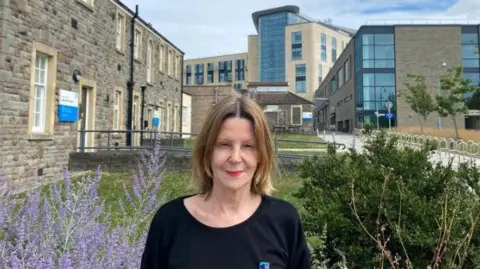
BBCBristol could have a single 24-hour emergency department within the next decade, the head of the city's newly merged hospital trust has said.
Maria Kane said it was "a possibility" that emergency care could be concentrated at Southmead Hospital in the future.
Her comments follow the merger of two major NHS trusts, creating one of the largest organisations in the country with 28,000 staff and a £2.6bn budget.
The newly named Bristol NHS Foundation Trust (BFT) also becomes the UK's biggest recipient of National Institute for Health and Care Research funding, with almost £3m.
Currently, the trust has three 24-hour emergency departments at Southmead Hospital, the Bristol Royal Infirmary (BRI) and Bristol Children's Hospital. There is also an A&E at Weston General Hospital, which closes overnight, and an emergency department at Bristol Eye Hospital. There is also a paediatric emergency department at the Bristol Royal Hospital for Children.
However, that model could change over the next decade.
"It's a possibility," said Maria Kane, when asked whether the city could end up with a single 24/7 emergency department.
"And certainly if we look across other countries, other parts of the UK, that has... worked."
She stressed no decisions had been made, patient safety would come first and any decision would be clinically led.
"We would want to really check out the sustainability of that… we absolutely need to make sure that we work with ambulance colleagues… and first and foremost, to make sure there is enough service outside the hospital in urgent care."
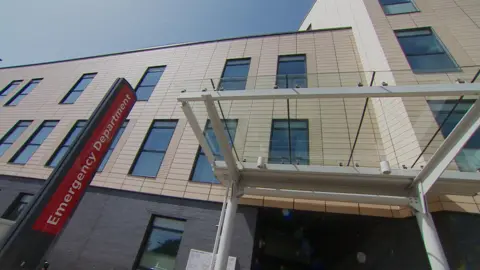
Asked whether this could mean consolidating services onto a single site, Kane said it was under consideration but not a foregone conclusion.
"If we are putting more services outside the hospital… is the footprint that we have today the same footprint we will need in the future?"
Transport and access will be key factors.
"There are limitations on some areas for transportation… we are working with local authority colleagues."
The merger formalises years of collaboration between the two organisations and aims to cut 44 duplicated services.
One example of a single service already up and running is the mental health liaison team, to help deal with a large increase in people in crisis turning up at the emergency department.
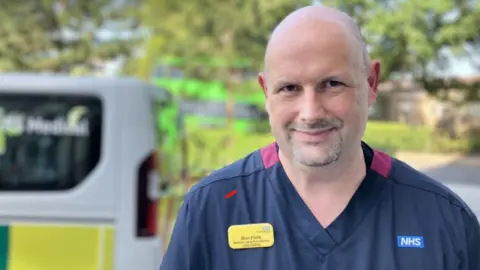
Lead nurse Ben Ford said: "They would be seen by someone from my team, they would have a psycho-social assessment.
"More importantly, as we merge, they can access some of the other services we have got.
"We have got cognitive behavioural therapy (CBT) services in the BRI... we have also got the ability to refer on to Avon and Wiltshire Mental Health Partnership Trust," he added.
Kane said aligning the trusts would benefit staff through shared contracts and more flexible working.
"It means for our 28,000 staff… we will be making sure there is fair pay, parity, far more opportunity to work right across our range of vacancies… we now allow people to just passport between all parts of the trust, so we're saving actually quite a lot of training hours and therefore, that's a great productivity saving for us."
'Postcode lottery'
A long-term goal is to create centres of excellence and reduce variation in care.
"There was a concern… about a postcode lottery, real difference in access times, [and] in outcomes… I'm really pleased to say we've done some fantastic work… levelling up and getting much better services for patients across Bristol, North Somerset and South Gloucestershire," Kane said.
Emergency care is part of a wider review of where services should be based.
"There's lots of things to take into consideration… we are looking at patient pathways, travel distances, modes of transport, what people need."
£37m savings
A key part of the 10-year plan is moving care out of hospitals, funded by savings from reduced duplication.
"We have a very big savings target over five years, £37m, which we are hoping to be able to save and reinvest in services outside the hospital to help deliver the 10-year NHS plan… about prevention, about care outside hospital, and about better digital delivery of services."
The funding will support neighbourhood health and primary care.
"They'll be reinvested outside the hospital. That is our intention. Into things like neighbourhood health, so supporting our primary care partners."
Pilot schemes are already testing new approaches for people with long-term conditions or frequent hospital admissions.
New technology is expected to play a growing role, including tele-dermatology.
"There's been a huge rise in skin cancer referrals… through doing this, we've been able to reduce in hospital referrals by 40%."
Outpatient care is also set to change significantly, with the proportion delivered outside hospital rising from around 5% to 70% by 2035.
Early pilots have already reduced missed appointments and saved money.
"We've reduced our 'did not attends' by 21%… we've saved £1.4m in postage alone," Kane added.
Research ambition
The merged trust is also positioning itself as a national leader in research.
"We are very proud of being the highest recipient of National Institute of Healthcare Research… we have just had as a combined organisation £3m of investment which is the highest in the country."
Kane said research would not just benefit doctors, but the wider workforce.
"We are using that not just to enable medical research but research opportunities for nurses, for allied health professionals."
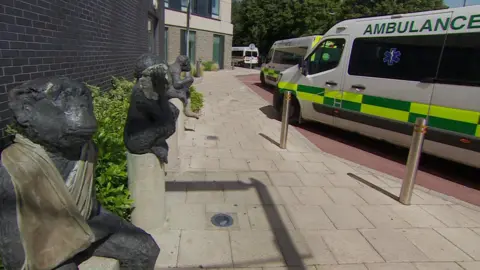
As part of the 10-year strategy, the trust will also review its buildings, including older parts of the BRI.
"Many parts of our estate are very old and some parts are very high functioning and much newer."
Decisions on where services should be located are expected within a year.
"The piece of work around where we think things should be is going to be carried out over the next 12 months."
For now, Kane said the merger was about long-term sustainability.
"If we carry out a 10 year plan… if we are preventing things, if we have better investment in community services… that would mean the need for two or three emergency departments is not the same and we could therefore make that decision safely."
Follow BBC Bristol on Facebook, X and Instagram. Send your story ideas to us on email or via WhatsApp on 0800 313 4630.
