Push for improved action on eating disorder care

 BBC
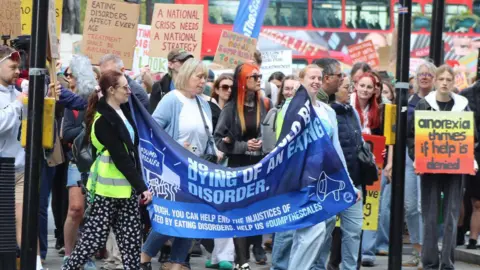
BBCPeople with eating disorders have launched a petition calling for a dedicated strategy, saying the care they received was inadequate and earlier intervention was critical.
The campaign - started by Dump the Scales - wants more investment into early intervention and prevention, along with better training for healthcare staff.
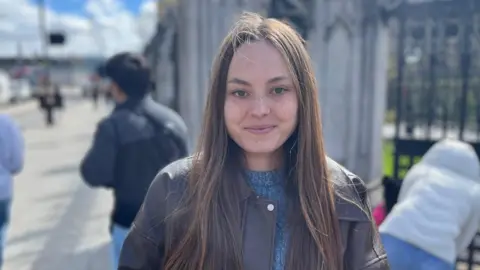
Tiffany, from south London, said she was asked by clinicians who "weren't trained properly for advice on how to lose weight, how to diet," while Gwen said she was asked to buy a set of scales.
National Institute for Health and Care Excellence (NICE) guidelines state clinicians should immediately refer to a community-based and age-appropriate eating disorder service.
According to Beat, at least 1.25 million people in the UK are affected by an eating disorder, though the charity believes the true figure is likely to be higher. Dump the Scales believes it is more like 4 million.
 Karen Forsyth
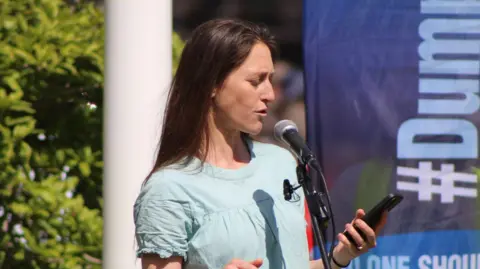
Hope Virgo, who started the petition, said she was turned away from services in 2016 because she was not "underweight enough to access eating disorder support".
"I felt just so frustrated and angry that a system which is a mental health service - but should be understanding of eating disorders - had no real understanding that eating disorders present in all different body sizes.
"I was also frustrated that society, that government, also don't understand eating disorders to that extent."
She added the campaign was looking at prevention and education so that people with eating disorders did not get to the point where intense treatment was needed. It is also calling for guaranteed timely access to specialist treatment, and a closer look at accessibility within services.
"We need to be getting in there much earlier and while there has been some focus on early intervention over the last couple of years, there just has not been enough, particularly in school environments," she added.
 Karen Forsyth
NICE guidelines state patient care should set out clear objectives for hospital admissions, as well as how patients would be safely discharged and supported back into community‑based care.
This guidance applies in England, while health policy is devolved in Wales, Scotland and Northern Ireland however, similar guidance may be adopted or reflected in those nations.
The guidelines also stress weight or BMI (body mass index) should never be used as the sole indicator to decide if the person should get treatment however both Tiffany and Gwen said this was not the case for them.
Tiffany was 17 when she was diagnosed with anorexia and was treated in south London.
Now 23 and living in Southwark, she said nurses were not properly trained in eating disorders.
"I was an inpatient for many years and I was told many comments," she said. "Things like asking for advice on how to lose weight, how to diet and these are from clinicians that are meant to be specialised in eating disorders."
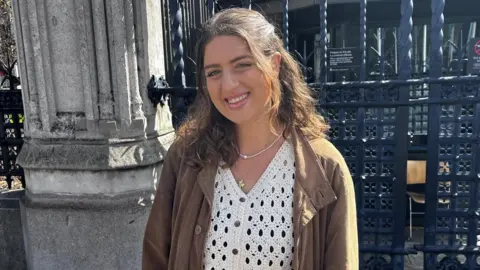
Gwen Kuhlman was 19 when she was diagnosed in central London with atypical anorexia, which is when a patient has all the symptoms of anorexia except being underweight.
"The very first appointment that I had, I was told that I needed to go away and I needed to go buy a set of scales, so that I would then weigh myself and be able to feed that back to them.
"I left immediately knowing that I would not return to that place because that was just so, so triggering for me."
Both Gwen and Tiffany said they felt "skinny culture" and diet culture were being normalised and that weight-loss jabs were having an impact.
 Karen Forsyth
The Department of Health and Social Care said it was working with NHS England to strengthen community-based eating disorder services to improve outcomes and recovery for patients of all ages.
The Central and North West London NHS Foundation Trust said its recruitment and talent pool was growing, along with new primary care services for those with mild to moderate cases.
Gwen and Tiffany are hoping others will not have to go through what they did.
"I needed that help at that early stage," Tiffany said. "If I was given it I could have recovered at a much earlier time point."
She added: "We need to stop waiting until people are pretty much on death's door in order to receive support, it needs to be there from day one."
If you've been affected by anything in this story please visit BBC Action Line.
Listen to the best of BBC Radio London on Sounds and follow BBC London on Facebook, X and Instagram. Send your story ideas to hello.bbclondon@bbc.co.uk
