I will be last man standing, says Raac home owner refusing to sell

 BBC
BBCIt is nearly three years since potentially dangerous concrete was identified in the roofs of hundreds of homes in Aberdeen.
More than 500 properties - most of them council-owned - were found to contain reinforced autoclaved aerated concrete (Raac) back in late 2023.
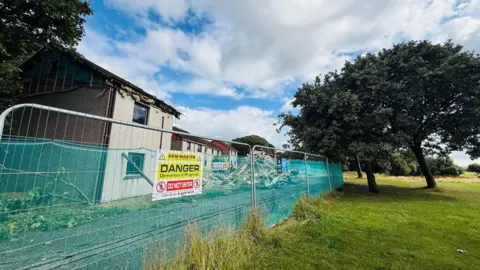
Work to demolish many of the properties started last month, but a handful of owners - who have rejected offers from the city council to buy their home - remain.
Among them is Raymond Smith, 40, who told BBC Scotland News: "This is a family home. I will be the last man standing."
Aberdeen City Council has said it remained in "active dialogue" with homeowners.
A total of 138 private properties and 366 council homes were found to contain Raac.
It was later announced that a plan to demolish and rebuild the properties was expected to cost more than £150m.
Through voluntary acquisition, 128 of the 138 private homes have been purchased by the local authority.
A deadline of 30 August was given for remaining homeowners to accept a council offer.
This led to concerns as some residents were still negotiating the sale of their property with the council, while others were still trying to buy a new home.
The Scottish government and council agreed a funding deal worth £10m to help support residents last year.
 Ian Lippe
Smith has lived in his three-bedroom home for 13 years.
He said the house was bought for £125,000, and that the council offered £112,000.
He claimed that was not enough for the home where he lives with his partner and child.
"I just think the whole situation's a mess, absolutely horrendous," he said.
"All this started three years ago. All they had to do was say we need the land back, give everybody a fair offer from the start, you have six months to move on.
"It wouldn't have been a problem for me."
He said people's lives had been "destroyed", and he was "very, very, very" determined to stay if he could.
"I've ordered my Christmas turkey already," he said.
"I like it here. I wouldn't have bought a house I'm not happy with. I'll be the last person here, definitely."

Landlord David Porter, 62, owns three affected properties.
He said he had even spent £20,000 to remove the Raac and replace a roof in one of them.
Porter said he had made a "massive commitment" to a long-term tenant.
"There is absolutely no way we'll be selling that one," he said.
He said he had repeatedly contacted the council about a proposed swap deal for the other two properties.
Speaking on the offers in general, he said: "There's no way you could buy another property within the city matching the accommodation of these places for the amount being given."
When asked how he felt the entire situation had been handled, he said: "One word - atrocious."
Aberdeen City Council said it was dealing directly with homeowners and that it was important their personal circumstances were handled with sensitivity.
"Only a small number of private homeowners remain involved," a statement said.
The council said while a deadline had been agreed by council, there was "discretion where owners are positively engaging".
The council statement added: "We do not intend to provide details of individual cases, ongoing discussions, and next steps, as it would not be appropriate to disclose these in a public forum.
"The council remains in active dialogue with homeowners and continues to look to engage with those who have not previously engaged or for whom contact has been limited.
"Anyone who wishes to discuss their circumstances, the terms of an offer, or the options available to them should contact the council directly via the dedicated Raac email at raac@aberdeencity.gov.uk."
What is Raac?
Raac stands for reinforced autoclaved aerated concrete.
It is a lightweight material that was used mostly in flat roofing, but also in floors and walls, between the 1950s and 1990s.
It is a cheaper alternative to standard concrete, is quicker to produce and easier to install.
It is aerated - or "bubbly" - like an Aero chocolate bar.
But it is less durable than other types of concrete and has a lifespan of about 30 years.
Its structural behaviour differs significantly from traditional reinforced concrete.
It is susceptible to structural failure when exposed to moisture as the bubbles can allow water to enter the material.
Raac is often coated with another material, such as bitumen on roofing panels. But this material can also degrade.
The Health and Safety Executive (HSE) said Raac was now beyond its lifespan and could "collapse with little or no notice".
