Facial recognition to be trialled at Tube stations

 Getty Images
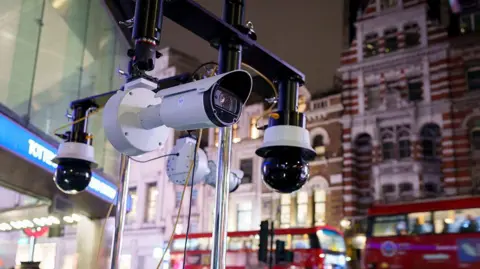
Live facial recognition (LFR) cameras are to be deployed at some of London's Tube stations from Tuesday.
Transport for London (TfL) said the technology would identify people on a police watchlist to help catch "high harm" offenders, such as those wanted for sexual offences, robbery and knife crime.
TfL said British Transport Police (BTP) will trial LFR at key stations for maximum impact based on intelligence and analysis of crime data. Images of people who are not a match to the watchlist will be "automatically and immediately deleted".
Big Brother Watch questioned the effectiveness of LFR and said its use was "dystopian" and that it "treats the public like suspects".
The first deployment on the Tube will be at Victoria station on Tuesday.
It marks an expansion of the BTP's LFR trial at major London railway stations which began in February.
Between February and July, the BTP deployed the technology 18 times across major London train stations, scanning more than 530,000 faces, according to the force's deployment logs.
Results show the operations resulted in zero true matches and no arrests, with the system triggering a single false identification.
The trial in Tube stations will take place in signed areas, allowing people to make "informed choices about passing through", TfL said.
There will be "alternative routes available", BTP added.
Siwan Hayward, director of security, policing and enforcement at TfL, said: "Everyone should be able to travel without fear of harassment, intimidation or violence.
"Tackling violence against women and girls and preventing sexual offending on our network remains a key priority.
"Live facial recognition has the potential to be a powerful additional tool in helping police quickly identify those wanted for high-harm offences, including sexual offences, and supports early intervention and helps stop incidents before they happen."
'Disturbing and dystopian'
Hayward described the trial as "an important step" in understanding how the technology can be used on the London Underground network "in a targeted, proportionate way with strict safeguards in place".
Silkie Carlo, the director of Big Brother Watch, said: "This is a disturbing and dystopian expansion of live facial recognition that will capture millions of innocent people's faces.
"Far from reserving this for exceptional cases, British police are now using live facial recognition routinely in the sort of pervasive way you might expect in China but not in a democracy."
Ch Supt Chris Casey, BTP's senior officer responsible for the project, said: "This marks an important new stage in our trial of LFR technology.
"Expanding deployments into London Underground stations will help us assess the technology in a different transport environment while continuing to refine how it is used across the railway network."
He said the deployments are "intelligence-led" and focused on people wanted the by police and courts, including those breaching bail conditions.
The Metropolitan Police trialled LFR in August 2016 at the Notting Hill Carnival, and first officially deployed the technology in 2020.
Listen to the best of BBC Radio London on Sounds and follow BBC London on Facebook, X and Instagram. Send your story ideas to hello.bbclondon@bbc.co.uk
