'Relief' as mother and baby homes redress scheme extended

 BBC
BBCThe Northern Ireland Assembly has backed a change to a "cut-off date" for compensation for relatives of people who were in mother-and-baby institutions.
Previously, only families of victims who died after 29 September 2011 would have been eligible for redress payments under the proposed legislation - a plan which campaigners described as "insulting".
On Monday, Assembly members supported an amendment to widen the scheme to relatives whose family members died after 28 April 1953.
Mark McCollum, who was born in the Marianvale institution in Newry, said he was "relieved" that eligibility for the scheme was extended.
He never met his birth mother, Kathleen McGuire, who died in 2000 at the age of 54.
The secretive institutions for unmarried women and girls, and their children, operated in Northern Ireland for around seventy years.
McCollum said the legislation is about recognition that what happened to the women affected as well as their children and their families was "wrong then and wrong now".
"I was taken over the border and placed in an institution in Donegal when you weren't allowed to take butter over the border. But they were taking babies over the border."
"There are so many people who died prematurely," he added.
"The recognition shouldn't depend on how long someone lived.
"The whole point of this process was to have as few people left behind as possible."
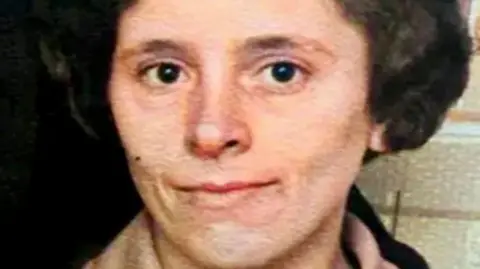 Family handout
He watched from the public gallery as the chair of the Executive Office Committee, Alliance MLA Paula Bradshaw, read an email in which he told his birth mother's story.
"I would have loved to have known what she would have thought about it," McCollum said.
He described the change of the cut-off date for posthumous applications to 1953 as a "compromise", as he had hoped for the redress scheme to be open to the relatives of any victims since the founding of Northern Ireland in 1922.
Bradshaw proposed the amendment on behalf of the committee, which scrutinises the work of the Stormont department headed by the first and deputy first ministers.
She told the Assembly: "1953 marks a significant improvement on 2011, which was a completely arbitrary date and a slap in the face for so many families."
She said the Committee chose the date of 1953 because it matched the posthumous eligibility cut-off date used in the redress scheme which was set up following the inquiry into child abuse in residential institutions in Northern Ireland, which published its report in 2017.
'Survivors left out'
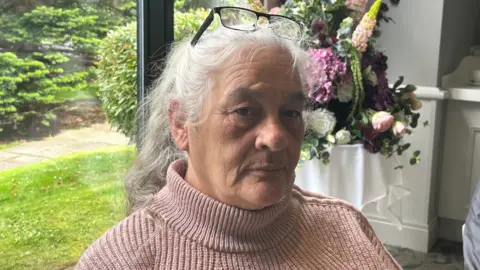
The Democratic Unionist Party's (DUP) junior minister in the Executive Office, Joanne Bunting, said the change would increase costs by an estimated £22m in redress payments and a further £8m for support services and information retrieval.
The bill which is going through the Assembly will establish an inquiry into mother-and-baby homes, Magdalene Laundries and workhouses, and an associated redress scheme.
More than 10,000 pregnant women and girls passed through the institutions which were largely run by religious orders from 1920s until the 1990s.
Marie Arbuckle was also at Stormont for the debate, at the part of the legislative process known as the further consideration stage.
She grew up in Northern Ireland, but was sent to a mother-and-baby institution in Dublin when she was 17.
She said she was disappointed that the Assembly did not pass amendments proposed by the People Before Profit MLA Gerry Carroll to extend the redress scheme to mothers and children who were in workhouses.
"A group of survivors has been left out, and these are the oldest survivors we have," she said.
"One of them died giving testimony.
"I don't understand why survivors have to fight."
The legislation will be debated in the Assembly one more time, in its final stage.
