Warnings as 'Europe's very hot air pushes our way'
Temperatures could soar to 35C (95F) in coming days as "very hot air from Europe pushes our way", an expert has said.
BBC weather presenter Sara Thornton said the mercury could hit 32C (89.6F) on Monday, before staying in the high 20s or low 30s throughout the week.
She added that the area was likely to be officially in a heatwave by Wednesday, and that it could last until the end of June, with temperatures potentially peaking at 35C (95F).
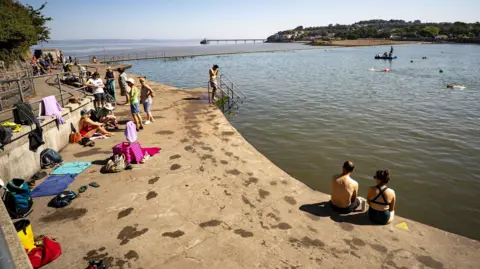
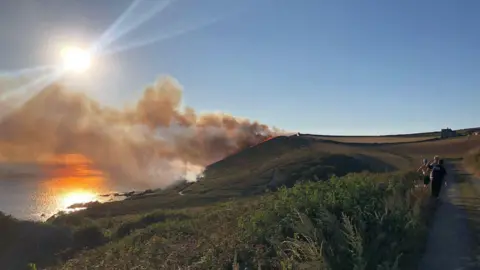
Warnings have been issued about a risk of fires and the dangers of open water swimming. The UK Health Security Agency (UKHSA) has also issued an amber heat-health alert for the south-west of England from 12:00 BST on Thursday until 20:00 on Tuesday.

 PA Media
Amber warnings are issued when high temperatures are likely to have a significant impact on health and social care services.
The warnings suggest there is likely to be an increase in deaths, especially among those aged over 65 or with long-term health conditions.
How long will the heat last?
This heatwave is likely to be a long one, with overnight temperatures also staying in the high teens, giving little chance for relief, Thornton added.
She said: "The early signs are that the last weekend of June could be even hotter, with some forecast models showing temperatures of 35C (95F) as very hot air from Europe continues to push our way."
Scientists have little doubt that the increase in summer heatwaves is human-caused climate change - largely the result of the burning of fossil fuels.
What are the dangers?
A variety of advice has been issued by fire services, water companies and local councils about ways to stay safe.
While big lakes and open bodies of water may look appealing, they can be very dangerous.
"Our reservoirs are operational sites, and even the strongest swimmers can get into serious difficulty.
"Beneath the surface there are concrete structures and hidden machinery that can cause injury and create unpredictable currents," Bristol Water said.
A Dorset and Wiltshire Fire and Rescue spokesperson also issued a warning about swimming.
"Cold water hits hard. Even strong swimmers can panic and lose control. Inflatables are not safe in open water," the spokesperson said.
Jane Shute, from Age UK Gloucestershire, warned that older people were especially at risk in the heat.
"Keep your blinds down and windows closed, any medication can be put in the fridge and drink plenty of fluids," she said.
SARA, a volunteer-run search and rescue charity, urged people to be careful swimming in cold water.
Richard Newhouse, from the charity, said understanding the hazards of open water was really important.
"Cold water shock kills people every time there is a heatwave, usually strong fit people, so please be especially careful not to jump into cold water on a hot day. Please don't let it be you," he added.
 Devon and Somerset Fire and Rescue Service
Risks of fire
Last year, several fires were caused by barbecues being lit on dry ground, including on a section of the Quantock Hills in Somerset.
Donna Potts, deputy head of prevention at Gloucestershire Fire and Rescue Service, said: "Always place your barbecue on level ground, well away from fences, sheds and hedges, and never leave it unattended.
"Keep children and pets away, avoid using petrol or other accelerants, and make sure it's fully cooled before disposing of coals or ashes."
Isn't this just summer?
The Met Office's State of the Climate 2024 report shows that in parts of the UK the hottest days are warming around twice as fast as typical days.
Compared with 1961 to 1990, the number of days 5C above average has doubled, while days 10C above average have quadrupled.
The higher starting temperatures mean that we're reaching heatwaves sooner.
'Simple steps'
Wiltshire Council councillor Clare Cape, cabinet member for public health, said simple steps can help people stay safe in the hot weather.
"Staying hydrated, keeping out of the sun during the hottest part of the day, closing curtains or blinds on windows that face the sun, and opening windows later in the evening when temperatures drop can help keep homes cooler," she said.
Cape urged people to check in on vulnerable friends, family or neighbours who may need extra support.
"Our outreach teams are also stepping up support for people sleeping rough during the hot weather.
"They will be carrying out enhanced outreach, consisting of welfare checks, offering water and sharing advice on staying cool, including identifying shaded areas and places to rest.
"We will continue to monitor the situation closely and share further updates and advice if needed," she added.
Follow BBC West social channels in Bristol, Gloucestershire, Somerset and Wiltshire. Send your story ideas to us on email or via WhatsApp on 0800 313 4630.
