Rare fungus discovered on tree at reservoir

 Leicestershire and Rutland Wildlife Trust
A rare fungus included in a list of the world's most threatened species has been discovered at a reservoir.
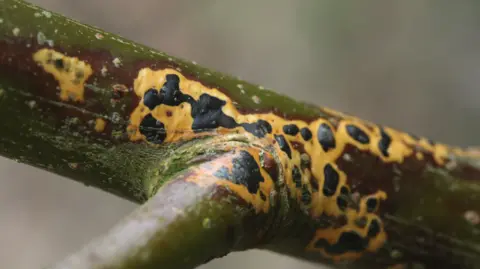
The willow blister fungus, also known as Cryptomyces maximus, was found on a coppiced willow tree at Rutland Water during a bat box survey by an officer from Leicestershire and Rutland Wildlife Trust.
It was only the second recording in England since 1876 of the spotty fungus, which was previously known from just a handful of sites in Pembrokeshire, Wales.
A sample was taken to the trust's volunteer training centre for formal identification, which was confirmed by a mycologist from London's Kew Gardens.
 Leicestershire and Rutland Wildlife Trust
The fungus appears in the World's 100 Most Threatened Species, a list published in 2012 as a result of a collaboration of more than 8,000 scientists from the International Union for Conservation of Nature Species Survival Commission and Zoological society of London.
The trust said the fungi's presence at Rutland Water "strengthens the case" for protected nature reserves.
A spokesperson said: "The Nature Reserve at Rutland Water is a Site of Special Scientific Interest, a Special Protection Area, and a Ramsar Wetland of International Importance, and demonstrates how conservation sites can play a crucial role in safeguarding biodiversity.
"This discovery underscores the need for increased funding to support and expand protected areas, ensuring that endangered species have a fighting chance for survival.
"We can tip the scales back into nature's favour, but we need the support and funding to do so."
Follow BBC Leicester on Facebook, on X, or on Instagram. Send your story ideas to eastmidsnews@bbc.co.uk or via WhatsApp on 0808 100 2210.
