'We were all just in awe': A stranding in Ireland sheds new light on the long, slow, ice-cold life of a deep-sea shark

 Lars von Ritter Zahony/ Ocean Image Bank
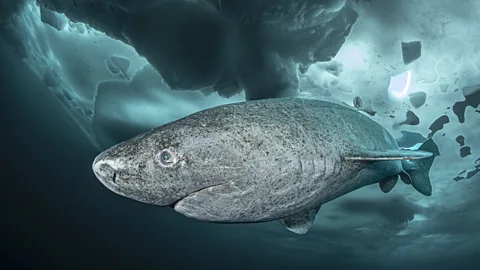
Some Greenland sharks alive today may have been contemporaries of Shakespeare. With a scarred heart that beats for centuries and eyesight that doesn't fade, this deep-sea shark defies age-related decline.
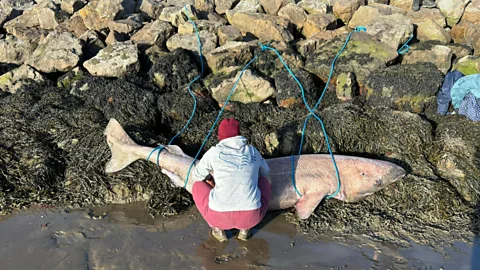
The ocean's dead often wash up on the storm-battered west coast of Ireland. But in April 2026, a group of researchers and volunteers stood on the cloudy shoreline of County Sligo, Ireland, and marvelled at the sight of a species that had never been stranded here before – a dead Greenland shark.
Judging by its size – around 3m (10ft) long – the grey-beige animal lying on the tidal flats was over 150 years old. It would have been born in the age of Queen Victoria and US president Abraham Lincoln, when three-mast sailing ships crossed the seas, and the car hadn't yet been invented.
By Greenland shark standards, that's pretty young.
"It's such a pity. This guy – it took him 150 years to get to the point where he could have reproduced, could have contributed to get the population on track, and may not have had the chance," says Emilie De Loose, a marine biologist at the Irish Whale and Dolphin Group.
The Greenland shark, the longest living vertebrate on the planet, can live for around 400 years. As baby sharks, some of the ones swimming around today may have been contemporaries of Shakespeare – though the exact length of lifespan is still subject to debate, with estimates ranging from roughly 300 to 500 years.
"We were all just in awe," says De Loose. "It's so mind-boggling to think how long that animal lived, and what it might have seen."
While sad for the species – and the shark – the stranding, and the necropsy that followed, were an opportunity to shine some light on a species shrouded in mystery.
A visitor from the deep
"There is something very intimate about working with dead animals, because you really get to know the species," says Jasmine Stavenow Jerremalm, a PhD researcher in marine ecology at University College Cork in Ireland, who took part on the necropsy of the shark. "Dead animals can tell us a lot about the living ones."
The first challenge was getting the shark to a lab. Greenland sharks are among the world's biggest sharks, measuring up to 5m (16ft). This one weighed over 200kg (440lb). The group on the shore covered the body with seaweed, to prevent seagulls and other animals from pecking at it. The next day, in a recovery operation overseen by the National Museum of Ireland, a crane hoisted it onto the back of a lorry and took it to a regional veterinary lab.
 Alamy
AlamyA day later, protected by masks, gloves and overalls, a group of researchers from a range of organisations and institutions, including the museum, started examining the shark in a well-ventilated space.
"When it's an animal that could be a few hundred years old, there could be anything in that animal, so for health and safety, you want to be sure you follow good routines," says Stavenow Jerremalm. "If it's an animal that's lived for that long, bacteria or viruses from very long ago could be within that body", and then suddenly get exposed through the necropsy, she explains. "It's important to be mindful that we don’t know why this animal died, and which potential diseases it could have within it."
When it comes to Greenland sharks, researchers are still trying to answer a vast range of questions – from how these animals manage to live for such an extraordinarily long time, to basic facts around their existence.
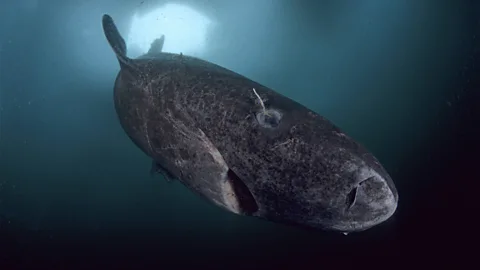
Greenland sharks are slow-swimming, solitary scavengers and predators. They feed on carcasses but are also known to catch prey such as seals, and have even been observed "hoovering" up their prey. Powerful suction allows them to suck prey into their mouths, swallowing it whole.
"Greenland sharks are very slow swimmers so they are mostly thought of as scavengers that feed off carcasses. But sometimes they seem to opportunistically manage to catch live, fast-swimming prey," like seals, says Lily Fogg, a postdoctoral researcher in evolutionary biology at the University of Basel in Switzerland. "Since Arctic waters can be quite dim, it is possible that they can ambush sleeping or resting seals, or maybe pick off seals that are already injured or trapped by ice."
Greenland sharks live in the North Atlantic and Arctic waters around Greenland, Canada and Iceland, and have evolved certain features that help them cope with the cold. High concentrations of chemicals in their bodies act as an anti-freeze, which has the side effect of making their flesh poisonous.
But much about this elusive animal remains unknown.
"For such a large shark with a broad distribution, that is not really a rare species throughout most of its range, it's amazing how little we know about these sharks," says Brynn Devine, a marine biologist and Arctic Fisheries Scientist at Oceans North, a conservation NGO, who was not involved in the necropsy.
"Even basic aspects of their biology and ecology are unknown," she says. "For example, we still do not know where their mating and pupping grounds are, and only one pregnant female has ever been observed so we don't even know for certain how many pups they have per pregnancy or how often they reproduce."
As a result of this uncertainty, scientists aren't able to accurately estimate how many Greenland sharks there are in the world, she says. This makes it harder to assess population health, and their risk from threats like fishing bycatch.
 Ana Sanz/ Irish Whale and Dolphin Group
"It's difficult to protect a species effectively if you aren't sure what areas or habitats are most important for them for key behaviours like mating and pupping, as well as not knowing how often they reproduce or how many pups they have," Devine says. "[There are] lots of big mysteries that still need to be solved beyond how they live so long."
It was the first stranding of a Greenland shark in Ireland, which does however get many other strandings, De Loose says – due to the way its west coast juts out into the Atlantic, and is battered by storms that can sweep animals ashore.
"It would have been old by our time scale – but it was maybe 150, maybe 200 years old if we're stretching it, so, for a Greenland shark it's just reached maturity," says De Loose.
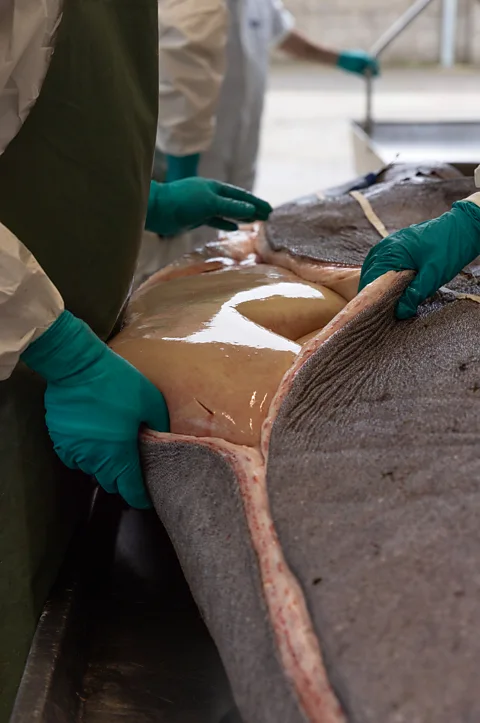
De Loose and the other researchers examined the shark for potential wounds or cuts that could explain its death – from fishing nets, for example – but found no signs of damage. They then carefully skinned the shark. The skin, covered in sharp little hooks called denticles, is currently stored in a freezer, ready for taxidermy.
The National Museum of Ireland hopes to eventually display the specimen: "This would allow future visitors to learn about one of the world's most mysterious shark species and the scientific work needed to study such creatures," says Amy Geraghty, curator of zoology at the National Museum of Ireland, Natural History. "In short, we hope to learn and share as much as possible from this unusual stranding."
The researchers then prised open the shark, revealing its massive liver – weighing 50kg (110lb) – which they carefully guided out into a large steel basin to examine it. "Everything was examined, measured and weighed with samples taken as we went," says De Loose.
Another crucial step was to remove the eyes: the lenses will be used for radiocarbon dating, which will help find out the shark's age.
Greenland sharks' eyes are another source of mystery.
"For a long time, Greenland sharks have been described as having very poor vision, or even being blind," says Fogg. "This is because of their extremely long lifespan [...] and little tassel-like parasites that hook onto the front of their eyes.
However, a 2026 research paper by Fogg and others has found the opposite: "Their eyes and retinas are actually intact and highly specialised for life in very dim light," explains Fogg, who was not involved in the Irish stranding case. "Even in individuals over a century old, the cells and molecular machinery needed for vision are still there and still look healthy. Their visual system is essentially like a 'low-light camera', which makes perfect sense if you spend your life in the dark, cold depths of the Arctic Ocean," she explains. "What's really remarkable is that this complex tissue appears to keep working for so long. It's a visual system that seems built to last for centuries."
The dangling parasites don't actually have much of an effect on the shark's vision, she says, according to the research.
 Ruth Hanniffy
This resilience is in contrast to humans' visual system, she says. Human eyesight tends to decline with age, "while in the Greenland shark, we show that vision can remain intact for over a century. This is quite astonishing as it suggests they may have evolved mechanisms to resist or delay this kind of age-related degeneration," says Fogg.
One reason for the resilience may lie in the Greenland shark's ability to repair damaged DNA, she suggests: her team found genes involved in DNA repair that were especially active, or "turned on", in the Greenland shark compared to other sharks that don't live for as long.
"This is especially interesting because DNA damage and repair capacity are widely linked to ageing processes across animals," she says.
A sample of muscle tissue will be sent to a lab for a different, experimental method to establish a Greenland shark's age, based on the length of its telomeres, the protective caps on the ends of DNA sequences, says Stavenow Jerremalm. Telomeres tend to shorten with age, along with exposure to environmental stresses.
"We opened the 'chest' to reach the heart of the animal so we could remove that as well," says De Loose. The heart seemed healthy, she says – and was huge, weighing 34kg (75lb): "It was gigantic, because it's a gigantic shark." For comparison, a human heart weighs around 300g (10oz).
How can a heart beat on for centuries? A recent study examining Greenland sharks' hearts found they showed common signs of ageing, such as scarring. However, despite these markers, the hearts seemed well-functioning. The findings suggest that the Greenland shark has evolved to be resilient to markers of ageing that are associated with poor heart health in other animals, including humans.
This highly unusual finding – the heart continuing to function, despite being marked by ageing – "underscores resilience as a key mechanism enabling extreme longevity," the papers' authors say.
For Stavenow Jerremalm, the post-mortem offered a chance to take a close look at some of the Greenland shark's unique features, which have evolved to perfectly suit its needs, such as feeding on carcasses on the seabed. "It eats it, even when it's rotten, no matter its stage – it takes that opportunity to eat," she says.
More like this:
The dead shark in the lab had the perfect tools for that job. "Its teeth were so adapted for ripping off chunks of carcasses, because of its straight, very sharp upper teeth, and the bottom teeth had two different directions, almost like a saw. That's a perfect adaptation for biting off chunks of carcasses it finds on the seabed."
The stomach and entire digestive tract were removed intact, for later analysis. Feeling the closed stomach, the researchers noticed that it seemed empty, but the spiral valve – a part of the intestine – seemed full, suggesting it had recently digested food. The empty stomach may not have been a problem for the shark, which has low energetic needs (their slow metabolism may have evolved to cope with resource-scarce environments, like the Arctic, with highly seasonal prey).
One of its testicles was twisted, and the spleen's colour looked unusual, De Loose says – but overall, the shark seemed healthy. It's possible that the shark was sick in a way that wasn't obvious, she suggests – and the analyses of the organs and samples may eventually reveal more about the cause of its death.
"It makes you wonder, what happened?" De Loose says. "It's sad because it's old by our standards, but it really had much of its life ahead."
--
For essential climate news and hopeful developments to your inbox, sign up to the Future Earth newsletter, while The Essential List delivers a handpicked selection of features and insights twice a week.
