The Viking word hidden in the Declaration of American Independence

 Getty Images
From Roman freedom to Viking happiness, the iconic words in the Declaration of Independence reveal thousands of years of humans wrestling with how to live well together – and the power of language to put those ideas into action.
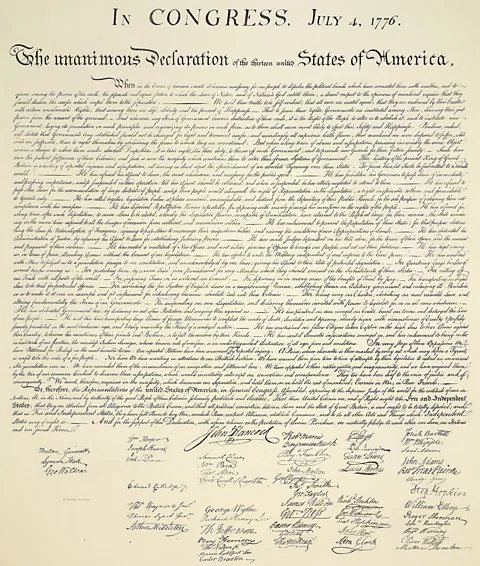
"We hold these truths to be self-evident, that all men are created equal, that they are endowed by their Creator with certain unalienable Rights, that among these are Life, Liberty and the pursuit of Happiness."
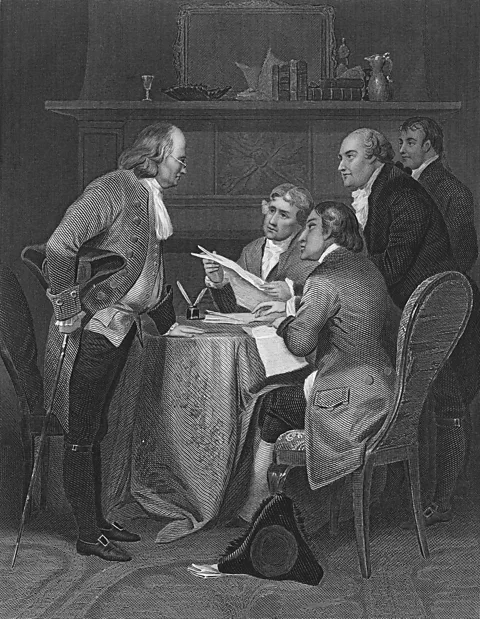
When Thomas Jefferson drafted these words in the Declaration of Independence, two things were on his mind. One: he needed to find "terms so plain and firm as to command their assent" by the colonies, as he later explained, and justify independence from Great Britain. Two: beyond the practical purpose, he wanted the text to be "an expression of the American mind, and to give to that expression the proper tone and spirit called for by the occasion".
250 years ago, Congress approved the Declaration on 4 July 1776. But the meaning of those seemingly simple terms – "created equal", right to "Life, Liberty and the pursuit of Happiness" – continue to provoke debate.
"These phrases seem always to be running automatically in the American background, rather like software," says Michael Ditmore, professor of English at Pepperdine University in Malibu, US, and the author of Texting the Nation: Agencies and Actions in the Declaration of Independence. "Still, considered purely in their textual wording, we hardly agree on what they mean or obligate us to," he adds.
A closer look at the origins of these words reveals that we're not the first to wonder about their meaning. From pre-Roman cultures to the Vikings, an extraordinary range of civilisations grappled with concepts like "liberty" and "happiness" – and in the process, coined the words that ended up declaring America's independence.
 Alamy
AlamyA 'mongrel language'
Let's start with the brief phrase "Life, Liberty and the pursuit of Happiness".
"This iconic line is actually a great demonstration of what a mongrel language English is," says Tom Birkett, a professor of Old English and Old Norse at University College Cork in Ireland.
"Life" is rooted in Old English, a language brought to Britain by Germanic tribes from around AD400-500. "Liberty" and "pursuit" are Latin-rooted, then evolved into French and arrived in Britain with the Norman French conquest in AD1066.
And then there is "happiness": a word echoing with distant voices telling stories of trolls, battles and seafarers.
"Happiness has an interesting etymology, as it comes from Old Norse happ, meaning 'fortune' or 'good luck'," says Birkett. "When 'happy' is first attested in Middle English it means 'fortunate', or 'blessed by good luck'."
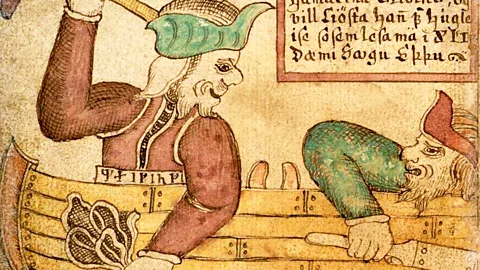
Old Norse, a Scandinavian language, was spoken by Viking raiders and Scandinavian settlers who brought the word to Britain from around AD800 onwards. Happ appears, for example, in the nickname of the Norse explorer Leif Erikson, who was also known as "Leif the Lucky", Leif heppni Erikson. He was a member of an early voyage to North America in the 11th Century, and saved a group of shipwrecked sailors – which may have partly inspired his nickname.
One way to interpret "happ" is as something fixed and fated, which can't be controlled. It still echoes with that meaning in English words such as "hapless" – luckless, unfortunate – and "happen" – to occur by chance.
 Getty Images
But over time, the English meaning of "happy" and "happiness" gradually shifted from "favoured by fortune" to "glad, pleased, content". In the 17th and 18th Centuries, the Enlightenment movement, with its ideals of human rights, fundamentally challenged the idea that one's fortune was fixed or divinely steered: instead, human reason and action took on a central role.
By the time the Declaration was drafted by Thomas Jefferson, with inspiration from the Virginia Declaration of Rights, "happiness" had acquired many layers of meaning. And in the Declaration, its pursuit was presented as a human right – one that was central to the new United States.
"The document was both political and philosophical, asserting the 'separate and equal station' of the new United States among the nations of the Earth, while also laying out the philosophical underpinnings for that assertion," says Carli Conklin, an associate professor of law and constitutional democracy at the University of Missouri, US, and the author of The Pursuit of Happiness in the Founding Era: An Intellectual History.
"As both Thomas Jefferson and fellow drafter John Adams stated, the Declaration was not asserting anything new. It was not intended to do so," says Conklin. "These ideas were commonplace in Enlightenment Era discussions about politics and law, with many of these ideas stretching back millennia." What was new was "the opportunity to practically apply these principles in the formation and establishment of a brand new government in the new United States", she says.
The punchy phrasing hid a lot of ambiguity, however.
 Getty Images
That's because on a practical level, the text had to be easy to agree to, says Ditmore: "It had to speak with a voice and sense common enough across 13 competing, edgy – and in-development – colony states to seal agreement for the publicity of independence." As a result, its phrasing was seemingly clear, and easy to endorse, but actually, left a lot of room for conflicting interpretations, he says.
Those interpretations have only widened since then. For example, how we think of happiness has changed over time, says Conklin.
"Our general understanding of happiness today does not seem to be as rich or as expansive as the understanding of the concept in the founding era," Conklin says. "To the founders, to be happy was to experience a state of well-being or human flourishing."
The founders distinguished between what they called "fleeting and temporal" happiness, and "true and substantial" happiness, she explains. To pursue true happiness was to live a life of virtue, she says: one of wisdom, justice, courage, moderation, industry and benevolence.
"As John Adams wrote in a letter to his wife, Abigail, the founders believed 'the virtues that make for a happy private life make for a happy public life', as well," says Conklin.
While the idea of a right to the "pursuit of happiness" might seem far removed from the happ in Old Norse sagas, there is a subtle echo of voyages, quests and human persistence in both contexts – along with the idea of an uncertain outcome.
"The Declaration does not include a right to attain happiness," Conklin points out. "It contains only the right to pursue."
How exactly might one pursue happiness, then?
One clue is in the other rights – to life and liberty, Conklin says: "The founders most frequently talked about liberty as a status – a status from which one could exercise their reason and free will toward action," she explains. "The right to pursue happiness, then, was the right to determine and then to take that action – to exercise one's reason and free will in active pursuit of one's own well-being."
That meaning of liberty – as a state that allows you to actively shape your life – may sound very modern. But as with "happiness", the ancient roots of "liberty" reveal how humans have wrestled with the idea of freedom, and what it means to be free, for a very long time.
Freedom and heartbreak in Roman-era Britain
"Liberty is a rather old word," says Philippa Steele, a research professor in the Faculty of Classics at the University of Cambridge. It is built on an Indo-European root "which surfaces in numerous languages across Europe and Asia with a meaning connected to 'people'," she explains.
This ancient word appears in Greek as eleutheria, in Latin as libertas, and many related, but lesser-known languages. In all cases, it generally related to personal freedom, she says.
The word, and Latin terms more generally, arrived in Britain several times.
 Alamy
AlamyOne of its oldest appearances on British soil is on a 2,000-year-old tombstone from a Roman-era settlement. The stone was put up by a widower, Barates, for his late wife, Regina. The Latin inscription refers to Regina as a "liberta", a "freedwoman": liberta, or libertus for men, was the Roman term for freed, formerly enslaved people.
Latin lived on in Britain for some time after the Romans left. But many of the Latin-rooted words used in English today, including "liberty", were re-introduced later, with the 1066 Norman French invasion – French being a descendant of Latin.
This historical link between the word liberty, and freedom from enslavement, then meets a painful twist in the Declaration of Independence: an early passage condemning slavery, and describing enslavement as a crime against liberty, was deleted from the draft. And Jefferson, as well as other founders, enslaved people themselves. "They did not apply these rights to all people, in practice," says Conklin.
Steering the ship
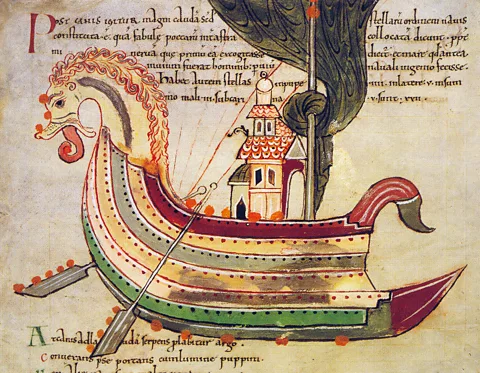
Other words in the Declaration also carry long histories of people trying to express complex ideas, for example, through metaphor. One of them is "government", as in: "it is the Right of the People to alter or to abolish it, and to institute new Government".
"It comes from Latin via Old French,” says Steele, but the Latin verb gubernare is a borrowing from [the Greek word kybernao]", meaning, to steer a ship. She adds that this Greek root also lives on "cybernetics", and other words that feature "cyber".
And then there is the document's title: "Declaration comes from a root related to light and brightness: claro quite literally means "illuminate", and a declaratio is an act of making clear," says Steele.
More like this:
While it drew on ancient words, the Declaration also marked a linguistic beginning: one of American English as a distinctive voice. That shift became more pronounced in the early decades of independence.
"The Declaration of Independence contains spellings that now look British," says Anne Curzan, a professor of English language and literature, linguistics and education at the University of Michigan, US. She points to the "–our" spelling in: "He has endeavoured to prevent the population of these States". In American English, "endeavoured" became "endeavored".
So what does the Declaration, this short text squishing together millennia of history, teach us today?
The answer depends on what we think the Declaration is for, says Ditmore. Is it "a creedal, maybe a propositional, document, one that so foundationally outlines the boundaries of American character and identity that we can return to them for correction when we stray"?
Or was it "a document that served a specific temporary, limited purpose admirably well, broadcasting independence far and wide, and its surface ought not be scratched further"?
In other words: is it a historical artefact – or a kind of manual for a good American life and thriving nation? I'll leave you to find your own answers to that – and join the long chain of human thought filling this document with life.
--
If you liked this story, sign up for The Essential List newsletter – a handpicked selection of features, videos and can't-miss news, delivered to your inbox twice a week.
