Why the penis is a barometer of men's health - and we need to wake up to its warnings

 Serenity Strull/ BBC
Erectile dysfunction can be an early warning of a heart attack, stroke, diabetes and dementia. It's time that patients and doctors alike started taking notice, according to researchers.
You could describe erectile dysfunction as a silent epidemic. According to multiple surveys, it afflicts more than half of adult men over 40. Few, however, are willing to discuss the issue with the people they love.
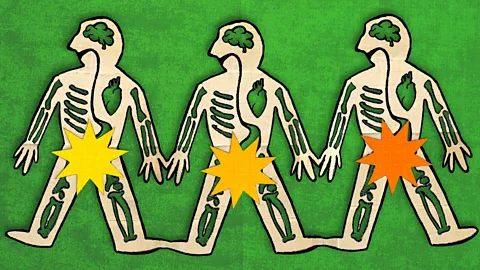
If the topic does come up in conversation, it's often seen as the subject of banter – rather than an early warning sign of impending illness. Yet, according to reams of new research, the penis is often a barometer of a man's overall health, with erectile dysfunction acting as a harbinger of many serious conditions, including diabetes, heart attack, stroke and dementia.
It is a "canary in the coalmine", according to sexologist Emmanuele Jannini at the University of Rome Tor Vergata, who recently edited a scholarly book reviewing the evidence to date. With better screening for erectile dysfunction, doctors could therefore diagnose some serious threats to men's health before they have progressed too far.
But many men's reluctance to talk about their sexual health means that they are missing these valuable opportunities.
Here's what you need to know about this extremely common complaint and the reasons it should ring alarm bells for your doctor.
Plumbing problems
Like many medical conditions, the precise prevalence of erectile dysfunction depends on how you define and measure it. As a result, studies report its global prevalence among adult men spanning from just 3% to 76.5% – a huge range. But one of the largest and most nuanced surveys examined around 1200 subjects using detailed questionnaires and found that 39% of men aged 40 regularly experienced some level of impotence, rising to 67% at age 70.
In many ways, erectile dysfunction is a plumbing problem.
Along the length of the penis run two spongy structures called the corpora cavernosa, which are typically flaccid. When a man becomes aroused, the brain sends signals to relax the muscles around the penis's arteries, creating an influx of blood into both of those cylinders. As they expand, the corpora cavernosa start stretching, and they compress the veins ushering blood outside the penis, trapping it inside.
Like a balloon filling with air, the organ expands and stiffens. Anything that reduces the build-up of blood through the penis's pipes will impair a man's capacity to achieve or maintain that erection.
The issue is often psychological. A stress response involving adrenaline and cortisol can lead our blood vessels to contract, preventing the corpora cavernosa from stiffening. Heightened levels of stress can also interfere with the production of testosterone, which can reduce libido and dampen arousal. (Importantly, people with glandular conditions like hypogonadism also have reduced production of testosterone, so this can play a role.)
That's not to mention that stress often comes with a general state of mental distraction that may make it hard to stay focused on sex.
There would have been a good reason for this in our evolution: if stress halts arousal, it ensures the body preserves its resources for survival in moments of danger. "If the environment is risky, it's important not to reproduce," says Jannini.
In the modern world, however, there are many non-life-threatening reasons we experience stress, so this protective mechanism might be called into action more often than necessary.
Heart and brain issues
In many cases, erectile dysfunction may also reflect far broader health problems. For one, it can arise from atherosclerosis – a condition in which blood vessels harden and narrow, leading to a major risk of heart disease. Since the penis's arteries are among the smallest in the body, they are often the first to fail, so cases of erectile dysfunction can act as a harbinger for this type of heart failure.
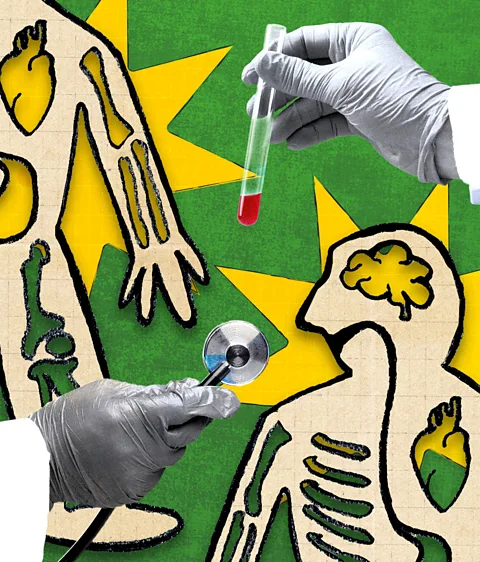
Analysing data from 154,794 individuals, one recent paper found that men with erectile dysfunction were 59% more likely to suffer coronary heart disease, and 34% more likely to have a stroke.
"A good measure of vascular health is having a good erection," says Michael Carroll, an expert in reproductive science at Manchester Metropolitan University in the UK, and author of the forthcoming book Your Nuts: The Science of How They Work and What It Means For Your Fertility, which is set for publication this summer.
 Serenity Strull/ BBC/ Getty Images
There is even some tentative evidence that poor penile health acts as a harbinger of cognitive decline, with one Taiwanese study finding that men who had been diagnosed with erectile dysfunction were 68% more likely to develop dementia over a seven-year follow-up. Like the penis, our brains are also dependent on a good blood supply to deliver fuel and clear away toxic waste.
The link with diabetes
Monitoring erectile dysfunction may be especially important for people at risk of diabetes, which can damage the circulatory and nervous systems through various mechanisms. For example, the spikes in blood sugar – which are common when the condition is badly managed – can lead to excess glucose sticking to proteins in vessel walls. This can cause the blood vessels to lose their elasticity – a process called glycation. Like atherosclerosis, this reduces the efficient flow of blood to the parts of the body where it is needed most, and delicate vessels in the penis are often the first to be affected.
"The link between diabetes and erectile dysfunction is very strong," says Bogdan Vlacho, a researcher at the Sant Pau Research Institute in Barcelona, in Spain. "Men with type two diabetes are about three times more likely to develop erectile dysfunction than those without diabetes."
In a recent review of the evidence, Vlacho also finds that people with diabetes and erectile dysfunction are considerably more likely to develop "peripheral neuropathy" – nerve damage to the hands and feet – than those with diabetes alone. They are also in greater danger of retinopathy, which can lead to blindness, and impaired wound healing, which can sometimes lead to amputation.
Yet, screening for erectile dysfunction among diabetic patients is not standard practice. "There is evidence that health care professionals don't talk with patients about this issue," says Santiago Martinez, an endocrinologist at the University of Barcelona, in Spain, who co-authored the review of studies.
 Serenity Strull/ BBC/ Getty Images
Potential therapies
A survey conducted by The Urology Foundation in the UK found that over half of the men with erectile dysfunction refrained from seeking medical help because of shame and anxiety surrounding the condition, and 20% even said they'd rather not drink beer for a month rather than see a healthcare professional about their discomfort.
But all men experiencing erectile dysfunction should seek help, according to Carroll. You may get relief for a considerable source of unhappiness and stress in its own right, while also beginning a valuable discussion about your overall physical health – one that may be lifesaving. "Addressing the problem early is key," he says.
After all, erectile dysfunction is not an incurable condition. Drugs like Viagra (sildenafil) dilate blood vessels in the penis – but some anecdotal evidence suggests that patients who have been taking these pills to improve their sex lives also have improved cardiovascular outcomes, including a reduced risk of heart failure – though this has not been proven in clinical trials yet. (Viagra was originally developed as a cardiovascular treatment for patients with high blood pressure before researchers noticed its now famous side-effect).
These drugs may even lower the chances of developing dementia, according to a study that analysed over 885,000 patients and found that it reduced the risk of developing Alzheimer's disease by two-fold.
At the very least, if you bring up your erectile dysfunction with a doctor, they can screen you for common risk factors for heart disease like hypertension and atherosclerosis, and advise you on issues such as obesity that might be contributing to poor cardiovascular health. In some cases, simple measures like dietary change and exercise may help. For those with diabetes, managing blood sugar levels will be essential.
Martinez and Vlacho, though, emphasise that research is still nascent on the effects of these therapies for erectile dysfunction, and whether they can also dampen the risk of other complications.
More like this:
Plus, disentangling the causes of erectile dysfunction may require some serious work, since it can also arise from habits like porn addiction and from mental health issues surrounding sexual desire. "If the man has diabetes or cardiovascular disease, that is usually easier to link and treat," Carroll says. "However, if there are lifestyle factors, such as drinking and smoking, mixed with psychological or behavioural aspects, like over-usage of porn – it may be more difficult to address. Often these men may not want to divulge their activities."
The lost bone
Besides these findings' obvious importance for our healthcare today, Jannini has been contemplating the potential evolutionary implications that the penis is such a barometer of holistic health.
As a species, humans are rather unusual in relying on their blood flow to achieve a firm penis. Most other primates, including our closest relatives, chimpanzees, have a retractable bone called the baculum, which is released during arousal to support their erection and keep the plumbing active and stiff. As a result, their sex life is not as intimately tied to their overall health as that of the average human male.
Why would the human male, then, have evolved to lose the baculum and gain the increased potential for sexual dysfunction and vulnerability? This is a fact that has puzzled many evolutionary biologists. Jannini, however, suspects that human males evolved to lose their penis bone to help our female ancestors identify who would make the fittest mates and who would pass on the best genes to their offspring.
"It is very strange that we lost the most important bone for reproduction, because our reaction is so unpredictable," Jannini says. "But it means it is the perfect biomarker for chronic diseases."
* David Robson is an award-winning science writer and author. His latest book, The Laws of Connection: 13 Social Strategies That Will Transform Your Life, was published by Canongate (UK) and Pegasus Books (USA & Canada) in June 2024. He is @davidarobson onInstagram and Threads and writes the 60-Second Psychology newsletter on Substack.
--
For trusted insights on health and wellbeing, sign up to the Health Fix newsletter by senior health correspondent Melissa Hogenboom who also writes the Live Well For Longer and Six Steps to Calm courses.
