Chile's Atacama Desert is one of the darkest places on Earth. But now the light is intruding

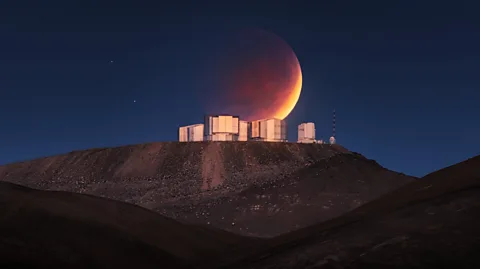 Yuri Beletsky (LCO
This remote desert in South America is one of the best places in the world for astronomy, but the slow encroachment of artificial light threatens that. It is a sign of just how inescapable light pollution now is.
It's 2:00 in Chile's Atacama Desert, and I wake up in the dark. Inside my room, it's the kind of black where you don’t know if your eyes are open or shut. I reach for my phone, hoping for some light to orient myself. But then I remember where I am.
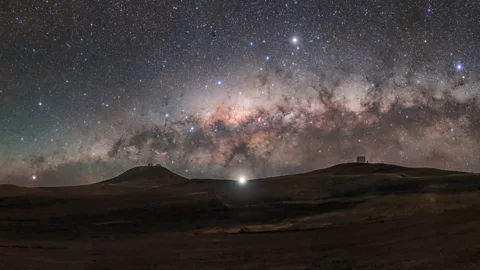
Instead, I edge towards my room's back door, which leads directly out onto the desert floor. My feet step from smooth tiles to the crunch of dry rock and sand. Outside the landscape is silent, but the stars above are incandescent – the sky is nothing short of complete.
Here, in this wilderness, keeping the lights off has spectacular rewards.
"There are very few places on Earth with these conditions," says Itziar de Gregorio-Monsalvo, a senior astrophysicist with the European Southern Observatory in Chile. Astronomers like her flock to this remote part of the Atacama Desert precisely for the view I'm enjoying.
But every year, artificial light from nearby cities, industrial complexes and mining operations are clouding the sky. Researchers are fighting to preserve the view, but unless something changes, one of the last places on Earth untainted by human light pollution may soon become too bright for new discoveries.
What's at stake is our understanding of the Universe itself.
When I look skywards where I live in London, the artificial glow of millions of lightbulbs hangs over the city, obscuring all but the brightest stars. But in the Atacama Desert, the night sky is more dense and vivid than I have ever seen.
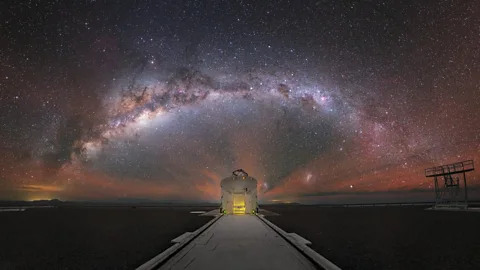
I'm visiting Paranal, an astronomical base operated by the European Southern Observatory (Eso), which is home to some of the world's most advanced ground-based telescopes. With clear skies and minimal light, its position in the sparsely populated Atacama Desert provides the perfect setting for professional astronomy.
Looking up, I see the pale, white stripe of the Milky Way daubed on a canvas of dazzling points. Remarkably, I also spy two splodges of green that I assumed would be impossible to perceive with the naked eye: the Magellanic clouds – a pair of dwarf galaxies. They are so far away that some of their light has travelled across the cosmos for approximately 200,000 years.
While that light was still 200 years from reaching Earth, Lord Byron published his gloomy, apocalyptic poem Darkness, a nightmare vision of a world with no light at all. "The bright Sun was extinguished," he wrote, "and the stars did wander darkling in the eternal space". He feared a Universe of total darkness. Two centuries later, we've built the opposite problem.
Every year, artificial lighting from outside Paranal has been creeping ever-closer. Here, the dark is precious – and endangered.
The battle against encroaching artificial light in the Atacama is a microcosm of a global problem. As electric bulbs have proliferated, around 80% of Earth's population now lives under light-polluted skies. A recent study of star visibility found that, on average globally, the sky brightened due to light pollution by almost 10% a year between 2011-2022. If a person could see 250 stars at the start of the period, the researchers found, they would only spot 100 by the end.
Psychologists have suggested that disappearing stars could worsen mental wellbeing, by removing a long-term human connection to the natural world. And ecologists have shown that when artificial light tricks animals and plants into believing it is daytime, it can affect their behaviour and physiology, disrupting ecosystems. For these reasons, some researchers argue that excess light should now be classified as a "hard" pollutant alongside chemical pollution of air or water.
In short, a lighter world is not necessarily a brighter one.
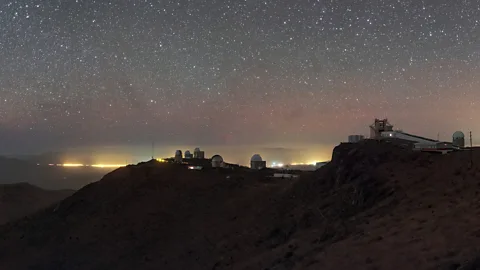 ESO/ P Horálek
The first warnings came from astronomers as far back as the 1970s when researchers in California in the US realised that San Francisco's lights would cloud their telescope observations. At the time, astronomers predicted that an increase in night-sky brightness of 10% above the natural level would severely impact ground-based astronomy.
By 2022, two-thirds of the world's major telescopes had surpassed this critical threshold.
"Astronomical observatories can be seen as the proverbial canary in a coal mine," the researchers behind this finding warned. "If we are not able even to keep the canary alive, then we can forget being able to solve the problem of light pollution as a global environmental issue."
Their study showed that one of those few astronomical sites still below the 10% limit was the Atacama Desert.
In the dark
Sited amidst the last refuge of darkness in a luminous world, Eso's Paranal observatory – operated by a consortium of European member states – hosts several world-class instruments for observing the cosmos. These include the Very Large Telescope (VLT) and its bigger brother the Extremely Large Telescope (ELT), which is due to be fully constructed by 2029, with its dome and main structure completed by 2027.
Some of the most important astronomical discoveries of the 21st Century have been made here, from the first direct image of an exoplanet to the star trajectories confirming the presence of a supermassive black hole at the centre of our galaxy, the Milky Way.
As soon as you arrive, you sense how precious the darkness is here. Blinds, shutters and awnings block all windows at night. The entire complex is designed to prevent light leakage. Scattered around the facilities, posters read "Dark is Beauty", encouraging people to close their shades or lower hand torches outside. After dusk, drivers are even instructed to use vehicles without main headlights.
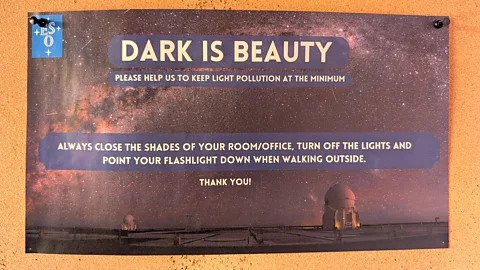 Richard Fisher
Situated at an altitude of 2,600m (8,500ft), it takes up to two hours to reach Paranal from the nearest city of Antofagasta, 81 miles (130km) away. Apart from the roads, there are no visible signs of humanity in any direction; only the rolling desert and Pacific ocean.
The reason why this observatory and others in the Atacama have stayed dark is simple, says astronomer Eduardo Unda-Sanzana of the University of Antofagasta, who has been an important local Chilean voice in warning about light pollution. "It's not really the result of human protections. But basically the result of human absence: the distances in the Atacama desert are so large that they have been a lot more effective than any regulation. They have been the actual defences of these dark sites."
Recently though, the growing light of Antofagasta has begun to leak into the edges of astronomical observations. Satellites, too, have become more abundant: when I visited, I watched a train of more than 20-30 pass above, one after the after – all visible with the naked eye. For the astronomers, satellites are manageable for now but if companies like SpaceX get their way, there could soon be thousands more photobombing observations, or even as many as a million if plans proceed to use satellites as orbital data centres for AI.
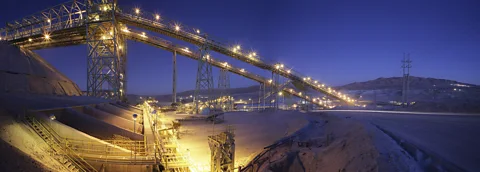
The biggest imminent threat for Paranal and other observatories, though, is industry: mining and energy facilities are moving ever-closer. "We have been monitoring the advance of light pollution for many years," says de Gregorio-Monsalvo, Eso's representative in Chile. "Around four or five years ago, we saw an increment in light pollution that was very high, with more and more industries in the area approaching Paranal."
 Y Beletsky/ ESO
Recently, these concerns crystallised into a single threat: an industrial megaproject known as the Inna complex, operated by the company AES Andes, which was proposed for construction only a few kilometres away from Paranal. A 2025 analysis by Eso warned that Inna threatened to increase light pollution above some of the telescopes by as much as 50%, as well as increase air turbulence and vibrations that would further degrade observations.
In early 2026, AES Andes announced they had decided not to proceed, citing other business priorities, rather than scientists' objections. "While the Inna project is fully compatible with other activities in the region, AES Andes has chosen to focus its efforts on the development and construction of its renewable energy and energy storage portfolio," the company told the BBC.
For the astronomers, though, it is not the end of the story. With no changes to how light pollution is regulated in Chile, they fear more may come. "The legal frameworks are exactly the same as we had one year ago… nothing is really decreed yet," says Unda-Sanzana. "If we lose the sense of urgency, it could be very real that a follow-up project could be submitted during 2026 and we are going to be facing exactly the same crisis."
Part of the problem, according to Unda-Sanzana and De Gregorio-Monsalvo, is that environmental impact decisions for these industrial facilities are being made based on the "do not pass 10% extra" light pollution threshold, which dates to the 1970s. "If they do not pollute [the skies] more than 10%, basically they pass and they can build the project," explains De Gregorio-Monsalvo.
But for a site like Paranal, anything more than a 1% increase is bad news. "In the 1970s, they were not aware of sites like Paranal. If you allow for 10%, you basically destroy the site," explains Unda-Sanzana.
 Getty Images
In 2025, the International Astronomical Union updated their guidelines, significantly lowering the 10% threshold, by calling for an upper limit for each site based on its situation. Since Paranal is one of only six professional observatories left globally with a light contamination level less than 1%, the guidelines recommend extra effort to preserve this darkness.
However, even if industry did keep to the revised thresholds, that still may not be enough, say astronomers, because enforcement is currently toothless. And under the current rules, two industrial sites could both win approval separately, but together be bright enough to exceed the limit. "The collective effect of the lights could still ruin the sky," explains Unda-Sanzana.
More like this:
Astronomers are now lobbying for a secondary norm that would allow Chilean authorities to intervene if light levels in the region pass a certain threshold. "The secondary norm would allow the government to react and say, 'OK, we need to decontaminate this place'... to dim the lights or change the technology or do something so that the environment is restored," says Unda-Sanzana.
 ESO/ P Horálek
What's happening in the Atacama may seem like a local problem, but in the long-term it could affect all of humanity's understanding of the cosmos. While it's possible to launch telescopes into space to escape light, these instruments perform different roles. The James Webb Space Telescope, for instance, may have made headlines with its discoveries, but astronomers also need the massive mirrors in ground-based facilities that provide finer detail. The upcoming Extremely Large Telescope – with a mirror 39m (128ft) wide – is far too big to put on a rocket.
If we let the glow of human light reach ever-further across the sky, it won't just be science that loses out – astronomers warn that we risk separating ourselves from the galaxy and Universe we live within.
After I woke up to see the dazzling sky at 2:00 in the Atacama, I reflected on how little time I spend looking at the stars nowadays, and how the artificial glow in my home city is so ubiquitous and normalised I fail to notice what it obscures.
True darkness is increasingly hard to find. "It's a problem of scarcity," says Unda-Sanzana. "Fifty years ago, there were abundant dark skies in the world. What was once abundant is now becoming extremely scarce. These are endangered environments and we're about to lose them, if we do not protect them. We will not have a replacement if we lose this battle."
* This article was updated on 29 May to clarify that the light from the Magellanic clouds takes 200,000 years to reach Earth rather than 200 years as previously stated.
--
If you liked this story, sign up for The Essential List newsletter – a handpicked selection of features, videos and can't-miss news, delivered to your inbox twice a week.
