How to know if your pet has allergies

 Getty Images
Cats and dogs can be allergic to pollen and even humans, but getting a diagnosis is a lengthy process.
You've been sneezing all week and your eyes are streaming. It's allergy season. But you're not the only one who's suffering. Your pet has been unusually itchy lately – scratching all night, keeping you awake, eyes teary and gummed up. They seem as miserable as you are. Could your cat or dog also be struggling with the pollen?
Our four legged friends are not exempt from suffering with hay fever – or seasonal allergies as it is known in North America. But it is only one possibility among myriad allergies, including some you might not expect. The path to finding out what's really plaguing our pets can be complicated. But it is getting easier.
What are the signs my pet might have an allergy?
Allergies happen when our immune system decides to suddenly attack a substance we're exposed to in our environment, whether that's pollen newly saturating the air or a fragrance we've been using for years.
 Getty Images
We humans may be tipped off to our allergies by sneezing and sniffling, but these symptoms are less common in cats and dogs. Increased eye discharge and a runny nose can be present in pets, along with asthma in cats, and ear infections or head shaking in dogs. Their allergies mostly manifest on the skin as atopic dermatitis.
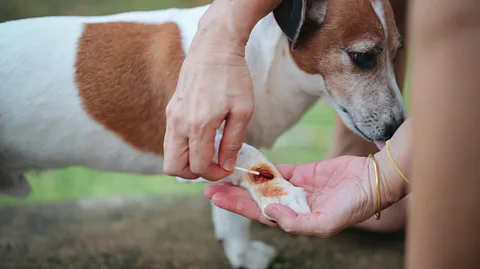
The persistent itching leads animals to obsessively lick, chew or bite their feet or other spots on their body. These can form "hot spots", reddened areas on the body that can turn into "terrible lesions in a matter of hours", says Brian Collins, a veterinarian at the Cornell University College of Veterinary Medicine in New York. You want to prevent this from progressing, because bacteria or yeast will take advantage of a chronic hot spot to create a painful infection.
Is it definitely an allergy?
Anything humans can be allergic to, pets can develop allergies to as well: pollen, grass, pests, food, dust mites, a perfume.
You might be tempted to try commercially available allergy tests for pets, often advertised on social media, that are said to identify the culprit. Jacqueline Boyd, a senior lecturer in animal science at Nottingham Trent University, warns that they don't work, however. (In one test, they showed the same results when given swabs from the fur of a plush toy.) And under no circumstances should you administer antihistamines from your own medicine cabinet. That's because a lot of things that look like an allergy aren't. "A lot of the work is ruling out the obvious things," she says.
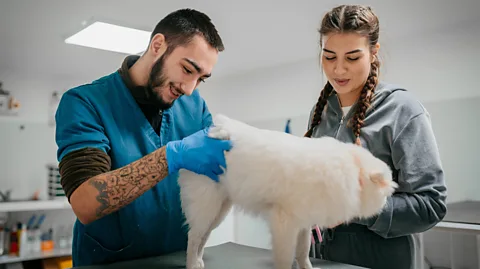
"The first thing we always look for is skin infection," says Collins. If the treatment gets rid of the itch, that answers the question.
The next step is to check for mites or fleas, whose bites may be aggravating for several reasons. You may protest that your dog has been treated for fleas, but fleas can be crafty, lurking on other pets (particularly cats) or in your house.
"It's more common than you think," says Boyd. While these may not be able to infest dogs, they're happy to hitch a ride on your hound for a quick bite before decamping back to their usual host, and some dogs can become sensitised to flea saliva. Complicating matters, some flea species are also seasonal, which may cause you to mistake the cause for pollen.
 Getty Images
In rare cases, itchy skin, particularly in older cats or dogs, may hint at more serious causes including cancer or metabolic disease.
If you and your vet have eliminated these possibilities, and the animal is still itching, the real detective work gets underway.
Treating allergy symptoms
The most important first step is to get the itching under control. "You want the animal to be comfortable," says Collins. A wide range of options – injections, oral medication, shampoos, and sprays – are available.
These treatments have come a long way. In the past, an allergic pet got steroid shots. They worked, but the side effects were considerable, and included excessive thirst, increased urination, weight gain and immunosuppression, which allowed opportunistic infections to sneak in.
But a few years ago, more targeted medicines arrived. Instead of broadly modifying the immune system, these zero in on itch and inflammation pathways more precisely, such as inhibiting the enzymes activated by chemicals called cytokines.
Such innovations mean that today's drugs are more effective, have fewer side effects, and work in around 80% of dogs, says Ralf Müller, a veterinary dermatologist at the University of Munich.
And they are usually enough when administered regularly. But it does leave 15% of dogs that don't respond. And even for good responders, the more tolerable medicines must be administered indefinitely. Some animals become resistant. And sometimes a seasonal allergy can transform into a constant allergy, says Collins.
For these and other reasons, many people want to resolve their pet's underlying problem once and for all.
Identifying the culprit
Vets will ask a lot of questions about the animal's lifestyle and history. Identifying the allergen is done by the process of elimination. "I advise all my clients to keep a doggy diary," says Boyd. Patterns may quickly emerge. Symptoms that blow up during some months and not others are seasonal; those that are persistent may point to food or another constant aspect of their environment.
"We don't have a single test that can differentiate an allergic individual from a non-allergic individual," adds Müller.
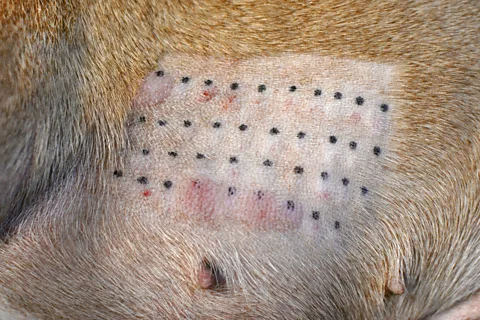
Now it's time to find a veterinary dermatologist. These specialists are rare – Collins says – but they are the ones best qualified to do intradermal allergy testing. The animal is put under sedation, and a patch of skin is shaved, on which a grid is drawn. A rogue's gallery of allergenic compounds is injected into its assigned square on the grid, and the dermatologist observes the reaction in the skin.
 Getty Images
Pet immunotherapy
After the results are in, a pet owner has two options: just keep treating the symptoms or fix the underlying sensitivity. The former is easier, but if you want to reduce the medication that your cat or dog must take, you can take steps to reverse the allergy entirely: a protocol that will desensitise your pet's immune system to the allergen, known as allergen-specific immunotherapy. The veterinary dermatologist mixes the most likely culprits into an immunotherapy cocktail. This is injected into your pet in slowly increasing increments.
The protocol treats the underlying cause, not just the symptoms, and when complete many pets will be largely cured or at least have a lot fewer symptoms. There are only two side effects from this treatment: anaphylactic shock (extremely rare – Müller has seen five cases in 43 years) and a temporary increase in itching.
However, not everyone can see it through. The baseline cost is about £1,000 (around $1,300) and it can take a year to see results. Success depends on owners not getting tired of administering the injections, and practitioners with adequate experience.
The good news is that better drugs are just over the horizon. Newer adjuvants and better approaches can compress the onerous one-year timescale to six weeks. The drugs are already on the market in Japan, and now waiting for regulatory approval in the EU, says Müller. "Then we will have a big paradigm shift in desensitisation."
Are allergies in pets increasing?
The blame often falls on breeders who focus on looks and fashion at the expense of immunological health. Müller says, however, this may be oversimplified.
More like this:
Responsibility can also be apportioned to owners and the lifestyle they provide for their pets. Their lives have changed in parallel with human lives, he says. Like us, they are spending less time outside and they are eating an increasing number of calories from processed food. They are also being washed and perfumed with greater frequency with varieties of products that may contain allergens.
There may even be a new entrant in the arsenal of potential allergens – humans. We emit dander like all other animals do. And dogs can be allergic to human dander. There isn't much good data to say how common it is for pets to be allergic to humans, says Collins.
But Boyd suggests that the way we now live with our pets these days makes it more likely that they will be exposed to us. "Before flea and tick treatments, we never used to let dogs sleep in our beds," she says. "Now they share our sheets."
--
For trusted insights on health and wellbeing, sign up to the Health Fix newsletter by senior health correspondent Melissa Hogenboom who also writes the Live Well For Longer and Six Steps to Calm courses.
